You'll encounter child-stealing entities across every inhabited continent: Germany's Erlking seducing victims through shadowed forests, Russia's Baba Yaga testing children in her rotating hut, Latin America's La Llorona drowning innocents while searching for her murdered offspring, Celtic changelings left by the Aos Sí, Japanese yōkai infiltrating households through shape-shifting mastery, the Philippines' chimeric Aswang with its proboscis hunting newborns, and Middle Eastern djinn employing substitution during spiritual vulnerability—each tradition preserving ancient wisdom about boundaries, mortality, and the protective circle beyond which dangers wait to claim the unwary, their stories revealing psychological defenses altered into cautionary legends that continue instructing communities through atmospheric narrative.
Key Takeaways
- The Erlking from Germanic folklore seduces children into forests, representing primal woodland dangers through a deceptive, beautiful appearance.
- Baba Yaga, Russia's forest witch, tests children's manners—rewarding respectful ones while devouring those who are rude.
- La Llorona, the Weeping Woman, drowns children near waterways while searching eternally for her own murdered offspring.
- Celtic changelings are fairy substitutes left when the Aos Sí steal human infants, identifiable by unusual appetites and behavior.
- Djinn employ three methods: substitution with changelings, possession during spiritual vulnerability, and luring children into liminal spaces.
The Erlking: Germany's Forest Phantom Who Lures Children to Their Doom
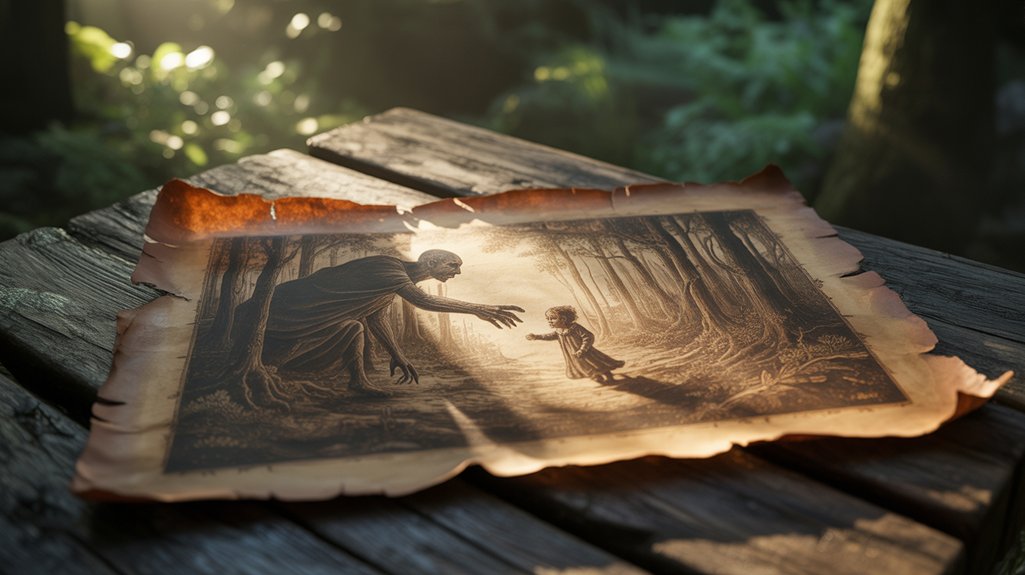
When the mists gather thick among the gnarled oaks and twisted alders of Germanic forests, the Erlkönig—literally “Alder King”—emerges from his shadowed territory to claim the souls of wandering children.
This eldritch sovereign, immortalized in Johann Wolfgang von Goethe's 1782 ballad “Der Erlkönig,” embodies primal forest dangers that once kept communities bound by curfew and caution.
You'll recognize the Erlking's allure in his whispered promises: golden robes, games with spectral maidens, treasures beyond mortal comprehension. He appears beautiful to his victims alone—a chimeric figure blending courtly refinement with inhuman menace.
The dying child sees splendor. The father sees only wind.
Between worlds of fever and night, innocence perceives enchantment where experience finds only the cold indifference of gathering darkness.
This entity predates Christian Germany, rooted in Danish elverkonge traditions where elven nobility ruled twilight territories.
The Erlking doesn't snatch violently; he seduces through temptation, exploiting children's wonder and curiosity. Liberation from mortal constraint becomes eternal captivity.
His victims simply cease breathing, leaving no evidence beyond a parent's unheeded warnings.
Like other Germanic peoples across Scandinavia and northern Europe, those who inhabited the dense forests developed folklore that reflected both their enchanted perception of nature and the very real dangers lurking within it.
Baba Yaga: Russia's Ambiguous Witch of the Woods
Deep within Russia's primordial forests, where silver birch and dark pine create a threshold between mortal territory and otherworld, Baba Yaga dwells in her chimeric hut—a structure that defies natural law by perching upon massive chicken legs, rotating at her command to reveal or conceal its bone-studded entrance.
Unlike the purely malevolent child-stealers of Western European tradition, this ancient crone occupies a liminal position in Slavic folklore: she devours some children who stumble upon her domain, yet tests others, offering aid to those who demonstrate proper respect, cleverness, or ritual knowledge.
She traverses the forest's eldritch pathways in her iron mortar, steering with a pestle while sweeping away her traces with a broom made of birch—a mode of transportation that alters domestic implements into vehicles of supernatural power.
Baba Yaga's Chicken-Legged Hut
Among the most eldritch architectural manifestations in Slavic folklore, Baba Yaga's dwelling stands upon two massive chicken legs, rotating ceaselessly through the primordial forests of Russian mythology.
You'll find this chimeric structure embodies the threshold between mortal sphere and otherworld—a sentinel that refuses entry until properly addressed. The chicken legged architecture symbolizes change and liminality in witch folklore, drawing from pre-Christian Slavic death cults where raised structures housed the deceased.
The hut spins, windowless walls facing travelers until commanded: “Turn your back to the forest, your front to me.” This revolving fortress protects Baba Yaga's territory, its avian supports representing both grounded earth-magic and skyward ascent.
Bone fences surround it, crowned with skulls whose empty sockets illuminate pathways for lost children—whether toward salvation or consumption. Like the mythical creatures found throughout Celtic folklore, Baba Yaga herself occupies a complex role that transcends simple categorization as benevolent or malevolent force.
Child-Eating or Child-Testing?
Though Baba Yaga terrorizes children in countless folktales, her relationship with youth transcends simple predation—she operates as both devourer and initiator, testing moral fiber through trials that alter or destroy.
This duality reveals ancient understandings of child protection through controlled exposure to eldritch forces. Her chimeric nature embodies societal fears about maturation's dangers:
- Courtesy tests: Children who greet her servants respectfully receive aid; rude ones become meals
- Task completion: Impossible demands separate the resourceful from the doomed
- Truth recognition: Those who see beyond her monstrous façade discover wisdom
She dwells in liminal spaces where childhood ends. Not mere monster, she changes—a dark mirror reflecting what strength costs.
Her chicken-legged hut marks boundaries between protected youth and tested adulthood, where survival earns knowledge.
Mortar and Pestle Transportation
Baba Yaga's vehicle embodies her paradoxical nature—she flies through Russian forests in a massive wooden mortar, propelling herself with its pestle while sweeping away her tracks with a birch broom or silver birch branch.
This eldritch conveyance alters domestic implements into instruments of aerial transgression. The mortar symbolism connects grinding, alteration, and death—tools that crush grain for sustenance become vessels traversing liminal boundaries between worlds.
Her pestle magic propels her through midnight skies, the pounding rhythm echoing ancient pharmacological preparations and shamanic practices.
You'll find in this chimeric transportation method the essence of Slavic folklore's reverence for practical objects imbued with supernatural potency. Kitchen implements become talismans. Domestic becomes divine.
The witch grinds reality itself, maneuvering through domains where children vanish into forest darkness, their fates uncertain.
La Llorona: The Weeping Woman of Latin American Legend
Across the moonlit arroyos and mist-shrouded rivers of Latin America, from Mexico's colonial heartland to the wind-swept pampas of Argentina, you'll encounter the eldritch wailing of La Llorona—the Weeping Woman whose origins lie tangled between Aztec goddesses and Spanish conquest trauma.
Her story first documented in sixteenth-century New Spain yet echoing far older Pre-Columbian tales of Cihuacōātl. She drowns children in her nocturnal wanderings, forever seeking her own offspring whom she murdered in a moment of rage or despair, the exact motivations shifting like ripples across water: spurned love, colonial violence, maternal madness.
Each region claims its own variation—she appears in white in Veracruz, carries a bent knife in Guatemalan accounts, haunts specific riverbanks in New Mexican villages—yet her bone-chilling cry remains universal, that spectral “*¡Ay, mis hijos!*” echoing through darkness wherever Spanish tongues have carried her curse.
Origins of the Legend
While scholars trace the earliest documented versions of La Llorona to colonial Mexico during the 16th century, the legend's roots penetrate far deeper into pre-Columbian consciousness, intertwining with indigenous Aztec goddesses who embodied maternal grief and divine retribution.
You'll discover the cultural significance within three primordial entities:
- Cihuacōātl – the serpent woman who wailed through Tenochtitlan's streets, prophesying conquest
- Chalchiuhtlicue – water deity who drowned humanity in apocalyptic floods
- Malintzin – historical figure whose alleged betrayal merged with maternal archetypes
The psychological roots emerge from this chimeric fusion.
Colonial guilt, indigenous trauma, and eldritch feminine power coalesced into one spectral figure. She haunts waterways still, manifesting ancestral warnings.
Transgression demands consequence. Freedom requires understanding these ancient truths.
Why She Takes Children
According to the most pervasive narrative threads, La Llorona searches eternally for the children she drowned in a moment of devastating rage—her own sons, murdered in retribution against an unfaithful lover or dismissive husband who valued his Spanish lineage above their mestizo bloodline.
You'll find her curse carries profound cultural symbolism: she embodies colonial trauma, patriarchal betrayal, and maternal grief twisted into something eldritch and chimeric.
She doesn't distinguish between her lost children and yours. Her affliction compels her to claim any child wandering near waterways after dark, attempting to fill the unfillable void within her spectral existence.
This supernatural mandate taps into universal parental fears—the terror of losing one's offspring to forces beyond mortal control, altered here into cautionary folklore that warns children away from dangerous nocturnal wanderings.
Regional Variations and Sightings
Throughout Mexico's varied topography—from Veracruz's humid Gulf coastline to Chihuahua's arid northern plateaus—you'll encounter substantively different manifestations of La Llorona, each iteration shaped by indigenous cosmologies predating Spanish conquest.
These regional differences reveal profound cultural significance, demonstrating how colonized peoples preserved ancestral wisdom within seemingly European narratives.
Consider three distinct chimeric forms:
- Oaxacan manifestation: She appears alongside pre-Columbian death deities, her wails merging with Zapotec funeral rites.
- Yucatán Peninsula variant: Blends with Mayan Xtabay legends, haunting cenotes where sacrificial victims once drowned.
- Northern borderlands version: Converts into an eldritch desert phantom, claiming children near the Río Grande.
Each locality preserves authentic encounters—mothers shielding infants from riverbanks, travelers fleeing her spectral presence.
These aren't mere superstitions. They're living testimonies to unbound cultural memory.
Changelings and Child-Stealing Fairies of Celtic Tradition
Since medieval Ireland's earliest recorded testimonies in the 11th century, the changeling—that pale, withered simulacrum left in place of a stolen infant—has haunted the threshold between human hearth and fairy mound with a persistence that suggests something more than mere superstition.
You'll find in changelings folklore a darker truth: the Aos Sí didn't merely visit. They replaced.
These eldritch substitutes manifested distinct characteristics. Insatiable appetite. Wizened features. Inhuman shrieks. The chimeric nature of fairy abductions reveals calculated purpose—your stolen child became servant, entertainment, or breeding stock for diminishing fairy bloodlines.
Celtic mothers learned protective measures: iron scissors beneath cradles, rowan crosses, constant vigilance during those dangerous first forty days. The Sídhe preferred unbaptized infants, dawn raids, moments of maternal inattention.
Records from 12th-century Wales through 18th-century Scotland document identical patterns. This wasn't isolated paranoia. This was systematic knowledge transmission across generations, preserved because the threat demanded remembrance.
The fairies took what they wanted. Always had.
Japanese Yōkai: Shape-Shifters and Spirit Kidnappers

While Celtic fairies worked their substitutions in moonlit glens, Japan's yōkai operated through metamorphosis itself—entities whose very essence defied fixed form, who didn't leave changelings but became the child, the parent, the trusted neighbor.
These shape-shifters rendered child safety precarious through chimeric transmutations that erased boundaries between protector and predator.
Three yōkai characteristics that enabled their abductions:
- Kitsune's anthropomorphic mastery – fox spirits achieving human semblance after centuries, infiltrating households as nursemaids
- Ubume's maternal deception – ghostly mothers clutching infants, compelling passersby to hold spectral children who grew impossibly heavy
- Tanuki's illusion-weaving – raccoon dogs creating elaborate theatrical realities where kidnapped children believed themselves home
The Edo period chronicled countless vanishings.
Villages developed elaborate countermeasures: amulets inscribed with protective kanji, threshold barriers of scattered beans.
Yet yōkai transcended such mortal safeguards. They inhabited the interstices. Eldritch. Unknowable.
Their metamorphic nature meant you'd never recognize the abductor—because the abductor wore your face.
The Aswang: The Philippines' Most Feared Nocturnal Predator
The creature's chimeric nature defies simple categorization:
| Aswang Type | Primary Target | Alteration Method |
|---|---|---|
| Manananggal | Pregnant women | Severed torso flight |
| Tik-Tik | Newborn infants | Elongated proboscis |
| Sigbin | Vulnerable children | Quadruped shadow-form |
Aswang characteristics include eldritch substitution tactics—leaving banana-trunk changelings in stolen children's places. They're bloodshot-eyed predators who reverse-walk to conceal their tracks. Salt, garlic, and holy objects repel them. During daylight they're your neighbors; at night, viscera-seeking abominations. You won't escape their tik-tik-tik sounds growing paradoxically quieter as they approach.
Djinn and Child Abduction in Middle Eastern Folklore

Across Arabian deserts and Levantine villages, djinn have commandeered the threshold between smokeless fire and human flesh for millennia—ancient beings predating Adam himself, crafted by Allah from marid flame according to Qur'anic surah.
These supernatural beings operate through eldritch cunning, coveting unbaptized infants and unguarded children who've yet to receive protective prayers.
Djinn employ three primary methods for child abduction:
- Substitution (Tabdīl): Replacing human infants with chimeric changelings woven from smokeless fire.
- Possession (Takhabbuṭ): Infiltrating children's bodies through moments of spiritual vulnerability.
- Luring (Istidraj): Drawing youth into liminal spaces—wells, ruins, boundary stones—where djinn sovereignty supersedes mortal law.
Understanding djinn origins reveals they're neither wholly malevolent nor benevolent.
Bound by their own codes, hierarchies, kingdoms.
You'll find mothers still whispering protective verses, hanging iron talismans, invoking names that ward these ancient intelligences from nursery thresholds.
The Pied Piper: Historical Mystery or Cautionary Tale?
Unlike djinn-haunted deserts where supernatural explanations suffice, Hamelin's vanished children of 1284 left behind stone inscriptions, ecclesiastical records, civic documentation—tangible evidence demanding rational inquiry alongside folkloric interpretation. The Pied Piper's origins remain chimeric, oscillating between plague allegory, children's crusade documentation, and economic migration necessity. You'll find scholars cataloging interpretations with forensic precision:
| Theory | Historical Basis | Folkloric Elements |
|---|---|---|
| Eastern Colonization | Moravian settlement records | Magical musician motif |
| Dance Plague | Ergotism outbreaks | Eldritch compulsion |
| Children's Crusade | 1212 youth migrations | Betrayal narrative |
| Plague Mortality | Black Death chronicles | Rat symbolism |
| Debt Default | Municipal conflicts | Supernatural revenge |
The Pied Piper's impact transcends medieval Hamelin, resonating through centuries as warning against broken promises, authority's capriciousness. You're confronting liminality itself—where verifiable loss alters into legend, where 130 children's disappearance becomes eternal proof to freedom's fragility, coercion's insidious melodies.
Why These Stories Endure: The Psychology Behind Child-Stealing Legends
When parental anxiety crystallizes into narrative form, you're witnessing psychological defense mechanisms transmuted through generations—these child-stealing legends endure because they externalize humanity's most primal terror into manageable, ritualized warnings.
These tales function as cultural reflections of societal fractures, manifesting your deepest psychological fears through eldritch imagery:
- Boundary enforcement: Creatures lurk at thresholds—riverbanks, forest edges, twilight hours—teaching children respect for liminal spaces without direct confrontation.
- Stranger danger encoded: Chimeric beings embody the unknowable other, those who exist outside your community's protective circle.
- Mortality processed: Death's abstraction becomes tangible through narrative, allowing grief its ancient vocabulary.
You inherit these warnings not as superstition but as condensed wisdom. Each retelling reinforces communal bonds, establishes behavioral codes without authoritarian decree.
The monster at the window? Your ancestors' method of preserving autonomy through shared, voluntary caution rather than imposed restriction.
Frequently Asked Questions
How Can Parents Protect Children From These Supernatural Creatures According to Folklore?
You'll find protective sovereignty through time-honored preventive measures: iron horseshoes warding thresholds against eldritch intruders, salt circles inscribed at doorways, bells sewn into children's garments.
Ancient parental guidance demands constant vigilance—never speak your child's true name aloud, maintain rowan branches above cradles, baptize swiftly.
Freedom from supernatural predation requires respecting liminal hours between dusk and dawn.
You must trust these ancestral safeguards, for they've shielded countless generations from chimeric entities lurking beyond civilization's fragile boundary.
Are There Any Documented Cases of Real Child Disappearances Attributed to These Legends?
You'll find no verified mythical disappearances—only cultural interpretations layered upon tragic realities.
Throughout centuries, communities confronted genuine child losses through supernatural lenses: the eldritch changelings of Ireland, Japan's spiriting-away yokai, Slavic forest demons.
These weren't documented supernatural events but rather liminal spaces where grief, medical mysteries, and unexplained vanishings merged with ancestral belief systems.
The folklore emerged as sacred explanation, altering incomprehensible loss into narratives your ancestors could comprehend, process, survive.
Which Creature Is Considered the Most Dangerous to Children Across All Cultures?
You'll find no single monster reigns supreme—that's the shadow's truth. Among mythical beings, the Slavic Baba Yaga emerges most frequently in scholarly discourse, her iron-toothed hunger spanning centuries of whispered warnings.
Yet cultural variations reveal equal dread: the Germanic Kindlifresser, literally “child-eater,” the Japanese Ubume drowning innocents, the Celtic changeling-makers.
Each eldritch entity reflects its culture's deepest anxieties about childhood vulnerability. Freedom from fear begins with understanding these ancient warnings, not dismissing their visceral power across civilizations.
Do Any of These Folklore Creatures Ever Return Stolen Children to Their Families?
You'll find child return legends scattered across traditions, though they're hauntingly rare.
Folklore redemption stories emerge when parents perform eldritch rituals—leaving iron tokens at crossroads, reciting ancient names backward at midnight, offering milk and honey to appease the chimeric abductors.
Celtic changeling tales occasionally describe rescued children, altered, speaking in archaic tongues.
Slavic rusalki sometimes release captives during seasonal festivals.
Yet most narratives end in shadows, children vanishing into liminal domains beyond mortal reach, forever dancing between worlds.
How Have Modern Movies and Books Changed These Traditional Child-Stealing Stories?
You'll find modern adaptations have paradoxically liberated these tales from their original terror—transforming eldritch child-stealers into misunderstood antiheroes.
Contemporary films, novels reimagine changelings, nøkken, La Llorona as symbols of cultural significance you're free to reinterpret: trauma survivors, environmental guardians, marginalized voices.
Where folklore once imprisoned communities in fear, binding them to rigid protective rituals, today's creators grant you agency.
They've transmuted ancient warnings into chimeric narratives exploring identity, belonging, otherness—no longer cautionary, but groundbreaking.
Conclusion
You've journeyed through humanity's oldest fears—the threshold where hearth-light fails, where protective boundaries dissolve. These eldritch narratives aren't mere cautionary tales. They're encoded warnings, collective memories crystallized into chimeric forms that guard the liminal spaces between civilization and wilderness, safety and peril. The child, universal symbol of vulnerability and futurity, becomes the focal point where cultural anxieties converge. These creatures persist because you recognize what they represent: the ever-present darkness that threatens innocence itself.