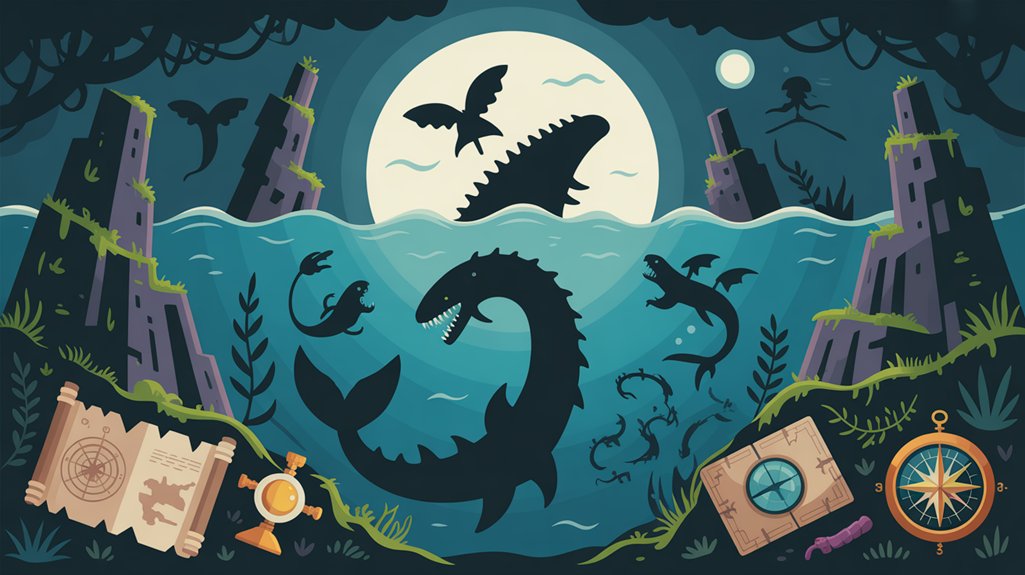
Eighteenth-century logbooks documented encounters with creatures like the Kraken—validated in 1873 when Reverend Moses Harvey photographed a beached Architeuthis dux—alongside Norway's chimeric Lusca and the serpentine entity observed by HMS Daedalus crew for twenty uninterrupted minutes off Africa's coast in 1848. These testimonies, corroborated by multiple witnesses and physical specimens featuring dinner plate-sized eyes adapted for abyssal hunting, converted maritime folklore into documented zoological reality, establishing the foundation for modern cryptozoology's pursuit of creatures dwelling in waters beyond surveyed charts where ancient knowledge intersects contemporary cetology.
Key Takeaways
- The Kraken, documented in Norwegian logbooks, was later confirmed as encounters with giant squids reaching forty-three feet long.
- HMS Daedalus crew witnessed a sixty-foot serpentine creature with a horse-like head off Africa's coast in 1848.
- Mermaids, frequently recorded in official ship logs, were often misidentified manatees or dugongs encountered during voyages.
- The Lusca, a hybrid part-cephalopod and part-shark creature, was described by Caribbean captains in historical maritime records.
- Bioluminescent deep-sea creatures and colossal cephalopods provided factual basis for centuries of documented sailor encounters with monsters.
Terrifying Logs From Ship Captains
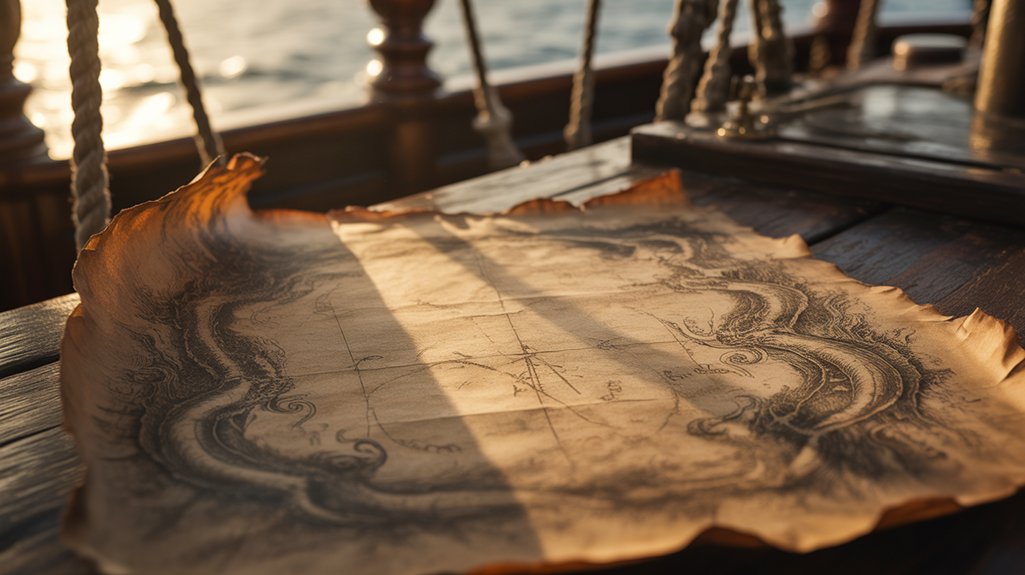
When maritime captains dipped their quills into ink-stained logbooks during the eighteenth and nineteenth centuries, they chronicled encounters that defied rational explanation—serpentine leviathans breaching gray Atlantic swells, their elongated forms coiling through frigid waters with movements both graceful and terrible.
These weren't mere sailor superstitions whispered below deck. Official records documented creatures with equine skulls and draconian profiles, observations made by men whose livelihoods demanded clear-eyed assessment of oceanic conditions.
Norwegian captains entering Greenland waters catalogued the Kraken's eldritch presence—tentacles vast enough to splinter oak hulls, dragging vessels into abyssal depths. Ship masters transcribed mermaid sightings with clinical precision, though desperation and distance likely altered manatees into chimeric sirens.
The Lusca inhabited Caribbean margins of these logs, its hybrid anatomy—part cephalopod, part shark—blamed for vanished fishing vessels. Ancient Leviathan descriptions merged biblical text with firsthand terror.
These mythical creatures inhabited official maritime records, their existence validated through institutional documentation.
##
The Kraken's eldritch form emerged from Norwegian and Greenlandic maritime consciousness during the eighteenth century, when Nordic sailors encountered massive cephalopods in Arctic waters. Their accounts described tentacles thick as ship masts coiling around wooden hulls with catastrophic force.
These testimonies, once dismissed as seafaring fantasy, gained empirical validation in 1857 when Danish naturalist Japetus Steenstrup examined a giant squid specimen, designating it *Architeuthis dux* and confirming that chimeric beasts of unfathomable size did indeed inhabit the abyssal depths.
Modern marine biology has since documented specimens exceeding forty feet in length, creatures whose bioluminescent eyes—the largest in the animal kingdom—pierce through oceanic darkness at depths where sunlight can't penetrate. Like other maritime legends documented in real-world legends, the Kraken emerged from genuine encounters with extraordinary creatures that challenged the boundaries of scientific understanding.
Ancient Kraken Legend Origins
Across the frigid waters of medieval Scandinavia, where slate-grey seas merged with bone-white horizons, Norwegian fishermen returned to port with accounts that would crystallize into one of maritime history's most enduring eldritch terrors.
These Kraken sightings emerged from encounters with colossal cephalopods prowling the lightless depths off Greenland's coast—creatures whose writhing tentacles could allegedly seize entire vessels, dragging them beneath unforgiving waves.
The beast's immensity spawned chimeric confusion: its massive back resembled terrestrial landmasses, altering the predator into phantom islands.
Such sailor superstitions weren't merely paranoid fantasy. Modern cetology confirmed giant squids' existence, validating ancestral maritime dread.
The Kraken legend therefore represents humanity's eternal negotiation with oceanic unknowns—those profound, pressurized abysses where measured science finally intersects with primal wonder.
Like other creatures once dismissed as sailor's tales, the Kraken eventually joined the ranks of former cryptids when scientific evidence confirmed the existence of its biological inspiration.
Giant Tentacles Attack Ships
Where churning Atlantic swells intersected with Caribbean shipping lanes during the eighteenth century's golden age of sail, maritime logbooks documented phenomena that maritime historians couldn't dismiss as mere superstition.
Captains recorded tentacle encounters with eldritch appendages—some measuring forty feet—coiling around masts, splintering oak planks. These weren't embellished tavern tales. They were sworn testimonies.
The Kraken's chimeric form manifested in moments of terror: sailors watched as massive tentacles erupted from abyssal depths, dragging vessels beneath roiling waves.
The Lusca, that part-octopus, part-shark horror lurking in Bahamian blue holes, yanked entire boats into submarine caverns.
Maritime myths emerged from genuine confrontations with deep-sea giants—colossal squids whose existence science later confirmed.
These creatures inhabited that liminal space where empirical reality intersects with ancestral dread, validating generations of seafarers who'd witnessed nature's most formidable predators.
Real Giant Squid Discovery
Until 2004's photographic breakthrough, Architeuthis dux existed in scientific literature as skeletal reconstructions pieced from decomposing carcasses—pale, ammonia-reeking specimens that washing ashore couldn't convey the creature's terrible grandeur.
When researchers finally captured living images in deep ocean habitats, they witnessed what generations of mariners had sworn existed: forty-three-foot leviathans with eyes diameter-matched to dinner plates, ten inches of light-gathering aperture designed for abyssal hunting.
These organs pierce darkness where sunlight dies.
Giant squid biology confirmed the Kraken's anatomical essence. The eldritch cephalopods weren't chimeric fabrications but tangible predators inhabiting pressure-crushed domains beyond human reach.
Each beached specimen thereafter became rosetta stone—flesh-written testimony validating centuries of maritime testimony.
Science hadn't discovered new monsters. It'd finally acknowledged ancient truths.
Modern Scientific Explanations
Though maritime folklore once languished in academia's margins—dismissed as sailors' hysteria, rum-addled phantasmagoria—contemporary marine biology has systematically validated the kernel of truth embedded within these testimonies.
Giant squid specimens, hauled from abyssal trenches, confirm the eldritch cephalopods whose tentacles wrapped around vessels weren't chimeric delusions. Creature identification protocols now parse oceanic myths through systematic lenses: manatees explain mermaid encounters, their rotund forms mistaken for feminine anatomy in salt-spray twilight.
The Bloop's seismic signature—ice fracturing across Antarctic shelves—demonstrates how misattributed natural phenomena birth legends. Even megalodon fossils substantiate archaic terror, sixty-foot predators whose jaws could swallow dhows whole.
Modern science doesn't destroy wonder; it illuminates which monsters actually prowled those unexplored waters, validating ancestral knowledge sailors carried across centuries of maritime tradition.
Babylonian Tiamat Clay Tablets
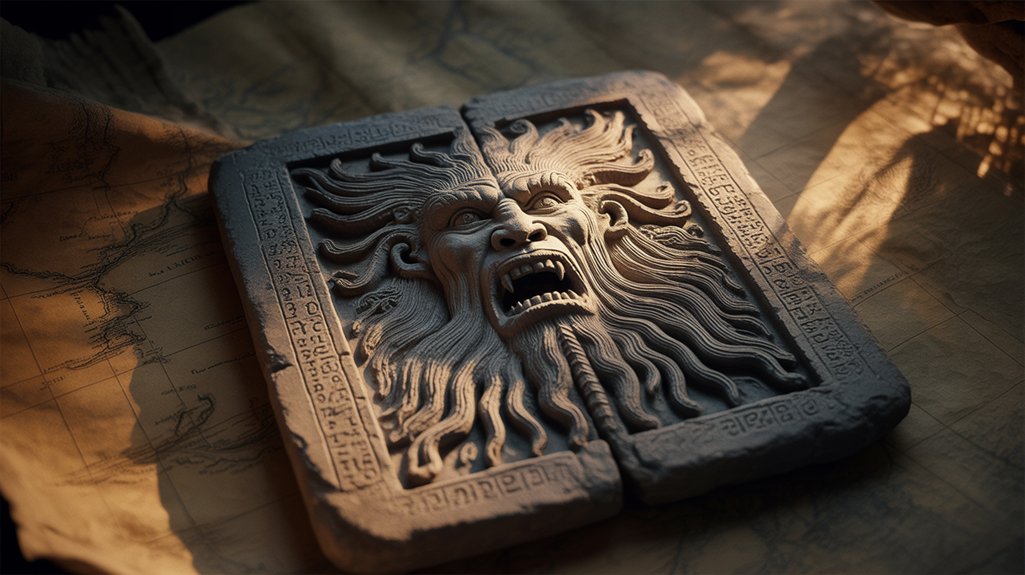
From the fertile crescent of the Tigris-Euphrates River Valley emerged tablets bearing witness to Tiamat—that eldritch matriarch of saltwater whose serpentine coils predated even the Epic of Gilgamesh, though both narratives spring from Mesopotamia's primordial imagination.
The Enuma Elish, etched into clay around the 12th century BCE, chronicles her chimeric form battling Marduk in cosmic warfare that doesn't merely entertain but explicates existence itself: chaos subjugated by divine order, formless waters shaped into firmament.
These weren't sailors' tales whispered in harbor taverns but theological foundations—creation mythology that positioned humanity's relationship with the unpredictable, many-headed terror lurking beneath every wave.
Mesopotamian Epic of Gilgamesh
When ancient Babylonian scribes pressed their reed styluses into wet clay around 2000 BCE, they preserved humanity's earliest written accounts of primordial terror—the goddess Tiamat, whose churning saltwater depths embodied chaos itself before the world took form.
Within the Epic of Gilgamesh's fragmentary verses, Tiamat emerges as something far beyond mere monster: she's the original void, birthing serpentine horrors from her abyssal womb. Her chimeric body shifted between draconic configurations, each form more eldritch than the last.
Tiamat's symbolism transcended simple villainy—she represented primordial chaos, the necessary darkness preceding creation. When Marduk finally cleaved her corpse asunder, fashioning earth from her remains, Mesopotamian cosmology crystallized into eternal truth: order demands violence, and civilization rises only from conquered wildness.
These clay tablets whispered ancient warnings. They still do.
Tigris-Euphrates River Valley Origins
Between the twin arteries of the Tigris and Euphrates, where Mesopotamian civilizations first channeled floodwaters into ordered fields, scribes converted cosmic dread into cuneiform permanence. The Enuma Elish tablets preserved Tiamat's eldritch essence—primordial chaos incarnate, saltwater mother of chimeric horrors. Her dragon-form embodied the untamed waters that both nourished and threatened existence.
| Tigris Mythology | Euphrates Symbolism |
|---|---|
| Swift currents = divine fury | Steady flow = ordered creation |
| Unpredictable floods = chaos | Agricultural sustenance = civilization |
| Tiamat's monstrous offspring | Marduk's triumphant cosmos |
These rivers shaped more than agriculture. They spawned philosophical wrestling with disorder's seductive pull. Tiamat's defeat represented humanity's eternal struggle: imposing structure upon nature's anarchic depths. The tablets immortalized water's dual nature—life-giver and destroyer—reflecting the precarious freedom ancient peoples carved from unforgiving landscapes.
Chaos-Versus-Order Creation Mythology
Although the Enuma Elish's seven tablets emerged from Babylon's library shadows circa 1200 BCE, their narrative roots penetrated deeper still—reaching back to Sumerian cosmogonies where Nammu, primordial abyss, birthed existence from undifferentiated brine.
Tiamat embodied chaos symbolism absolute: dragon-serpent coiling through pre-creation waters, her chimeric form representing ocean's eldritch hostility toward civilization's fragile order. These mythical creatures weren't mere fantasy—they encoded maritime terror within theological frameworks.
When Marduk cleaved her scaled corpus, fashioning heavens from her ribs and earth from her spine, Babylon's priests articulated humanity's oldest confrontation: the imposition of structure upon nature's wild indifference.
Here dwelt no entertainment, but existential navigation. Sailors inheriting these cosmologies understood intimately—every storm recalled Tiamat's thrashing, every calm her temporary defeat. Creation meant perpetual conquest.
Norse Jörmungandr World Serpent
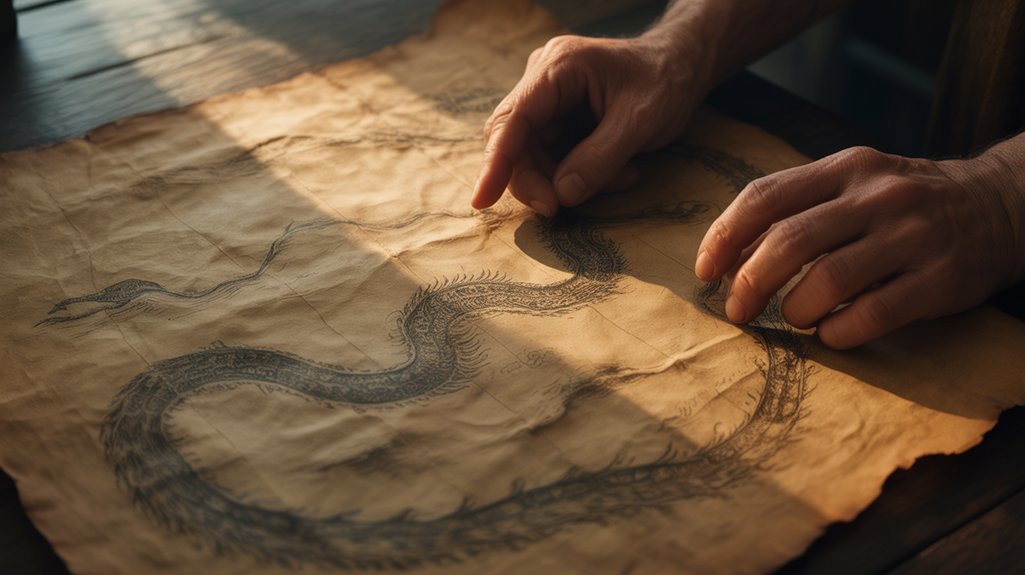
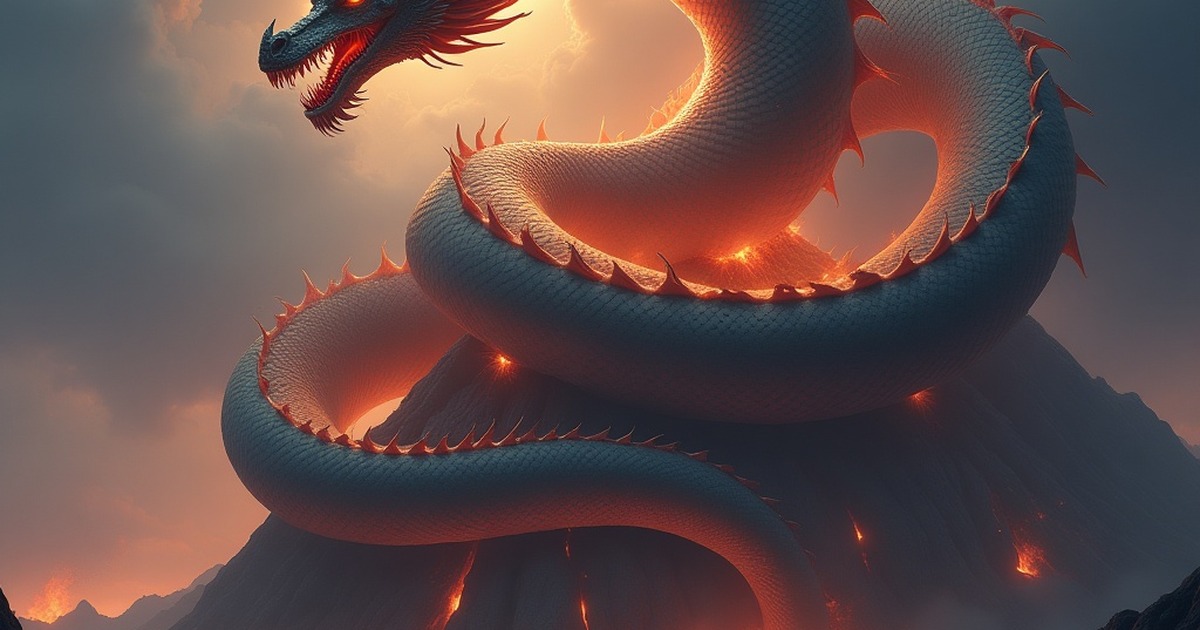
In the churning waters of Norse cosmology, Jörmungandr emerges as perhaps the most eldritch manifestation of oceanic terror—a serpent so colossal it encircles Midgard itself, tail clenched between fangs in an eternal ouroboros. Born from Loki's union with the giantess Angerboda, this wyrm shares kinship with Hel and Fenrir, forming a trinity of chaos-spawn destined to dismantle the ordered world.
Jörmungandr's Prophetic Framework
| Mythic Role | Cosmic Function | Ragnarok Destiny |
|---|---|---|
| World-Binder | Maintains boundary between order/chaos | Releases tail, freeing apocalypse |
| Thor's Nemesis | Tests divine strength repeatedly | Mutual destruction through venom |
| Ocean Embodiment | Manifests primal maritime fear | Drowns lands in tidal uprising |
Jörmungandr symbolism resonates through Norse mythology as boundary-keeper and world-ender simultaneously. Norwegian and Icelandic sailors attributed serpentine sightings to this creature, their terror grounded in cosmological understanding. Modern resurrections—particularly God of War's interpretation—demonstrate how ancient archetypal dread transcends millennia, speaking to humanity's eternal confrontation with unfathomable depths.
Ragnarök's Apocalyptic Serpent Symbolism
When Jörmungandr releases its tail from between venomous fangs, the gesture doesn't merely signal battle—it unravels reality's fundamental architecture. Yormungandr mythology presents the serpent as cosmic ouroboros, its self-consuming form maintaining the boundaries between ordered civilization and primordial chaos. Ragnarök symbolism alters this creature into something beyond monster—an eldritch manifestation of inevitable change.
The serpent's apocalyptic role encompasses four essential dimensions:
- Cosmic dissolution: The breaking of the tail-grasp triggers universal collapse
- Divine mortality: Thor and Jörmungandr's mutual destruction proves even gods face finite endings
- Cyclical regeneration: Death births renewed worlds from cataclysmic ashes
- Existential freedom: Ragnarök liberates reality from predetermined patterns
This chimeric entity embodied Norse understanding that destruction wasn't mere ending but necessary threshold.
The World Serpent's venom—killing Thor nine steps beyond their final confrontation—represented change's irreversible nature. Ancient Scandinavians recognized apocalypse as liberation from stagnant cosmic order, embracing catastrophe's terrible promise.
HMS Daedalus 1848 Sighting
On August 6, 1848, Captain Peter M'Quhae and his crew aboard the HMS Daedalus encountered something eldritch in the waters off Africa's western coast—a serpentine entity whose presence would elevate mere naval incident to become codified maritime testimony.
The captain's official dispatch to the Admiralty, preserved in meticulous logbook entries and corroborated by multiple officers, described a creature of such chimeric proportions that it defied contemporary zoological classification.
These documented testimonies, bearing the weight of Royal Navy authority, converted rumor into record, folklore into empirical puzzle.
The Official Ship Report
Though countless mariners had whispered tales of serpentine leviathans in harbor taverns and dockside quarters, the autumn of 1848 brought forth something unprecedented—an official naval document that would pierce the veil between maritime folklore and documented reality.
Captain William H. W. Smith's meticulous entries converted the HMS Daedalus logbook into scholarly evidence, recording measurements, behaviors, undulations. The official documentation detailed an eldritch form rising from Atlantic depths near the Azores—elongated, purposeful, defying rational categorization.
Crew reactions manifested as collective astonishment rather than individual madness; multiple witnesses corroborated the chimeric vision. Their sworn accounts, preserved in Royal Navy archives, raised this encounter beyond mere speculation.
Here existed tangible evidence: ink upon parchment, signatures beneath observation, the liminal space where empirical record embraces oceanic mystery.
Captain M'Quhae's Detailed Description
Captain Peter M'Quhae's testimony would crystallize the Daedalus encounter into maritime immortality through prose that married precision with wonder.
His account detailed a fifty-foot leviathan bearing a horse-like countenance, its dark scales catching sunlight as it undulated through South Atlantic waters with eldritch grace.
The captain's credibility rested upon measured observation—twenty minutes of sustained contact, the creature's significant wake, its sinuous locomotion defying conventional marine biology.
Such serpent symbolism resonated deeply within nautical consciousness, evoking ancient chimeric forms that haunted humanity's oceanic boundaries.
M'Quhae's description transcended mere report, entering that liminal space where empirical documentation meets ancestral knowing.
The beast's persistent presence alongside the vessel suggested neither accident nor illusion.
Something vast moved through those waters—something that refused classification.
Crew Witness Testimonies
Beyond the captain's authoritative declaration, other witnesses aboard the Daedalus emerged to corroborate what their commander had documented—their voices adding stratified layers to an already remarkable testimony.
Multiple crew members independently described the eldritch apparition: sixty feet of serpentine anatomy, crowned by an equine skull that defied taxonomic classification. Their accounts converged with uncanny precision, challenging conventional dismissals of sailor psychology as mere fantasy born from oceanic isolation.
The chimeric entity remained visible for twenty minutes, eliminating momentary hallucination as explanation. These testimonies raise profound questions regarding eyewitness reliability in maritime contexts—when do corroborating narratives transcend skepticism?
The Daedalus incident suggests collective observation possesses epistemic weight that transcends individual perception, altering sailors' sworn statements into documentary evidence that continues haunting rational discourse.
0,000 Leagues Under the Sea
Beneath the roiling surface of historical maritime records, where eighteenth-century ship logs meet ancient oral traditions, lies a stratum of testimony that documents encounters with creatures whose very existence challenged the taxonomic boundaries of known biology.
Where maritime archives intersect with ancient lore, testimony emerges of creatures defying all taxonomic classification and biological possibility.
These oceanic folklore accounts weren't relegated to tavern tales—they permeated official documentation with disturbing consistency.
The deep-dwelling entities that haunted sailors' consciousness manifested through specific patterns:
- Kraken manifestations: Tentacled leviathans surfacing from abyssal trenches, their chimeric forms inspiring terror
- Serpentine coils: Undulating bodies breaking wave crests, defying conventional marine classification
- Hybrid anatomies: Creatures blending human and piscine features, eldritch in their biological impossibility
- Bioluminescent apparitions: Phosphorescent beings rising from lightless depths
These mythical creatures represented humanity's confrontation with an untamed wilderness.
The Leviathan symbolized primordial chaos itself—vast, incomprehensible, utterly beyond human dominion.
Each sighting reinforced maritime culture's understanding: beneath those waves existed domains where natural law bent toward the impossible.
Giant Squid 1873 Confirmation
On November 2nd, 1873, Reverend Moses Harvey received an urgent summons to examine something profoundly unsettling—a massive cephalopod specimen hauled from Newfoundland's frigid waters, its tentacles stretching across his parlor floor in testimony to centuries of dismissed maritime accounts.
This wasn't mere folklore anymore. The creature's powerful arms bore rows of serrated suckers, each one capable of gripping prey with eldritch precision. Its eyes, enormous and unblinking even in death, measured nearly a foot in diameter—organs evolved for piercing abyssal darkness.
Harvey's documentation provided irrefutable validation. Historical accounts once deemed chimeric suddenly demanded reconsideration. Sailors who'd sworn they'd witnessed tentacled leviathans rising from oceanic depths were vindicated.
The giant squid emerged from shadow into scientific taxonomy, bridging the liminal space between myth and taxonomy.
Physical evidence converted skepticism into acceptance. Here lay tangible proof that the ocean's depths harbored genuine monsters—creatures whose existence paralleled Kraken legends yet transcended them through sheer biological reality.
Modern Cryptozoology Origins Traced
While Harvey's cephalopod specimen modified scientific consensus in 1873, it simultaneously birthed an entire discipline—one that would formalize humanity's eternal pursuit of creatures dwelling at perception's edge.
Modern cryptozoology emerged from maritime folklore's crucible, where Kraken legends and Leviathan accounts coalesced with documented encounters involving giant squids and sperm whales. The field traces its intellectual genealogy to those liminal moments when sailors, gripped by fatigue and desperation, reshaped whale fins and manatees into chimeric horrors.
Sailor psychology became foundational to understanding these mythical encounters. The 1700s and 1800s witnessed proliferation of exaggerated testimonies—accounts born from isolation's weight upon consciousness.
Yet cryptozoologists don't dismiss these narratives as mere delusion. Instead, they excavate historical sightings of eldritch entities like Ogopogo and Nessie, searching oceanic depths for validation. The discipline respects ancestral knowledge while wielding scientific methodology, acknowledging that misidentification once obscured genuine phenomena.
Sometimes legends harbor truth beneath their scales.
Science Validates Ancient Legends
Through methodologies refined across centuries, scientific inquiry has altered folklore's gossamer threads into empirical validation—authenticating what maritime cultures preserved through oral tradition.
Giant squid carcasses, discovered across disparate oceanic regions, corroborated historical accounts of tentacled leviathans that haunted sailors' nightmares. These eldritch specimens, measuring over forty feet, proved the Kraken wasn't entirely chimeric.
Fossil evidence strengthens this convergence. Megalodon remains—teeth the size of human hands, vertebrae like millstones—confirm that mythical creatures of impossible proportion once prowled primordial depths. Ancient mariners weren't fabricating terror.
Yet misidentification accounts for considerable folklore. Manatees became mermaids through exhaustion's lens, dugongs altered into sirens. Poor visibility, psychological strain, and lamplight's distortions created monsters from mundane fauna.
The pattern emerges clearly: sailors' testimonies contained kernels of truth, wrapped in superstition and embellishment. Science hasn't demolished these legends—it's revealed their foundations, demonstrating that humanity's relationship with the ocean's mysteries has always balanced observation with interpretation.
Frequently Asked Questions
What Psychological Factors Made Sailors Prone to Sea Monster Misidentification?
Cognitive biases rendered mariners susceptible to chimeric interpretations of oceanic phenomena. Sleep deprivation, isolation, and scurvy-induced delirium amplified pattern recognition errors, altering mundane creatures into eldritch horrors.
Folklore influence proved equally potent—cultural narratives transmitted through generations created expectational frameworks that shaped perception itself. The mind, desperate for meaning amid vast emptiness, conjured monsters where unfamiliar biology existed.
Pre-existing mythological schemas acted as perceptual filters, liberating sailors' imaginations while simultaneously imprisoning them within inherited taxonomies of terror that transcended rational observation.
How Did Map Makers Incorporate Sea Monster Legends Into Early Cartography?
Medieval cartographers converted chimeric oceanic terrors into cartographic symbolism, adorning uncharted waters with serpentine forms and tentacled horrors.
These mythical representations weren't mere decoration—they served as warnings, marking dangerous passages, unexplored territories, and the empire's edges.
The eldritch creatures functioned as both artistic flourishes and navigational codes, their placement deliberate, purposeful.
Sailors understood: where dragons coiled on vellum, reality frayed.
Maps became sacred texts, binding folklore to geography, preserving ancient maritime wisdom within ornate borders and compass roses.
What Economic Impact Did Sea Monster Fears Have on Maritime Trade Routes?
Sea monster fears imposed profound economic consequences upon medieval and Renaissance maritime trade, forcing merchants to navigate longer, costlier routes around legendary danger zones.
The chimeric beasts—krakens, serpents, leviathans—became invisible tariffs. Ships avoided certain waters entirely, increasing voyage duration by weeks.
Maritime safety concerns drove insurance premiums skyward, while cargo losses to “unexplained” disappearances devastated profit margins.
These eldritch anxieties shaped commerce's very geography, binding trade networks to fear's ancient cartography rather than efficiency's rational demands.
Did Insurance Companies Account for Sea Monster Attacks in Shipping Policies?
Like Lloyds of London emerging from shadowy coffee houses, maritime insurers indeed acknowledged the eldritch terrors haunting deep waters.
Historical insurance policies from the 17th century onwards classified “perils of the sea”—chimeric beasts included—within their clauses, though they wouldn't explicitly name krakens or serpents.
Maritime regulations forced merchants to document losses, yet insurers cleverly obscured sea monster claims under broader categories: storms, shipwreck, unknown catastrophe.
This ambiguity protected both premium-paying captains and profit-seeking underwriters from supernatural accountability.
How Do Modern Submarine Exploration Technologies Search for Unknown Marine Creatures?
Modern underwater robotics pierce abyssal depths where human vessels can't venture, their mechanical eyes scanning for chimeric forms in perpetual darkness.
Sonar arrays map marine biodiversity across continental shelves, revealing eldritch architectures of unknown ecosystems.
Submersibles equipped with bioluminescent lures descend kilometers beneath crushing pressure, their cameras capturing organisms defying terrestrial logic.
These autonomous explorers—silent, tireless—drift through hadal zones, documenting creatures that blur boundaries between myth and taxonomy, liberating humanity's understanding from surface-bound constraints.
Conclusion
The boundary between maritime myth and biological reality dissolves entirely when twentieth-century science validates what ancient mariners knew viscerally—eldritch leviathans prowl oceanic depths beyond human comprehension. Those supposedly fantastical chronicles, dismissed as sailor's delirium, now emerge as prescient documentation of chimeric horrors inhabiting abyssal trenches. The cryptozoological record vindicates every terrified captain who witnessed tentacled nightmares surface from primordial darkness. Perhaps humanity's ancestral dread of deep water wasn't mere superstition. Perhaps those archaic warnings carried profound truth all along.