You'll find shape-shifters emerged as humanity's primordial technology for negotiating fluid boundaries between civilization and wilderness, manifesting in the eldritch Sorcerer of Trois-Frères' limestone galleries around 13,000 BC. From Lycaon's lupine punishment to Japanese kitsune's wisdom-bearing transitions, these therianthropic figures validated shamanic consciousness across cultures—documenting not mere supernatural fancy but the soul's chimeric architecture. Ancient peoples inscribed metamorphosis as both curse and catalyst, their narratives revealing ethical truths about selfhood's permeable nature through ritualistic alteration that continues resonating in contemporary consciousness.
Key Takeaways
- Ancient shape-shifters expressed anxieties about identity boundaries, enabling cultures to explore the fluid connection between human and animal nature.
- Transformation served as divine punishment for moral corruption, as seen in Greek Lycaon and Slavic werewolf traditions.
- Shamanic practices used shape-shifting rituals to access spiritual realms, documented in 13,000-year-old cave art like Trois-Frères' Sorcerer.
- Different cultures assigned specific meanings: European werewolves represented involuntary duality while Japanese kitsune embodied voluntary wisdom and gender fluidity.
- Metamorphosis functioned as symbolic architecture for conveying ethical truths, consequences of actions, and potential paths to redemption.
Humans Becoming Beasts: Origins
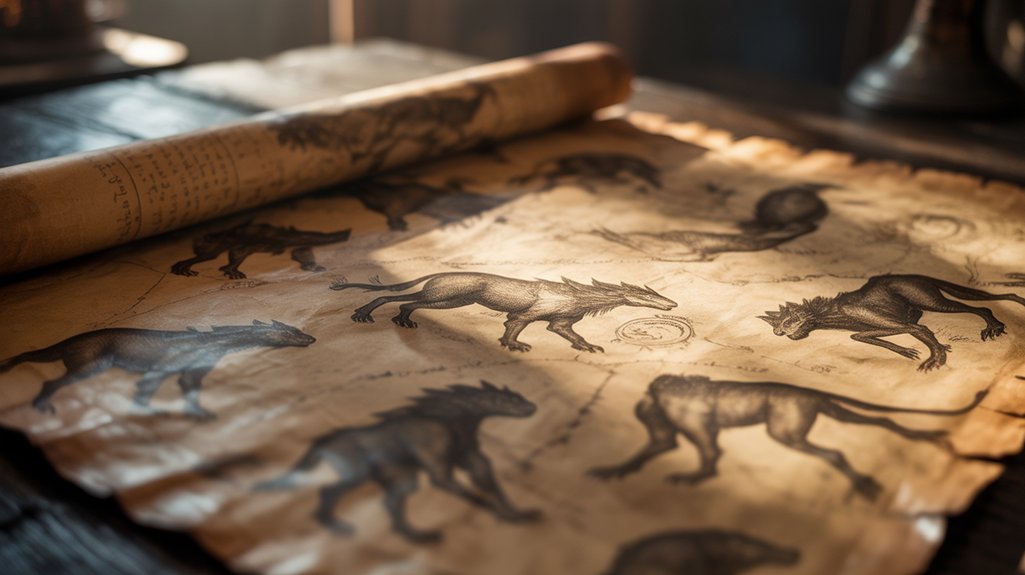
When ancient peoples gazed upon the threshold between human consciousness and animal instinct, they gave form to their deepest anxieties through therianthropy—the alteration of flesh from civilized human to primal beast.
Therianthropy captured humanity's primal terror—the recognition that civilization's veneer was merely skin-deep, masking the beast beneath.
You'll find humanity's earliest confrontation with this eldritch change etched into limestone at France's Cave of the Trois-Frères, where the Sorcerer—part human, part stag—dances across stone dated to 13,000 BC. This chimeric figure wasn't mere decoration. It represented ritualistic belief in transformation itself.
Greek mythology crystallized these fears through Lycaon, whose impiety earned Zeus's wrath, his human form twisted into lupine monstrosity. Divine retribution through flesh.
Slavic traditions echoed this pattern, where moral corruption triggered alteration into mythical creatures—werewolves prowling moonlit forests, punishment made manifest.
These alterations weren't random. They articulated your ancestors' recognition of duality: the civilized mask worn daily, and beneath it, primal instincts straining against social chains.
Freedom and savagery. Human and beast. Forever locked in struggle.
##
You stand at the threshold where flesh becomes fur, where human consciousness merges with the eldritch essence of beast—a change that ancient civilizations understood not merely as fantastical impossibility but as profound spiritual truth.
From the shamanic traditions of circumpolar peoples to the chimeric deities of Mesopotamia, circa 3000 BCE, shape-shifting emerged as humanity's attempt to comprehend alteration itself: the fluid boundaries between self and other, civilization and wilderness, mortality and transcendence.
These primordial narratives, woven through Egyptian therianthropy and Celtic skin-walkers alike, reveal how our ancestors encoded moral wisdom within bodies that shifted, teaching that identity remains perpetually unfinished, always becoming.
Origins Across Ancient Civilizations
Across the vast tapestry of human civilization, from the ziggurat-crowned cities of Mesopotamia circa 3500 BCE to the sacred kivas of pre-Columbian Americas, the archetype of the shape-shifter emerges as a persistent, haunting constant—a liminal figure dwelling in the spaces between fixed forms.
You'll find these mythological origins rooted in humanity's primal recognition of nature's fluid boundaries: Enki altering to bridge divine and mortal domains, Proteus writhing through eldritch metamorphoses along Aegean shores, Loki's chimeric deceptions weaving chaos through Yggdrasil's branches.
Each culture encoded transformative power differently—Vishnu's avatars restoring cosmic equilibrium, Coyote's trickster wisdom illuminating spiritual truths, Circe wielding alteration as benediction and curse.
These weren't mere stories. They were keys to understanding existence itself, maps charting territories where identity dissolves, reconstitutes, transcends. In Greek mythology, Pan's hybrid form—born fully developed with horns, beard, and goat-like features—embodied this perpetual liminality between human civilization and untamed wilderness.
Symbolic Transformation and Identity
Beyond these cultural particulars lies something far more profound—the shape-shifter's deepest function as symbolic architecture for understanding identity itself.
You'll find that identity fluidity operates as humanity's oldest psychological mirror, reflecting our chimeric nature through metamorphic symbolism. These eldritch changes weren't mere fantasy; they mapped the terrifying truth that selfhood remains perpetually unstable, contested, negotiable.
When Ovid chronicled change, he wasn't recording supernatural events—he was documenting the soul's architecture. The werewolf's monthly rupture, the selkie's sealskin choice, the witch's liberation through animal form: each represents your eternal struggle between societal constraint and authentic being.
Shapeshifting embodies radical freedom, that dangerous recognition that you've never been fixed, never singular. Identity changes constantly. You're already shifting.
Spiritual Power and Shamanism
Such shape-shifting validates profound cultural truths: identity remains fluid, adaptability constitutes survival, interconnectedness binds all existence.
You witness freedom incarnate.
In traditions ranging from Inuit mythology to Norse and Celtic lore, shape-shifters embody the shamanic ability to traverse the boundaries between human and animal realms.
Moral Lessons Through Metamorphosis
While alteration narratives throughout global mythologies often celebrate the ecstatic possibilities of bodily transcendence, modification in folklore equally serves as divine pedagogy—a visceral, corporeal means of inscribing ethical truths upon transgressive souls.
You'll find Slavic tales wielding metamorphosis as eldritch punishment: deceitful merchants become crows, their chimeric forms broadcasting moral consequences. These altering lessons expose selfish desires through bodily exile, forcing identity reflection upon those who betray communal trust.
Shape-shifting's dual nature emerges—simultaneously curse and catalyst for character growth. The narratives function as cautionary tales warning against greed's seductive whisper.
Yet redemption arcs persist: alteration can purify rather than merely condemn. Through feathered wings or bestial limbs, folklore teaches you that authentic freedom requires ethical anchoring, that power without virtue breeds only monstrous becoming.
Prehistoric Cave Art Evidence
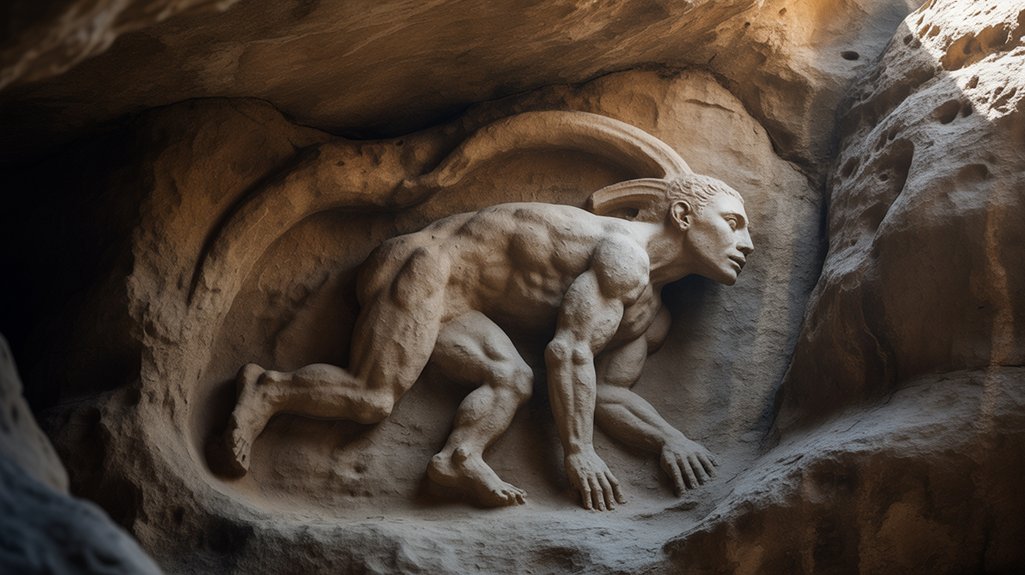
You'll find humanity's oldest evidence of shapeshifting consciousness etched into limestone walls within the Cave of Trois-Frères, nestled deep in France's Ariège region, where approximately 13,000 years ago an unknown artist rendered what scholars call “The Sorcerer”—a chimeric figure blending human posture with antlered crown, owl-like eyes, and animal limbs.
This enigmatic being suggests shamanic practitioners once donned ritualistic guises to traverse the membrane between mortal and beast, human and spirit, achieving alteration through ceremony rather than physical metamorphosis.
The ancient ochre lines whisper of something profound: our ancestors didn't merely observe animals but believed they could become them, channeling their essence through sacred rites performed in subterranean darkness.
Cave of Trois-Frères
Deep within the Ariège region of southern France, the Cave of Trois-Frères guards one of humanity's earliest testimonies to shapeshifting consciousness—a palimpsest of ochre and charcoal etched into limestone approximately 13,000 years before the Common Era.
You'll encounter “The Sorcerer” here, a chimeric entity melding human posture with cervine antlers, lupine ears, feline grace. This eldritch figure dominates the sanctuary's deepest chamber, where prehistoric rituals likely unfolded beneath flickering torchlight.
The cave symbolism transcends mere decoration; you're witnessing shamanic metamorphosis codified in stone, where practitioners believed they could slip between flesh and fur, accessing animal consciousness.
Scholars debate interpretations, yet the artwork's intention remains luminous: these weren't fantasies but lived spiritual technologies, mapping humanity's ancient understanding that identity itself was fluid, permeable, transcendent.
France's Ariège Region Location
The Ariège Department sprawls across the Pyrenean foothills like a geological palimpsest, its limestone karst terrain honeycombed with over five hundred catalogued caverns—secret chambers where Ice Age hunters inscribed their cosmological architectures into living rock. You'll discover the prehistoric significance here, where Ariège geography created perfect conditions for spiritual documentation.
| Location Feature | Prehistoric Significance | Cultural Evidence |
|---|---|---|
| Limestone caves | Sacred ritual spaces | 13,000-year-old art |
| Pyrenean foothills | Hunter-gatherer territory | Animal-human chimeras |
| Karst formations | Natural cathedral chambers | Metamorphosis imagery |
| Trois-Frères site | Shamanic documentation | The eldritch Sorcerer |
These hunter-gatherers recognized transformation's power, etching their cosmological understanding onto subterranean walls. The famous Sorcerer—that chimeric fusion—reveals humanity's ancient comprehension of shapeshifting as spiritual technology, preserved within Ariège's geological vault.
Shamanic Ritual and Transformation
When Paleolithic practitioners donned antlered headdresses and carved their hybrid visions into calcium carbonate sanctuaries, they weren't merely decorating—they were documenting change as sacred technology.
The Trois-Frères cave complex preserves this eldritch knowledge, its 13,000-year-old surfaces bearing witness to ritualistic practices that dissolved boundaries between flesh and spirit.
The Sorcerer figure stands paramount: chimeric, liminal, deliberately ambiguous. You're observing shamanic journeys made permanent through ochre and intention, where alteration functioned as cognitive apparatus rather than metaphor.
These practitioners accessed alternate consciousness states through deliberate change, their hybrid forms serving as portals between mundane and numinous domains.
The repetition of therianthropic imagery across millennia suggests not artistic whimsy but systematic methodology—a technology of transcendence predating written language, encoded in stone.
Global Shapeshifting Mythology Traditions

Across continents and millennia, shapeshifting narratives have emerged as fundamental expressions of humanity's relationship with the liminal—those threshold spaces where identity dissolves and reforms. You'll discover that cultural interpretations of these altering symbols reveal profound truths about human consciousness, from Europe's lycanthropic curses to India's ichchhadhari naag, serpentine beings who navigate between reptilian and human existence.
| Tradition | Primary Form | Cultural Significance | Alteration Nature | Symbolic Essence |
|---|---|---|---|---|
| European Werewolves | Wolf-human | Bestial duality, curse | Involuntary, lunar | Loss of control |
| Japanese Kitsune | Fox-woman | Gender fluidity, wisdom | Voluntary, seductive | Transcendent power |
| Celtic Shapeshifters | Various animals | Revenge, sovereignty | Punishment or gift | Justice enacted |
| Scottish Selkies | Seal-human | Forbidden love, longing | Object-dependent | Trapped identity |
| Native Skinwalkers | Predatory beasts | Transgression, witchcraft | Eldritch corruption | Violated boundaries |
These chimeric figures embody freedom's paradox—alteration as liberation and imprisonment simultaneously.
Bridging Humanity and Nature
- Celtic selkies shed sealskin for human flesh, traversing coastal thresholds where ocean meets land, instinct meets reason.
- Japanese kitsune accumulate tails with centuries of wisdom, their vulpine cunning merged with human complexity.
- Indigenous skinwalkers cross spiritual boundaries your modern mind struggles to conceptualize.
- Berserker warriors channeled ursine fury, becoming neither wholly man nor beast.
Their alterations reveal eldritch truths: boundaries you've constructed between species exist only in perception.
Through shapeshifting narratives, ancient cultures taught adaptability, moral growth, and the recognition that wilderness dwells within your supposedly civilized heart.
Greek Gods' Deceptive Transformations
You encounter in Greek mythology a pantheon whose alterations served not enlightenment but stratagem—Zeus assumed chimeric forms of bull, swan, and golden rain to circumvent mortal resistance, while Proteus, that eldritch sea-prophet of Pharos, shifted through countless shapes to evade those seeking his unwilling prophecies.
These metamorphoses reveal the gods' deployment of deception as divine prerogative, where change became instrument rather than revelation.
The immortals wielded shape-shifting as punishment too, as Athena's spider-curse upon Arachne and Circe's porcine enchantments demonstrate, rendering metamorphosis itself a proof to Olympian dominion over form, truth, and consequence.
Zeus's Seductive Animal Forms
When Zeus sought union with mortal women beyond the watchful gaze of his wrathful consort Hera, he embraced chimeric metamorphosis as his primary stratagem—altering flesh divine into bestial forms that concealed his thunderous essence while simultaneously overwhelming his targets with otherworldly magnificence.
His divine manipulation manifested through calculated alterations: the golden shower cascading upon Danaë's imprisoned form, the majestic bull bearing Europa across Mediterranean waves, the swan's eldritch approach to Leda.
Zeus's allure resided not merely in physical beauty but in the intoxicating unpredictability these animal masks provided—desire made manifest through feather, horn, and shimmering precipitation.
Each alteration revealed mythology's moral ambiguity, where power and seduction intertwined, leaving mortal women forever changed by encounters with beings who transcended humanity's limitations.
The shapeshifter embodied freedom's darkest paradox: liberation through possession.
Proteus: The Evasive Prophet
While Zeus wielded metamorphosis as weaponized seduction, Proteus—the Old Man of the Sea, Poseidon's herdsman of seals—changed not to conquer but to conceal, his shapeshifting constituting an elaborate defensive architecture against those who'd wrest prophetic knowledge from his reluctant oracle.
You'll find in Homer's account of Menelaus's wrestling match with this eldritch prophet a profound meditation on elusive truths: Proteus' wisdom flows like quicksilver through changing identities—lion, serpent, leopard, boar, water, tree—each transformation a barrier against unwanted revelation.
The name itself, derived from “protos” (first), hints at primordial fluidity. His chimeric evasions offer rich metaphorical interpretations: knowledge resists easy capture, truth demands persistent grip, and wisdom won't surrender itself to casual inquiry.
You must hold fast through every change.
Transformation as Divine Punishment
Where Proteus's metamorphoses built walls against revelation, the Olympians' altering punishments demolished identity itself—reducing transgressive mortals to bestial forms that mirrored their crimes, their hubris crystallized into permanent flesh.
You'll witness divine retribution's eldritch architecture in Lycaon's lupine exile, Zeus's answer to cannibalistic impiety.
Athena unraveled Arachne's humanity, thread by thread, until only spider remained—eternal weaver without glory.
Circe's swine-spells enacted moral consequences for violation's sake, while Demeter's grief birthed lizard-Ascalabus from mockery's ashes.
These weren't mere displays of divine caprice. They carved cosmic law into living tissue, warnings etched in altered bodies.
The gods demanded humility; they received defiance. The result? Permanent metamorphosis. Identity stripped. Humanity revoked.
Each alteration whispered the same truth: respect the boundaries between mortal and divine, or lose yourself entirely.
Contemporary Fiction and Film
The ancient archetype of the shapeshifter—that liminal being who traverses the boundaries between human and beast, self and other—has undergone a profound alteration within contemporary fiction and film, emerging not as mere echo of folklore but as a sophisticated lens through which modern audiences examine identity's fluid nature.
Shapeshifters traverse boundaries between human and beast, reflecting existence's mutable essence through corporeal transformation and fluid identity.
You'll discover shapeshifter symbolism woven throughout:
- Werewolves and animagi in “Twilight” and “Harry Potter” manifest character duality through corporeal alteration.
- Mystique's chimeric form embodies deception's eldritch power, challenging appearance versus essence.
- “Buffy's” shapeshifters navigate acceptance, wrestling with supernatural inheritance.
- “The Shape of Water's” amphibious protagonist transcends species boundaries through altered love.
These narratives liberate you from rigid identity constructs. The shapeshifter becomes your mirror, reflecting existence's mutable essence—that primal understanding that change isn't punishment but possibility.
Here, ancient wisdom resurfaces: authenticity requires embracing your multifaceted nature, acknowledging the beast and divine dwelling simultaneously within your flesh.
Modern Jungian Archetype Analysis
Beyond cinema's flickering shadows lies a deeper cartography of meaning—one that Carl Jung meticulously charted when he identified the shapeshifter as primal architect of psychic alteration.
You'll discover how these chimeric entities embody the archetypal significance of change itself, mapping the treacherous passage between conscious awareness and the eldritch territories of the unconscious mind. Their identity fluidity mirrors your own multiplicity, that essential duality existing between human rationality and bestial instinct.
The shapeshifter crystallizes Jung's shadow concept—those repressed qualities lurking beneath civilized masks.
When ancient peoples crafted narratives of humans becoming wolves, ravens, serpents, they weren't simply entertaining themselves; they were documenting the Self's arduous journey toward individuation. Each metamorphosis represents psychological integration, the alchemical marriage of opposing forces within your psyche.
Today's struggles with identity and authenticity echo these primordial concerns.
You're still negotiating that liminal space between societal constraint and inherent wildness, seeking liberation through understanding these archetypal patterns that transcend temporal boundaries.
Psychological Identity Exploration Today
While your ancestors altered through ritual and myth, you navigate metamorphosis through pixels, pronouns, and pharmaceutical intervention—the shapeshifter's domain hasn't vanished but relocated to therapy offices, gender clinics, and Reddit threads where identity fragments and reforms.
This psychological metamorphosis mirrors ancient transformations, yet manifests through contemporary vehicles of self-determination. You wrestle with identity duality not in moonlit forests but fluorescent-lit consulting rooms, confronting the chimeric nature of selfhood through neurochemistry and chosen nomenclature.
The eldritch pull toward change persists, unchanged in nature. Your generation's shapeshifters emerge from cocoons of societal constraint, claiming agency over their transformative journey.
Digital avatars become your pelts and feathers, hormone therapy your shamanic invocation. This freedom to reconstruct identity represents humanity's ancient hunger given modern vocabulary—the same primal recognition that transformation isn't betrayal of authentic self but its revelation.
You understand what your ancestors knew: that fixed identity is the true illusion, fluidity the primordial truth.
Enduring Shapeshifter Legacy Today
How do ancient metamorphs manifest in your twenty-first-century consciousness when Mystique's blue-scaled alteration flickers across cinema screens, when Teen Wolf's adolescent rage finds catharsis in lycanthropic change, when Kafka's Gregor Samsa still haunts literature syllabi as humanity's ultimate outsider?
You're witnessing cultural symbolism's perpetual transformation—shapeshifters transcending their archaic origins to address your contemporary crises of selfhood.
Modern fantasy franchises channel these eldritch shifts into explorations of identity fluidity, where werewolves embody suppressed instincts and chimeric beings represent society's marginalized voices.
Shapeshifters translate ancient metamorphosis into contemporary identity politics, transforming mythic beings into mirrors for our fractured, evolving selves.
Video games grant you agency within these ancient paradigms, letting you inhabit transformation's liminal space. Adaptability becomes your sacred virtue.
The shapeshifter persists because you need permission to evolve, to shed constraining identities like serpentine skin.
These narratives whisper that multiplicity isn't fragmentation—it's wholeness.
Your fascination with transformation reflects an essential truth: authentic freedom requires embracing your protean nature, accepting every contradictory facet dwelling within your consciousness.
Frequently Asked Questions
What Are the Most Famous Shapeshifter Characters in Modern Video Games?
You'll encounter profound shapeshifter archetypes in *The Witcher 3's* doppler encounters, *Bloodborne's* eldritch Great Ones, and *Dungeons & Dragons: Shadow over Mystara's* chimeric druids.
These game mechanics liberate you from fixed forms, echoing ancient alteration rites.
*Altered Beast* (1988) pioneered morphological freedom through were-beast communion.
*Prototype's* Alex Mercer embodies pure metamorphic potential, consuming identities like shamanic soul-eaters.
Each system channels primal human yearning for transcendence beyond corporeal boundaries, changing limitation into boundless possibility.
How Do Different Religions View Shapeshifting Abilities Today?
You'll find most contemporary beliefs treat metamorphosis cautiously—traditions neither openly embrace nor entirely dismiss these eldritch possibilities.
Christianity views such changes as demonic deception, while Islam's djinn possess chimeric fluidity within theological boundaries.
Hindu mythological interpretations celebrate divine shape-shifting through Vishnu's avatars, honoring cosmic play.
Buddhism acknowledges change through rebirth's endless cycles.
Indigenous faiths maintain living reverence for skin-walkers, animal-human thresholds.
Each tradition guards its own liminal truths, respecting ancient boundaries between worlds, forms, essences.
Are There Any Documented Medical Conditions That Inspire Shapeshifter Legends?
You'll find that medical anomalies—hypertrichosis creating wolf-like appearances, porphyria's light sensitivity and altered features—birthed alteration myths across continents.
Psychological disorders, particularly clinical lycanthropy and dissociative conditions, manifested as chimeric identity shifts in pre-scientific societies.
These afflictions weren't mere superstition fodder. They represented genuine human experiences, eldritch and inexplicable, demanding narrative frameworks.
Ancient observers, freed from modern diagnostic constraints, wove these visceral changes into sacred lore, honoring the liminal reality between body and spirit, illness and transcendence.
Which Shapeshifter Movies Have Won Major Film Awards?
You'll find Oscar winners surprisingly rare in shapeshifter cinema.
*An American Werewolf in London* (1981) claimed the inaugural Best Makeup Academy Award, establishing genre influence that rippled through decades of alteration narratives.
The metamorphic artistry, chimeric prosthetics illuminated by moonlight—these eldritch crafts finally received institutional recognition.
Beyond this landmark achievement, major awards have largely eluded the shapeshifter domain, though technical categories occasionally honor the visceral magic of bodily change, that ancient boundary-crossing made visible.
Do Any Animals Exhibit Behaviors That Ancient Cultures Considered Shapeshifting?
You'll discover animal mimicry everywhere—octopi altering texture and hue, moths becoming bark, arctic foxes shifting white to brown.
These eldritch transmutations formed folklore origins across cultures. The !Kung San tracked chameleons as threshold beings, Norse völur honored the skinwalker bear, Amazonian shamans witnessed jaguars embodying ancestors.
Such metamorphoses weren't metaphor to ancient observers; they were witnessed truth. Nature's chimeric displays sparked humanity's shapeshifter narratives, bridging material reality with numinous possibility, liberating consciousness from fixed form.
Conclusion
You've journeyed through millennia of alteration myths, witnessing humanity's chimeric dance between flesh and fur, civilization and wilderness. These eldritch tales aren't mere folklore—they're mirrors reflecting your own liminal existence. You stand perpetually at the threshold, balanced between reason and instinct, culture and nature. The shapeshifter endures because you're the shapeshifter: forever adapting, changing, negotiating the permeable boundaries of identity itself. This ancient wisdom remains your inheritance, pulsing through collective memory.