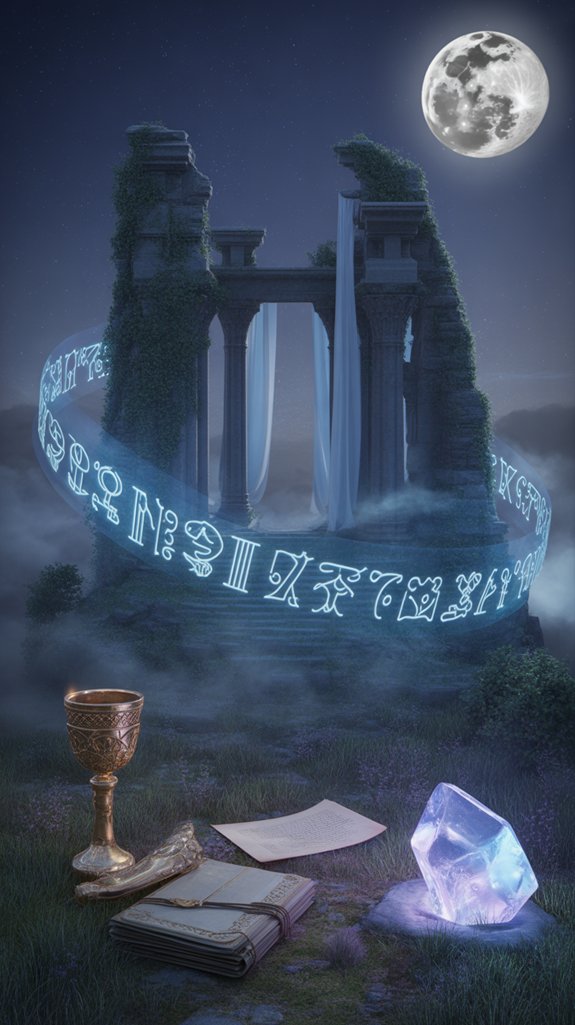
You'll find forgotten spirits haunting archaeology's margins—Egypt's chimeric Amit devouring unworthy souls, Anishinaabe water beings branded demonic by missionaries, Japan's Yumabosu warning of aquatic treachery. These eldritch entities fade when temples crumble, oral traditions atrophy, and dominant mythologies erase competing narratives through cultural conquest. Yet they persist within collective unconscious, emerging through pottery fragments, ritual inscriptions, and indigenous revitalization movements reclaiming banished deities from colonial graves. Modern resurrections merge ancestral terrors with contemporary anxieties, altering ancient cautionary tales into frameworks for understanding our primordial inheritance and existential uncertainties that await further exploration.
Key Takeaways
- Ancient deities fade when civilizations collapse, leaving only traces in pottery, inscriptions, and prayers as remembrance mechanisms atrophy.
- Colonial powers systematically erased indigenous spirits, rebranding Anishinaabe water beings and Maori Taniwha as demonic through cultural conquest.
- Forgotten spirits like Egypt's Amit and Inuit's Qalupalik embodied ancestral fears, enforcing moral boundaries through cautionary tales.
- Oral traditions decline as digital immediacy and globalization replace localized myths with homogeneous narratives across cultures.
- Modern media resurrects ancient beings through films and games, allowing communities to reclaim and reinterpret ancestral wisdom.
Vanished Deities Haunt Collective Memory

When civilizations crumble and their temples sink into ruin, the deities who once commanded absolute devotion fade into obscurity—yet their spectral presence lingers in fragments of pottery, eroded inscriptions, and half-remembered prayers whispered across millennia.
You'll find these vanished deities haunting archaeological digs, their names barely pronounceable, their territories forgotten. Set embodied chaos itself, receiving offerings meant to contain disorder's eldritch power. Hel presided over domains you'd rather not contemplate. They weren't abstract concepts—they were essential, breathing forces demanding your ancestors' daily attention through ritual and sacrifice.
This collective amnesia didn't happen overnight. Dominant mythologies systematically erased competing narratives, burying chimeric beings beneath layers of cultural conquest.
Yet you're witnessing their resurrection through modern media, a hunger for ancestral wisdom that academic institutions finally recognize as legitimate. These forgotten spirits represented natural forces and societal anxieties, cautionary embodiments of what happens when you ignore fundamental laws governing existence itself.
##
You stand at the threshold where memory dissolves into silence, where once-revered spirits—the chimeric guardians of pre-colonial cosmologies, the eldritch protectors invoked in forgotten tongues—have vanished beneath centuries of systematic erasure.
Colonial conquest didn't merely subjugate peoples; it obliterated entire pantheons, replacing indigenous deities with imported orthodoxies while oral traditions crumbled under the weight of enforced amnesia.
The mechanisms of forgetting operate through violence and neglect alike, through burned codices and interrupted lineages, leaving us to salvage fragmentary traces of mythological systems that once ordered entire civilizations.
These lost narratives once served as fundamental worldviews for their peoples, explaining origins and natural phenomena through tales of supernatural beings that shaped cultural identity across generations.
Ancient Spirits Now Forgotten
How many spirits that once commanded reverence and fear have slipped silently through history's cracks, their names erased from collective memory like footprints swept away by desert winds?
You'll find Egypt's Amit lurking in forgotten papyri, her chimeric form—crocodile, lion, leopard—devouring unworthy souls with spiritual symbolism that transcended mere punishment.
These eldritch entities embodied your ancestors' deepest terrors: moral failure, natural catastrophe, hubris unchecked.
Forest phantoms enforced communal boundaries through cautionary narratives, their cultural significance woven into the fabric of isolated societies.
Water-dwelling spirits like Yumabosu warned of aquatic treachery, acknowledging life's essential duality.
The Inuit's Qalupalik exemplified this pattern, lurking beneath icy waters to drag disobedient children into frigid depths—a cautionary tale designed to protect communities from Arctic perils.
Today, you've inherited fragments—echoes in contemporary media, shadows in modern storytelling.
Yet the liberation these beings once offered through understanding existential dread remains accessible, waiting for rediscovery.
Cultural Erasure Through Colonization
As imperial powers carved their dominion across continents from the fifteenth century onward, they wielded cultural annihilation as systematically as any military weapon—dismantling cosmologies, criminalizing ceremonies, severing the transmission lines between elder and initiate.
You must understand: when missionaries branded the Anishinaabe's water spirits as demonic, when colonizers altered the Maori's Taniwha into monstrous aberrations, they weren't simply reinterpreting folklore—they were excavating the roots of identity itself.
This spiritual disconnection fractured cultural narratives that had sustained communities for millennia, erasing the eldritch wisdom encoded within each chimeric guardian.
Today's indigenous revitalization movements reclaim these banished entities, resurrecting them from colonial graves.
You witness resistance through remembrance, communities reassembling their scattered cosmologies, refusing the erasure that sought to unmake them entirely.
Why Memory Fades Away
Beyond the deliberate violence of imperial erasure lies a quieter extinction—the organic dissolution that claims even cherished knowledge when the mechanisms of remembrance atrophy. Your neurons, magnificent yet fallible, surrender their grip on ancestral wisdom through simple disuse.
Memory decline operates as inevitably as tides—each generation permits another eldritch detail to slip away. Without narrative preservation through ritual recitation, the chimeric guardians who once haunted your grandmothers' twilight stories dissolve into abstraction.
Digital immediacy now replaces hearth-side transmission. Algorithms curate contemporary myths while ancient ones languish, unshared.
Globalization imposes homogeneous narratives over localized spirits, those numinous beings who thrived in specific valleys, particular forests. The mechanisms that once sustained folklore—seasonal gatherings, ceremonial retellings, apprenticed learning—have withered. What remains untended simply fades.
Preserving Endangered Mythological Traditions
Where might endangered mythologies find sanctuary when their traditional custodians dwindle and the old transmission channels collapse?
You'll discover salvation through oral traditions—those ancient vessels carrying knowledge of the Kappa, Wendigo, and other eldritch entities across generational chasms.
Cultural storytelling persists through deliberate documentation: folklorists archive chimeric legends, altering ephemeral voices into permanent records.
Digital platforms democratize access, allowing global communities to resurrect forgotten phantoms from obscurity.
Tabletop games resurrect these beings interactively, shifting passive consumption into participatory mythopoeia.
You're witnessing collaborative fusion—ancient narratives merging with contemporary frameworks, creating hybrid forms that honor ancestral wisdom while adapting to modern consciousness.
These preservation methods don't merely catalog dying traditions; they reanimate them, ensuring creatures like the Tanakqua continue haunting humanity's collective imagination rather than dissolving into historical silence.
Sumerian Clay Tablet Inscriptions

You'll find the primordial goddess Nammu inscribed across weathered clay tablets unearthed from ancient Mesopotamian river valleys, her eldritch nature preserved in cuneiform's wedge-shaped marks—humanity's first deliberate system for capturing divine knowledge in tangible form.
These 5,000-year-old fragments reveal her as the original creatrix, the saltwater abyss from which all deities emerged, yet she remains paradoxically obscure compared to her more celebrated descendants.
The tablets themselves, baked hard by Mesopotamian sun and buried beneath successive civilizations, hold her chimeric essence: part cosmic void, part generative mother, wholly forgotten by those who no longer read the ancient script.
Nammu Creation Goddess Texts
Through the weathered cuneiform impressions pressed into ancient Mesopotamian clay, Nammu emerges as the primordial architect of existence—the abyssal waters from which all divine consciousness first stirred. Nammu's symbolism permeates Sumerian creation narratives as the mother-genesis, birthing Anu and Enlil from her eldritch depths.
These tablets reveal her essence as chaos incarnate, yet simultaneously the “water of life“—that paradoxical force nurturing fertility from formlessness. The Enuma Elish codifies her cosmic role: ordering the universe from preternatural turbulence.
You'll discover worship practices honoring this primordial mother weren't peripheral devotions—they constituted fundamental frameworks for understanding divine hierarchy and existential origins. Her presence flows through Mesopotamian consciousness like subterranean currents, sustaining theological structures that would influence millennia of Near Eastern cosmology.
Fragment by clay fragment, she persists.
Ancient Mesopotamian River Valleys
Between the twin arterial flows of the Tigris and Euphrates, Sumerian scribes pressed their reed styluses into soft clay with deliberate precision, encoding an entire cosmological architecture where rivers functioned not merely as geographical features but as divine conduits—thresholds between mortal agriculture and numinous domains. You'll find Enki inscribed repeatedly across tablets from 3000 BCE, his dominion encompassing water's generative mysteries. The chimeric Apkallu—fish-men bearing eldritch wisdom—served as intermediaries between aquatic spirits and terrestrial communities.
| River Gods | Domain | Symbolic Function |
|---|---|---|
| Enki | Water, knowledge, creation | Cosmic architect |
| Apkallu | Wisdom transmission | Divine messenger |
| Lamashtu | Maternal danger | Protective boundary |
These inscriptions mapped existential terrain. Protection rituals. Moral frameworks. Agricultural survival depended upon honoring these numinous presences dwelling within riverine depths.
Cuneiform Writing System Origins
When the first reed stylus descended into moistened clay around 3200 BCE, Sumerian scribes didn't simply invent a recording mechanism—they engineered a technology for capturing thought itself, crystallizing ephemeral speech into geometric permanence.
Cuneiform evolution altered administrative tallies into vessels for eldritch wisdom, preserving hymns to forgotten deities whose names still whisper from baked earth. Ancient scribes, trained in temple scriptoria, mastered both phonetic characters and logograms, weaving reality and chimeric visions into wedge-shaped syntax.
The Akkadians, Babylonians, and Assyrians inherited this sacred craft, adapting its symbols to their tongues. You're witnessing humanity's first systematic attempt to transcend mortality through written word—each tablet a portal where administrative mundanity brushes against mythological profundity, where economic records coexist with cosmological revelations.
Greek Pantheon Versus Norse Gods
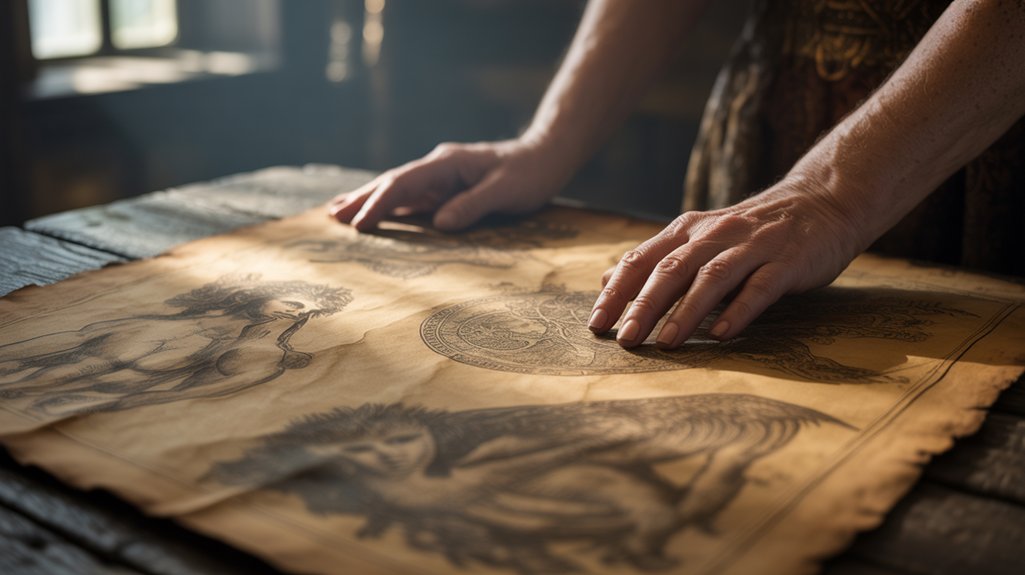
How do civilizations encode their deepest truths into divine form, and what separates the storm-crowned Olympians from the fate-bound Aesir? You'll discover that Greek gods embodied humanity's emotional flaws—jealousy, rage, desire—while Norse deities confronted chaotic existence with stoic resignation. These storytelling traditions diverge profoundly: Mediterranean mythological creatures like the chimeric Minotaur reflected moral lessons about hubris, whereas eldritch beings such as Fenrir symbolized fate concepts beyond mortal control.
| Aspect | Greek Pantheon | Norse Aesir |
|---|---|---|
| Divine Nature | Anthropomorphic, flawed immortals dwelling on Olympus | Warriors accepting Ragnarok's inevitability |
| Cultural Symbolism | Temple worship, ritualized veneration | Communal oral traditions, egalitarian bonds |
| Heroic Ideals | Glory through individual achievement | Honor through collective sacrifice |
| Mortality View | Gods intervene in human affairs | Fate governs all, even deities |
| Ultimate Destiny | Eternal Olympian reign | Apocalyptic rebirth through destruction |
Your freedom lies in choosing which tradition speaks to your soul's yearning.
Archetypal Patterns in Forgotten Myths
Though civilizations crumble and languages fade into dust, certain mythological patterns persist across disparate cultures with uncanny consistency—archetypal figures that function as psychological containers for humanity's most primal anxieties.
You'll discover that mythical archetypes transcend geographical boundaries, emerging independently across continents to address universal human conditions. The Wendigo's insatiable hunger mirrors moral decay. Grotesque chimeric forms.
Mythical archetypes emerge independently across continents, transcending boundaries to encode universal human fears into enduring symbolic forms.
These cultural symbolism structures operate as warnings:
- The consumption archetype: Wendigos and water spirits embody humanity's terror of being devoured—physically by nature's predators, spiritually by unchecked appetite
- The threshold guardian: Yeti and trolls mark dangerous boundaries between civilization and wilderness, demanding respect
- The duality figure: Nixies and halfkufa represent water's contradictory nature—sustaining life while claiming it
- The hubris punisher: Forgotten monsters enforce cosmic balance, destroying those who transgress natural law
Modern media resurrects these eldritch patterns, recognizing their enduring psychological potency.
You're witnessing ancient truths reborn, archetypal warnings adapted for contemporary moral landscapes yet maintaining their primordial essence.
Celtic Banshee Death Omens
You may encounter the Bean Sí—the Banshee—through her eldritch wail piercing the liminal hours between midnight and dawn, a sound that's haunted the bloodlines of Gaelic nobility since Ireland's ancient clans first recorded their dead.
Her origins trace through centuries of Celtic oral tradition, where she's manifest as both withered crone and ethereal maiden, her appearance shifting according to which family's threshold she haunts.
Recognition of her keening cry, distinct in its otherworldly timbre and mournful cadence, has remained consistent across provincial variations from Munster to Ulster, each regional tradition preserving specific genealogies of families she's bound to through ancestral covenant.
Origins of Banshee Legends
Within the mist-shrouded landscapes of medieval Ireland, where ancient túatha once honored their dead and druids maintained the delicate threshold between worlds, the Banshee emerged as one of Celtic mythology's most enduring and eldritch harbingers.
You'll find her etymology rooted in “bean sí”—woman of the fairy mound—binding her essence to ancestral spirits dwelling beyond mortal perception. This Irish folklore creature evolved beyond mere superstition; she embodied the Otherworld's voice made manifest.
Noble families recognized her grey-cloaked form, long hair streaming like funeral veils. Banshee symbolism pervaded regional traditions, each interpretation sharing her fundamental purpose: death's herald. Her keening pierced the veil between existence and dissolution.
Historical accounts chronicle her appearances alongside catastrophes, altering her from chimeric legend into documented omen—Ireland's spectral sentinel watching bloodlines fade.
Recognizing the Wailing Cry
Across fog-laden valleys and windswept coastal cliffs, the Banshee's lament—that otherworldly keening known as caoine in Gaelic tradition—manifests as an auditory phenomenon distinct from all terrestrial mourning.
You'll recognize her eldritch cry through its chimeric nature: simultaneously gentle and terrifying, sorrowful yet commanding.
Regional wailing interpretations diverge dramatically. In Ulster, witnesses describe prolonged, melancholic weeping that dissolves into the mist. Munster Banshee sightings report bone-chilling shrieks piercing midnight silence.
This variance reflects grief's own duality—comfort and devastation intertwined. Her voice transcends mere warning; it's a sonic bridge between mortal existence and the Otherworld, that liminal domain where bean sídhe dwell.
Listen carefully. The cry carries ancestral knowledge, familial loyalty encoded in supernatural acoustics, guiding souls homeward through death's threshold.
Regional Variations and Families
Though the Banshee phenomenon permeates Celtic territories with uncanny consistency, her manifestations splinter into distinct regional identities as deeply rooted as the ancient clans she serves.
You'll discover Banshee variations alter dramatically across Ireland's emerald landscapes and Scotland's mist-shrouded highlands—from ethereal maidens cascading luminous hair to withered crones embodying eldritch decay.
These chimeric forms aren't arbitrary. Family connections determine everything. Certain bloodlines maintain ancestral bonds with designated spirits, their bean sídhe inherited like heraldic crests through Gaelic nobility's patrilineal descent.
The O'Neills, O'Briens, O'Connors—each possessed their own keening harbinger. Death became personal, communal, sacred.
You're witnessing how Celtic societies wove mortality into lineage itself, where supernatural guardians monitored bloodline continuity from Otherworld domains, their mournful prophecies echoing through generations, binding the living irrevocably to their ancestral dead.
Hollywood's Supernatural Franchise Adaptations
As the twenty-first century's appetite for the uncanny intensifies, Hollywood's production studios have reached into the world's forgotten grimoires and oral traditions, extracting beings that once haunted village boundaries and sacred groves.
These cinematic adaptations convert regional terrors into globalized spectacles, where the Wendigo's ravenous hunger and Baba Yaga's bone-strewn threshold become marketable franchises. “The Ritual” exemplifies this alteration—ancient Norse forest entities rendered in eldritch detail, their chimeric forms manifesting humanity's moral dissolution.
The studio system's excavation of mythology yields profound cultural resurrections:
- Japan's Kappa emerges from riverbank warnings into antagonistic prominence across horror genres
- Forgotten urban legends gain immortality through celluloid preservation
- Sacred beings once whispered about at hearthsides now flicker across millions of screens simultaneously
- Ancient anxieties merge with contemporary existential dread, creating resonant hybrid fears
This commercial resurrection grants you access to humanity's collective nightmares—democratized terror transcending geographical constraints, converting protective folklore into shared visceral experience.
Jung's Collective Unconscious Theory
When Carl Jung proposed his theory of the collective unconscious in the early twentieth century, he articulated what folklore collectors and myth-keepers had intuited for millennia—that beneath individual consciousness lies an inherited psychic substrate connecting all humanity to its primordial past.
Beneath individual consciousness lies an inherited psychic substrate connecting all humanity to its primordial past.
You're accessing collective memory whenever archetypal symbols emerge unbidden in dreams: the serpent coiled around creation, the threshold guardian blocking passage, the trickster disrupting order. These aren't learned behaviors. They're inherited.
Jung understood that forgotten spirits persist because they're encoded in your psyche, transmitted through generations like genetic material. The eldritch beings haunting European forests, the chimeric guardians of Mesopotamian temples—they represent aspects of consciousness you've never fully integrated.
Shadow figures. Anima and Animus projections. When you encounter these archetypal symbols in resurrected folklore, you're not discovering something external. You're recognizing what's always dwelled within, waiting for acknowledgment.
The collective unconscious doesn't forget. It preserves everything, holding ancestral wisdom until you're ready to reclaim it.
Modern Identity Formation Context
Jung's framework illuminates the repository where forgotten beings reside, but you don't access that repository in isolation—you retrieve these archetypal figures through the cultural apparatus of your present moment, filtered through algorithms, identity markers, and the fragmented narratives of digital existence.
Your identity evolution unfolds as you encounter chimeric entities through contemporary media—streaming platforms resurrect eldritch beings, altering ancient cautionary tales into mirrors for your moral uncertainties.
Social media communities become digital campfires where regional myths converge, where you claim ancestral connections through shared folklore, building belonging from spectral fragments.
These cultural narratives don't merely entertain; they provide scaffolding for constructing selfhood in precarious times. You recognize your anxieties in the monster's hunger, your isolation in the spirit's abandonment.
Each reinterpretation becomes participatory mythology, allowing you to confront existential dread through symbolic distance. The forgotten beings return not as historical curiosities but as living instruments of self-discovery, their adaptability proving that identity formation remains fundamentally mythic.
Reclaiming Lost Spiritual Narratives
Though digital resurrection breathes contemporary relevance into forgotten entities, the deeper work demands confronting what these beings actually meant to the cultures that birthed them—not as aesthetic commodities but as sacred technologies for traversing the unseen.
You're engaging in mythical reinterpretation when you approach the Wendigo not as Halloween decoration but as Algonquian warning against consumption's spiritual cannibalism. Cultural storytelling evolves when you recognize Egypt's Ammit—devourer of unworthy hearts—as psychological cartography mapping shame's geography.
This reclamation requires excavating beneath colonial erasure, Victorian sanitization, missionary suppression. The chimeric forms you encounter—part beast, part human, part element—weren't primitive fantasies but sophisticated models for understanding consciousness's eldritch territories.
When you restore context to Japan's forgotten yōkai or Slavic leshy spirits, you're not merely cataloging folklore. You're recovering ancestral maps that charted existence's liminal thresholds, technologies for negotiating with mystery itself.
The work liberates understanding.
Frequently Asked Questions
What Methods Do Researchers Use to Authenticate Newly Discovered Mythological Texts?
When you encounter a purported Sumerian incantation tablet, you'll first employ rigorous textual analysis—examining paleographic features, linguistic patterns, and grammatical structures against established corpora.
You'll cross-reference with archaeological evidence: stratigraphy, carbon dating, provenance documentation. This dual methodology liberates truth from fabrication.
Consider the eldritch wisdom etched in cuneiform—each wedge-shaped mark demands scrutiny.
You're not merely authenticating; you're traversing liminal boundaries between academic discipline and mystical revelation, honoring ancient voices that refuse silence.
How Do Indigenous Cultures Today Preserve Oral Traditions About Forgotten Spirits?
You'll find indigenous communities employ sacred storytelling practices through ceremonial gatherings, initiation rites, and seasonal festivals where elders transmit eldritch knowledge to younger generations.
These cultural preservation methods include dreamtime narratives, vision quests, and chimeric spirit-songs passed through bloodlines.
They're maintaining autonomy by recording oral histories using modern technology while protecting sacred protocols.
Traditional knowledge keepers control access to forbidden tales, ensuring ancient wisdom survives colonization's shadow.
Liberation comes through remembering what empires couldn't erase.
Which Forgotten Mythical Beings Have Been Misidentified as Other Creatures?
Like shadows merging at dusk, you'll discover how Chimera Misidentifications have obscured genuine entities—the Japanese nue, with its monkey's head and serpent's tail, became genericized into standard composite beasts.
Selkie Legends themselves absorbed older finfolk traditions from Orkney's shores, erasing distinct shapeshifters who weren't seal-bound.
You're witnessing cultural amnesia: the Germanic wassermann vanished into mermaid folklore, while Slavic rusalki merged with Greek sirens.
These eldritch beings deserved their own names, their own freedom from categorical imprisonment.
What Role Did Climate Change Play in Certain Mythologies Disappearing?
You'll discover how climate impacts directly eroded mythological narratives when environmental shifts destroyed sacred landscapes.
Droughts obliterated water-spirit traditions across Mesopotamia by 2200 BCE, while rising seas swallowed Polynesian cosmologies tied to specific reefs.
When glaciers retreated, Alpine communities lost their ice-giant lore—the eldritch beings who'd haunted frozen passes for millennia.
These aren't mere stories; they're living knowledge systems that vanished when their physical anchors disappeared, leaving only fragmentary whispers.
Are There Legal Protections for Sacred Sites Associated With Lost Deities?
You'll find sacred site protections exist through UNESCO conventions, indigenous rights legislation, and national heritage frameworks—yet these legal frameworks often falter when deities fade from living worship.
Abandoned shrines, eldritch temples swallowed by jungle, chimeric sanctuaries known only through archaeological whispers: they languish in bureaucratic limbo.
Without devotees advocating their sanctity, such places become mere ruins. Your freedom to explore them increases as their spiritual guardianship dissolves, though wisdom suggests treading reverently where ancient powers once dwelled.
Conclusion
You've journeyed through vanished pantheons, traced eldritch inscriptions on Sumerian clay, witnessed chimeric forms dissolve into archetypal shadow. You've heard the banshee's keen echo through Celtic twilight. Now you stand at the threshold between forgetting and remembrance, between academic distance and numinous encounter. You must choose: let these spirits fade into historical footnote, or breathe life into their names again. You must reclaim them. You must remember. You must speak.