Mythical creatures function as cosmogonic architects in ancient narratives, converting primordial chaos into structured reality through violent metamorphosis. You'll find Mesopotamia's Tiamat dismembered by Marduk circa 1800 BCE, her corpse forming heaven and earth—a pattern echoed in Egypt's Apep, Norse Jörmungandr, and Judeo-Christian Leviathan. These serpentine entities occupy liminal spaces between disorder and cosmos, their defeat establishing divine sovereignty while their bodies become tangible geography. The archetypal pattern persists across five millennia, suggesting Jung's collective unconscious operates through shared psychic structures that continue resonating in contemporary climate symbolism and cinematic reinterpretations of humanity's perpetual negotiation with entropy.
Key Takeaways
- Serpents and dragons embody primordial chaos that must be defeated to establish cosmic order and structured reality.
- Marduk's dismemberment of Tiamat transforms chaotic forces into heaven and earth, exemplifying creation through destruction.
- Mythical beings serve as architects of reality, with divine creatures like Khnum and Enki crafting humanity and souls.
- Serpentine entities occupy liminal spaces, representing both destroyer and creator roles essential for cosmic balance and regeneration.
- Dragons function as guardians of civilization and cosmic harmony, illustrating the dual nature of chaos and order.
Chaos Serpents Birthed Cosmic Order
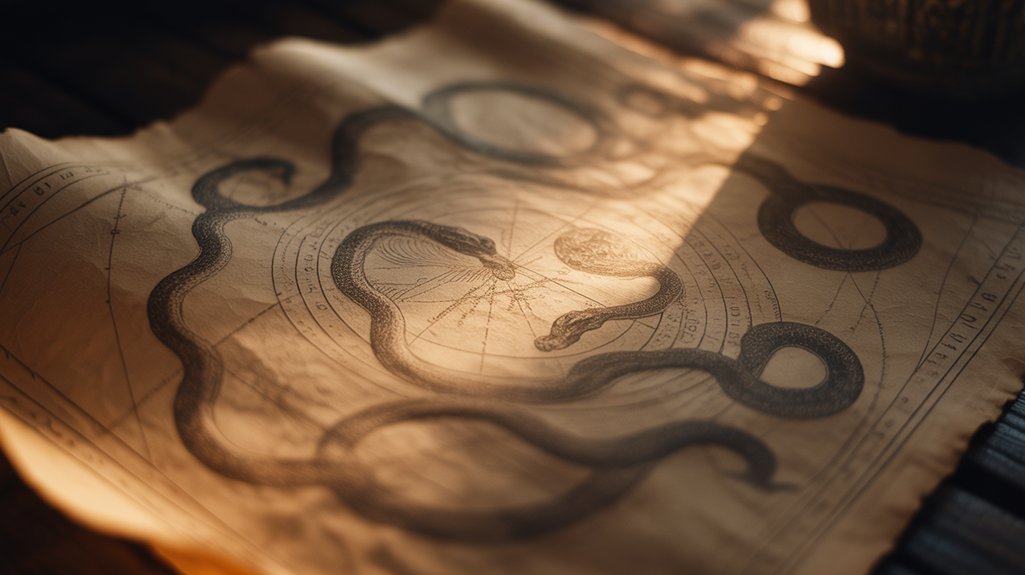
Before light pierced the void, before gods claimed dominion over ordered domains, the serpent coiled in waters that knew neither surface nor depth.
You'll find Tiamat's eldritch form embodied this primordial conflict—chaos disruption made manifest in scales and fang. The Babylonian Enuma Elish, composed circa 1200 BCE, chronicles how Marduk confronted this chimeric entity, altering her corpse into structured reality. Her ribs became the vault of heaven. Her tears, rivers.
You're witnessing humanity's oldest recognition: order demands violence against disorder. These serpentine figures weren't mere monsters but necessary adversaries, their defeat catalyzing cosmic architecture. Marduk's triumph established celestial hierarchies, terrestrial boundaries, humanity itself—servants who'd maintain divine order, sparing gods from labor.
The pattern repeats across cultures. Each chaos serpent's destruction births your world anew. Their coils contained potential; their death, purpose.
These stories of creation reveal mythology's fundamental purpose: explaining how existence emerged from the void, translating the incomprehensible into narratives that anchor cultural identity. You're inheriting cosmos forged from serpentine dissolution, where freedom exists only because primordial chaos accepted its chains.
##
You stand at the threshold where serpentine forms coil through humanity's oldest cosmogonies, their scaled bodies bridging the formless void and the ordered world.
These eldritch entities—dragons writhing through Mesopotamian clay tablets, ophidian deities undulating beneath Egyptian temple reliefs, chimeric beasts carved into Sumerian cylinder seals circa 3000 BCE—transcend mere symbolism to become the very sinew of creation itself.
Within their mythic flesh pulses the paradox: they're simultaneously the chaos that must be conquered and the primordial force without which no cosmos could emerge from the waters of potentiality.
In Norse cosmology, such creatures inhabited a world where nature and culture intertwined, perceived not as separate realms but as enchantingly unified expressions of the sacred.
Dragons in Cosmological Tales
When the first civilizations gazed upon the formless void, they didn't envision sterile emptiness—they conjured serpentine leviathans writhing through primordial waters, their scales glinting with the promise of worlds yet unborn.
You'll find dragon symbolism embedded in humanity's oldest cosmologies, where these eldritch beings served as chaos representation itself. Mesopotamia's Tiamat embodied this primordial turbulence, her chimeric form shattered by Marduk's blade, her corpse becoming sky and earth.
Yet dragons weren't merely antagonists. China's luminous serpents carved rivers from mountains, guardians of cosmic harmony.
Hindu tradition presents Vasuki coiling around Mandara, churning existence from the ocean's depths. These creatures occupied liminal thresholds—simultaneously architects and adversaries, their destruction paradoxically necessary for creation's unfolding.
Serpents and Primordial Waters
Yet alteration follows subjugation.
Fertility springs from vanquished serpents, cyclical regeneration emerging where tumult once reigned.
From Hindu Ananta to Aztec Quetzalcoatl, you witness this chimeric duality: creator-destroyers whose scales glisten with both genesis and annihilation, forever coiled around existence's axis.
Divine Beasts Shaping Earth
Beyond these serpentine guardians of cosmic waters lies another class of beings—creatures whose very bodies became the substance of existence.
You'll find Tiamat, that eldritch chaos-dragon of Babylonian lore, dismembered by Marduk's blade to forge heaven and earth from her primordial flesh. This is mythical origins incarnate: destruction birthing creation's order.
The Sumerians understood this duality, watching as Enki shaped humanity from clay to liberate divine laborers. Divine craftsmanship reaches its zenith in Egyptian Khnum, molding souls upon his celestial wheel.
These weren't mere monsters. They were architects of reality itself, their chimeric forms containing multitudes—chaos and cosmos, annihilation and genesis.
You're witnessing fundamental truth: the universe demands sacrifice, alteration, the breaking of ancient bodies to birth new worlds.
Creatures as Cosmic Forces
Though dragons coiled around Mesopotamian tablets and serpents writhed through Vedic hymns, these beings transcended mere bestial form—they were cosmic architecture given scales and sinew.
You'll find Tiamat, that primordial Babylonian terror, embodying chaos itself before her dismemberment birthed ordered reality. This mythological symbolism reveals creation's violent necessity: destruction precedes formation.
Eastern dragons maintained cosmic balance differently, serving as eldritch guardians regulating water's flow, their serpentine bodies channeling rain to parched earth. They weren't monsters but living equations maintaining fertility's delicate calculus.
The chimeric Minotaur operated similarly, representing primal forces civilization must confront, overcome, change. These creatures weren't metaphors—they *were* the forces themselves, inhabiting that liminal space where abstract power requires tangible form, where cosmic principles demand teeth, wings, terrible beauty.
Mesopotamian Tablets Document Serpent Deities

You'll find the serpent's eldritch presence carved into cuneiform tablets from 1750 BCE, where the Sumerian Enuma Elish records Tiamat's chimeric form emerging from the primordial waters of the Tigris-Euphrates confluence.
These ancient Babylonian scribes, working in temple scriptoria along fertile riverbanks, preserved not mere mythology but sacred cosmology—the serpent deity's scales glistening with both creative potential and annihilating force.
Within temple precincts, priesthoods performed elaborate rituals that honored these ophidian powers, their incantations echoing through ziggurat chambers where serpent imagery adorned every ceremonial vessel.
Sumerian Enuma Elish Tablets
When ancient scribes pressed wedge-shaped styli into clay tablets around 1100 BCE, they weren't merely recording stories—they were preserving the cosmological architecture of Mesopotamian consciousness, and at its foundation writhed Tiamat, the primordial serpent goddess of salt waters.
You'll discover Tiamat's significance extends beyond mere antagonism—she births the first divine generation before becoming chaos incarnate. Her chimeric form embodied both fertility and annihilation, the eldritch duality you'd recognize in nature itself.
Marduk's triumph wasn't simple conquest; he cleaved her serpentine body, fashioning heaven from one half, earth from the other. Order crystallized from pandemonium.
These cuneiform tablets reveal how your ancestors understood creation: not as peaceful genesis, but violent alteration—serpent blood watering the cosmos.
Ancient Babylonian River Valleys
Between the Tigris and Euphrates, where silt-rich waters carved civilization from desert, the serpent coiled through sacred consciousness with an omnipresence modern minds struggle to comprehend. You'll discover Tiamat's eldritch form dominating ancient waterways, her chimeric essence representing both chaos and fertility. The serpent symbolism permeated every aspect of Mesopotamian cosmology—terrifying, necessary, primordial.
| Serpent Aspect | Cosmic Function |
|---|---|
| Tiamat (Saltwater) | Primordial chaos requiring conquest |
| Apsu (Freshwater) | Life-giving source before order |
| River Dragons | Guardians of civilization's lifeblood |
| Marduk's Triumph | Alteration of chaos into structure |
These weren't mere metaphors for freedom-seeking peoples traversing existence. They were recognition that creation demands destruction, that order emerges from conquered wilderness, that your ancestors understood cosmic balance through serpentine imagery winding through clay tablets and temple walls.
Temple Rituals and Priesthood Roles
Through temple doorways where incense smoke curled like living scripture, Mesopotamian priests enacted elaborate ceremonies that channeled serpent deities' transmutative power into agricultural abundance and cosmic stability.
You'd witness these intermediaries performing their priestly duties with unwavering precision, invoking Tiamat's eldritch descendants through offerings and sacred utterances. The ritual significance transcended mere supplication—each gesture acknowledged serpent deities' chimeric nature, honoring both their destructive chaos and creative potential.
Cedar smoke mingled with whispered prayers as priests maintained the precarious balance between cosmic forces. These weren't hollow performances but essential acts of preservation, ensuring fertility flowed through Mesopotamian fields while keeping primordial disorder at bay.
Serpent motifs adorned temple walls, eternal witnesses to humanity's covenant with these ancient, scaled arbiters of existence.
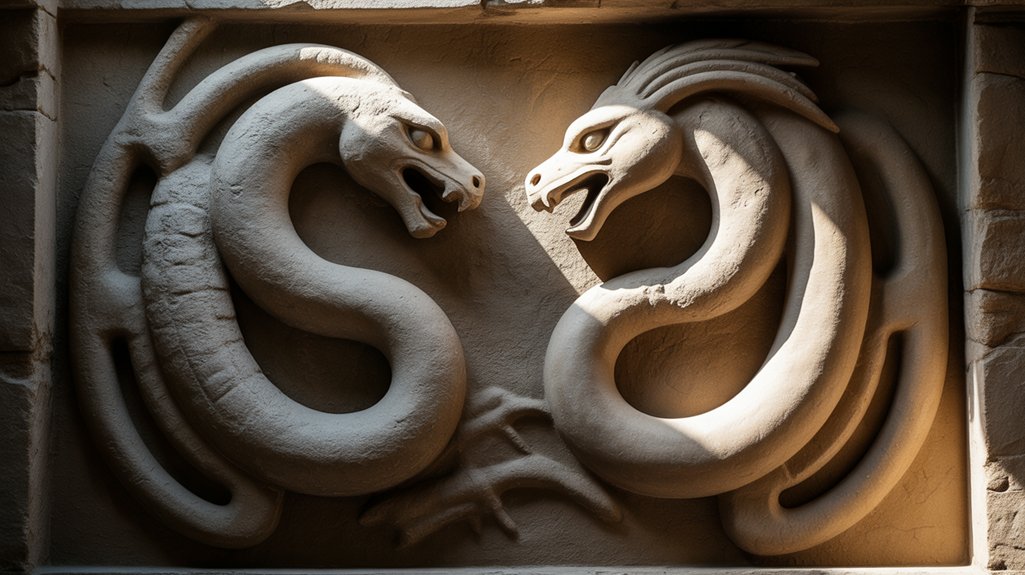
Egyptian Apep Versus Greek Typhon
| Attribute | Apep (Egyptian) | Typhon (Greek) |
|---|---|---|
| Physical Form | Colossal serpent | Hundred-headed giant with serpentine features |
| Cosmic Role | Daily antagonist, never permanently destroyed | One-time challenger, imprisoned under Etna |
| Symbolic Function | Perpetual chaos requiring constant vigilance | Defeated chaos establishing divine supremacy |
| Cultural Impact | Ritualized daily through temple practices | Explained natural disasters, particularly volcanic activity |
Both entities demanded divine intervention to preserve cosmic order.
Serpents Representing Primordial Chaos
Across civilizations separated by vast distances and millennia, the serpent emerged as humanity's chosen vessel for conceptualizing the formless, writhing void that preceded creation—that eldritch state where matter, energy, and time existed in undifferentiated flux.
You'll discover serpent symbolism threading through Babylonian Enuma Elish, where Tiamat's chimeric form embodied cosmic disorder before Marduk's triumph established celestial order.
These ancient narratives reveal serpents as paradoxical entities, simultaneously threatening and necessary:
- Tiamat (Babylonian, circa 1800 BCE): Primordial saltwater goddess whose serpentine body contained creation's raw materials
- Genesis serpent (Hebrew tradition): Agent of chaos alteration through temptation and forbidden knowledge
- Ancient Near Eastern dragons: Divine adversaries representing untamed nature's resistance to cosmic structure
You're witnessing more than simple monster tales. These coiling figures embody regeneration through destruction, the eternal cycle where chaos births order, only for entropy to reclaim dominion.
The serpent's cyclical shedding of skin mirrors creation's perpetual renewal.
Jörmungandr and Leviathan Narratives
You stand before two eldritch manifestations of primordial chaos—Jörmungandr, the world-encircling orm of Norse cosmology, and Leviathan, the untamable leviathan of Hebraic scripture—whose serpentine forms emerged from disparate theological landscapes yet speak a universal language of cosmic disorder.
These chimeric entities, born from the liminal waters preceding creation itself, embody humanity's ancient recognition that order must eternally struggle against the churning abyss.
Their narratives, preserved through Eddic poetry (13th century CE) and the Book of Job (circa 6th-4th century BCE), reveal how distinct civilizations conceived nearly identical symbols to express the terrifying power of nature's ungovernable forces.
Serpents of Cosmic Chaos
When ancient peoples gazed upon the churning depths of primordial oceans, they perceived not mere water but an eldritch force—chaos incarnate, serpentine and vast beyond mortal comprehension.
You'll find this serpent symbolism threading through disparate cultures: Jörmungandr, who encircles Midgard with poisonous intent, destined to battle Thor when the cosmos tears itself apart at Ragnarök.
The Leviathan, writhing through Judeo-Christian texts as chaos representation itself, challenges divine sovereignty over creation's waters.
These aren't merely monsters—they're philosophical frameworks. Unpredictable. Necessary.
Through their coiling forms, you witness humanity wrestling with fundamental questions: Can order emerge from disorder? Must destruction precede renewal?
The serpents offer no comfort, only cosmic truth—that chaos remains woven into existence's fabric, demanding perpetual vigilance, perpetual balance.
Symbolic Meanings and Origins
These serpentine embodiments of primordial terror demand closer examination—not as mere narrative devices but as cosmological architecture.
You'll find Jörmungandr encircling Midgard represents cyclical inevitability, the ouroboros principle manifesting through Norse cosmology. Leviathan emerges from Jewish tradition as chaos incarnate, the eldritch force Yahweh subdues to establish cosmic order.
Both creatures function as threshold guardians in creation narratives, marking boundaries where formlessness yields to structure.
The mythical symbolism here transcends simple monster tales. You're witnessing ancient peoples wrestling with fundamental questions: How does order emerge from chaos? What keeps entropy at bay?
These chimeric serpents embody nature's untamed fury, reminding you that creation requires continuous struggle against dissolution. They're metaphysical anchors, holding reality's fabric taut against the void's pull.
Respect them.
Cultural Impact Across Civilizations
Through the centuries, Jörmungandr and Leviathan have carved themselves into humanity's collective psyche with such ferocity that their echoes reverberate through medieval manuscripts, Renaissance paintings, and modern cinema alike.
You'll find their mythical symbolism embedded within illuminated texts, where scribes wrestled with eldritch chaos made manifest. These serpentine titans transcended their original narratives, becoming universal emblems of humanity's perpetual struggle against cosmic disorder.
Cultural interpretations shifted across civilizations—Norse skalds witnessed apocalyptic inevitability in Jörmungandr's coils, while Hebrew prophets saw divine sovereignty in Leviathan's subjugation.
Sacred. Terrifying. The chimeric forms influenced medieval bestiaries, shaped theological discourse, inspired Milton's Paradise Lost.
You inherit their legacy whenever you confront existence's fundamental tension: the battle between structure and entropy, between your desire for freedom and the constraints that define reality itself.
Contemporary Media Reimagines Chaos Serpents
As ancient myths cascade into the digital age, chaos serpents shed their primordial skins to emerge as multifaceted antagonists across contemporary media landscapes—creatures that retain their eldritch essence while acquiring new symbolic dimensions. Tiamat's descendants now writhe through fantasy narratives, their chaos symbolism evolving from cosmic adversaries into mirrors reflecting humanity's fractured psyche.
Modern adaptations reshape these chimeric beings into vessels for exploring moral complexity:
- Game of Thrones weaves serpentine motifs through its exploration of power's corrupting influence.
- Final Fantasy deploys chaos serpent archetypes as interactive trials, challenging players to confront primordial forces.
- Contemporary films resurrect these ancient antagonists as psychological manifestations of inner turmoil.
This narrative evolution demonstrates remarkable continuity—the struggle between cosmos and chaos persists, though battlegrounds shift from Mesopotamian clay tablets to pixel-rendered worlds.
You witness ancient wisdom reborn, these serpents binding mythological heritage to digital storytelling, their symbolic potency undiminished across millennia, bridging archaic cosmologies with modern existential confrontations.
Jung's Collective Unconscious Theory
When Carl Gustav Jung first articulated his theory of the collective unconscious in the early twentieth century, he revealed a psychological architecture that explained why Tiamat's serpentine coils appear not only in Mesopotamian texts but in dragon myths from medieval Europe to pre-Columbian Mesoamerica—a shared psychic substrate beneath individual consciousness.
You're witnessing archetypal imagery manifest across civilizations that never contacted each other. These chimeric forms—serpents, phoenixes, eldritch hybrids—aren't mere fantasy. They're psychological exploration made tangible, erupting from depths where your individual mind dissolves into humanity's primordial memory.
Jung identified the Shadow lurking in these monstrous forms, the Hero confronting them. Each encounter with such creatures becomes initiation.
When you engage these myths, you're not studying dead religions. You're accessing change itself. These archetypes transcend cultural boundaries precisely because they emerge from psychic structures you share with ancient priests and contemporary seekers alike.
The creatures don't symbolize fear—they *are* fear crystallized, desire embodied, evolution given scales and wings.
Climate Change Symbolism Emerges
The serpent Apep writhing through Egyptian cosmology carries in its venomous coils not merely chaos abstracted but drought incarnate, famine given fangs—and you'll find this pattern replicated with uncanny precision across continents where rising waters and scorched earth demanded theological explanation.
Ancient serpents coiled not around superstition but survival—drought and deluge compressed into scales, venom translating the climate catastrophes our ancestors couldn't otherwise name.
These climate myths emerge as humanity's earliest environmental symbolism, encoding meteorological catastrophe into eldritch narratives you can trace from Mesopotamian Tiamat to Mesoamerican Cipactli.
When Marduk splits the primordial ocean-goddess, when Thor battles the World Serpent circling Midgard's shores, you're witnessing ancient communities grappling with ecological volatility through chimeric metaphor.
The appeasement rituals, the cyclical defeats—these weren't superstitious performances but adaptive frameworks for societies maneuvering unpredictable climates.
You possess this inheritance now. Modern reinterpretations reclaim these symbols as prophecy rather than prehistory, mythical creatures altered into warnings your ancestors encoded across millennia, their environmental symbolism speaking directly to your century's unraveling atmospheric stability.
Serpents' Enduring Cultural Legacy
Serpent iconography slithers through five thousand years of human consciousness with hypnotic persistence, its forked tongue tasting theological boundaries you've inherited without recognition. From Tiamat's eldritch coils in Babylonian cosmogony to Quetzalcoatl's chimeric fusion of feather and scale, serpent symbolism embodies cultural duality—simultaneously destroyer and progenitor, tempter and guardian.
You'll find this paradox woven through Genesis, where Eden's serpent offers forbidden gnosis, through Apollo's victory over Python at Delphi, establishing Hellenic cosmic order from ophidian chaos. African traditions preserve serpents as sacred sentinels, protecting mysteries you've forgotten how to seek.
This archetypal persistence reveals something profound about your ancestral psyche. The serpent refuses singular definition, coiling instead through liminal spaces between knowledge and destruction, creation and entropy.
Its presence in disparate mythologies—Mesoamerican, Mediterranean, Mesopotamian—suggests universal recognition of change's necessity. Shedding skin. Rebirth through dissolution. You're still living within these ancient metaphors, whether you acknowledge their scaled sovereignty or not.
Frequently Asked Questions
How Do Bird Deities Compare to Serpents in Creation Mythology?
You'll find bird symbolism embodies transcendent liberation—soaring between celestial and terrestrial domains, bearing solar power and divine wisdom.
Serpent attributes, conversely, manifest primordial chaos and regeneration through their chthonic nature, earth-bound yet eternally renewing.
Birds create through ascension, their wings fragmenting darkness; serpents through alteration, coiling round cosmic eggs.
Both serve as liminal architects, yet where avian deities illuminate conscious awakening, ophidian forces embrace shadow-knowledge, the eldritch mysteries dwelling beneath civilized order.
What Role Did Dragons Play in Asian Creation Stories?
You'll discover dragons weaving the cosmos itself—celestial serpents whose breath became rain, whose scales formed mountains.
In Chinese mythology, Pangu's primordial companion dragons shaped the world's rivers; their dragon symbolism embodied cosmic balance, yang energy released.
The creation significance runs deeper: these eldritch beings weren't mere creatures but demiurges themselves, separating heaven from earth, commanding elements with chimeric power.
They're your ancient architects. Liberation incarnate, breaking chaos into ordered domains through sovereign will.
Are There Benevolent Serpent Creators in Any Ancient Mythologies?
You'll discover benevolent serpents as creator deities across numerous traditions.
In ancient Egyptian cosmology, the primordial serpent Nehebkau brought life from chaos waters.
The Aztec Quetzalcoatl, feathered and eldritch, fashioned humanity itself.
Australian Aboriginal Dreamtime reveres the Rainbow Serpent—a numinous force shaping landscapes, watercourses, and peoples.
West African Vodun honors Dan, the serpentine creator deity embodying cosmic wisdom.
These chimeric beings weren't feared—they represented change, fertility, divine knowledge.
Freedom from Western dragon-as-villain narratives reveals serpents' sacred creative power.
How Did Ancient Cultures Depict the Physical Appearance of Chaos Serpents?
You'll find ancient depictions of chaos serpents rendered as truly eldritch entities—think cosmic downloads of primordial terror.
Mesopotamian Tiamat bore scales gleaming with saltwater luminescence, her chimeric form sprouting horns, wings, and venomous fangs.
Egyptian Apophis stretched endlessly through subterranean darkness, a writhing void-mass defying measurement.
Norse Jörmungandr encircled Midgard itself, embodying the ouroboric boundary between order and dissolution.
These weren't mere snakes—they were living cosmological forces, their physicality expressing humanity's deepest anxieties about existence unraveling.
What Other Primordial Creatures Besides Serpents Appear in Creation Myths?
You'll encounter cosmic eggs across Indo-European traditions, primordial vessels birthing entire universes—the Orphic traditions of 6th century BCE Greece preserved these mysteries.
Giant turtles bear creation's weight in Iroquois and Hindu cosmologies, their shells becoming foundation.
The eldritch *Purusha* of Vedic texts, dismembered to forge reality itself.
Chinese *Pangu*, emerging from chaos.
These chimeric beings transcend serpentine forms, yet share that ancient power—entities of threshold, alteration, absolute beginning.
Freedom dwells in their boundless possibility.
Conclusion
You've traversed primordial depths where chaos serpents writhe through humanity's oldest narratives, their eldritch forms coiling through Mesopotamian clay, Egyptian papyri, Norse sagas. These chimeric guardians persist—not as relics, but as living symbols threading through your collective unconscious, evolving within contemporary ecological anxieties. Stand witness: the serpent endures, altered yet eternal, its scales catching firelight in Jung's psychological labyrinths, its vast body encircling your modern mythmaking. The ancient pattern repeats, unbroken, luminous.