Auto-generated transcript. Minor errors may exist. The audio is the authoritative version.
This is The Old Fires.
Imagine standing at the edge of your world as water rises. You're on high ground — the highest you could find — clutching your children as black water swallows the temple where you were married, the market where you bought grain this morning, the cemetery where your grandparents rest. The smell of wet earth mixes with something else. Fear. Loss. The weight of watching everything you know disappear beneath a surface that reflects nothing but sky.
If this happened to you, wouldn't you tell your children? And their children?
Every culture on Earth has a story like this. The flood myth is the most universal narrative we know. Sumerian tablets. Hebrew scripture. Hindu puranas. Aboriginal songlines. Mesoamerican codices. Norse eddas. All of them remember water rising. All of them remember one family, one boat, one warning from the divine.
Tonight, we're asking the question that has haunted folklorists for over a century: is that a coincidence — or a message written in our collective blood?
The Pattern That Won't Break
I was twenty-three, sitting in Professor Chen's comparative mythology class, when I first felt the ground shift beneath everything I thought I knew about stories. She had filled the whiteboard with flood myths — dates, locations, details. Mesopotamia, 2100 BCE. The Indus Valley, transmitted orally for millennia before being written down. The Andes, carved in stone. Australia, sung in languages older than agriculture.
“Notice,” she said, tapping the board with her pen, “they're too similar to be coincidence. But too different to be copied.”
That sentence has followed me for fifteen years. Because the more you study flood myths, the more unsettling the pattern becomes. These aren't variations on a theme. They're the same song, hummed by voices that never heard each other across oceans and millennia.
Let me show you what I mean.
The oldest written flood story we have comes from ancient Mesopotamia. The Epic of Gilgamesh, carved in cuneiform around 1700 BCE, but recording traditions far older. In it, Utnapishtim tells Gilgamesh how the god Ea warned him of a coming deluge:
*”Demolish the house, build a boat. Abandon wealth, seek life. Spurn possessions, save living things. Bring aboard the seed of all living creatures.”*
Utnapishtim builds his boat. The flood comes. The text tells us: *”The waters roared like a bull; the wind wailed like mourning women. For six days and seven nights, the flood raged. On the seventh day, the tempest stilled.”*
He sends out birds to test the waters. First a dove, then a swallow, then a raven. When the raven doesn't return, he knows it has found dry land. Sound familiar?
Now travel west to the Hebrew tradition. Genesis, chapter seven. Noah receives his warning from Yahweh: build an ark, gather animals two by two, save your family. The flood comes. *”The waters prevailed exceedingly upon the earth; and all the high hills, that were under the whole heaven, were covered.”* Forty days and forty nights. Noah sends out a raven, then a dove. The dove returns with an olive branch. The waters recede.
The parallels are so exact that biblical scholars have long acknowledged that Genesis draws directly from Mesopotamian sources. The Hebrews knew these stories. They inherited them, transformed them, made them their own. That's cultural transmission. We can trace it.
But here's where it gets strange.
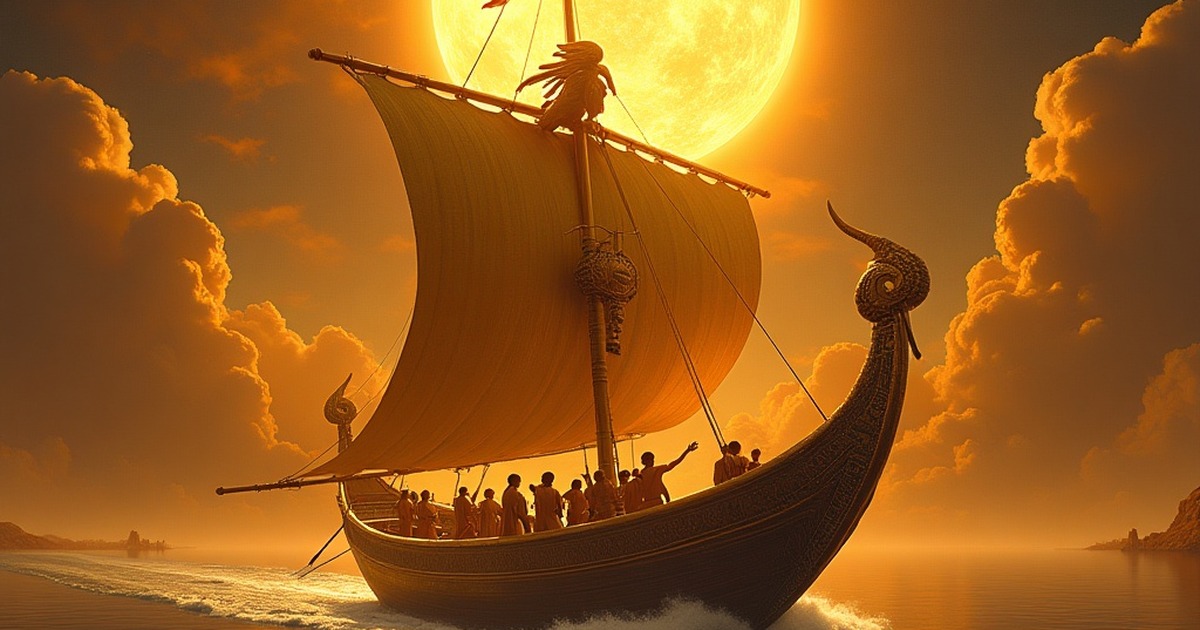
Travel east to the Hindu tradition. In the Matsya Purana, composed over a thousand years later but preserving much older oral traditions, we meet Manu. The god Vishnu appears to him in the form of a fish and warns: *”In seven days, the ocean will rise and destroy all life. Build a boat.”* Manu builds his vessel. He loads it with seeds, plants, animals. The deluge comes. Vishnu, still in fish form, tows the boat to safety on the peak of Mount Himavan.
Notice what's happening. The core elements remain the same — divine warning, righteous man, boat, animals, survival — but the cultural DNA has completely changed. The Hindu flood isn't punishment for sin, as it becomes in Hebrew tradition. It's cosmic rhythm. Natural cycle. The universe breathing in and out across vast spans of time.
Now cross the Pacific. In the Popol Vuh, the sacred book of the Maya, we read of the gods' attempts to create human beings. The first attempt fails. The second creates wooden people, but they lack souls, so the gods send a flood to destroy them. *”A great flood was made; it came down on the heads of the wooden creatures.”* Only a few survive by transforming into monkeys. The third attempt finally succeeds.
Here, the flood isn't about saving one righteous family. It's about cosmic trial and error. Divine experimentation. The gods learning how to make beings worthy of existence.
Different theology. Same water.
[BED: SWELL]
But we're just getting started. Because when you expand the map, the pattern doesn't break. It multiplies.
The Aboriginals of Australia tell of Tiddalick, the great frog who drank all the water in the world, then released it in a catastrophic flood that reshaped the continent. These stories are encoded in songlines — oral maps that indigenous Australians have used to navigate their landscape for over forty thousand years.
The Chumash people of coastal California speak of a great deluge that covered the earth, leaving only the peaks of the highest mountains visible above the waves. The Māori of New Zealand tell of Tawhiri-matea, god of wind and storm, whose rage flooded the world until only a few humans remained on high places.
The Inuit have flood stories. The Inca. The Cherokee. The Yoruba of West Africa. The Sami of northern Scandinavia. The list goes on and on, until you realize you're looking at something that defies explanation by cultural contact alone.
These peoples were separated by vast oceans, by thousands of years, by languages and cosmologies that share no common root. Yet they all remembered the same catastrophe. They all preserved the same hope: that when the waters rise, some will survive to tell the story.
When Coincidence Breaks
Last winter, I was in northern Scotland, staying in a cottage near Loch Katrine. It had been raining for three days straight — not the gentle Scottish mist you expect, but hard, driving rain that drummed on the roof like impatient fingers. On the third night, I woke to the sound of rushing water.
The stream that ran beside the cottage had overflowed its banks. In the darkness, I could see it spreading across the meadow, claiming ground that had been dry for decades. And I felt something I hadn't expected. Not just concern for the cottage, or inconvenience about being stranded. I felt… recognition. As if my body remembered this danger from somewhere deeper than personal experience.
That's when I understood something about flood myths that all the scholarly analysis had missed. They're not just stories about water. They're stories about the moment when the familiar world reveals itself to be fragile. When the ground beneath your feet — literal and metaphorical — turns out to be temporary.
And that feeling, that recognition, is universal. Because water is the medium of life, but also the agent of dissolution. It nourishes and destroys with equal indifference. Every human being who has ever lived has understood this paradox in their bones.
Which brings us to the second theory for why flood myths appear everywhere: they're not historical memory. They're psychological architecture.
Carl Jung, the Swiss psychologist, proposed that certain images and stories exist in what he called the collective unconscious — patterns of meaning that emerge from the structure of human consciousness itself. He called these patterns archetypes: the Mother, the Hero, the Shadow, the Wise Old Man. And among these, he identified the Flood.
In Jungian terms, the flood represents the return to the primordial waters of the unconscious — the dissolution of individual ego into the vast, undifferentiated source from which all consciousness emerges. It's the psychological equivalent of death and rebirth. The old self drowns; the new self emerges, purified and transformed.
This would explain why every culture frames its flood story as a moral reckoning. The waters don't rise accidentally. They rise because something is wrong with the world, because the old order has become corrupt, stagnant, unworthy of continuation. The flood washes clean. It creates the possibility of beginning again.
Think about how we use flood metaphors in everyday speech. We talk about being “overwhelmed” by emotion — literally, whelmed over, swamped, drowned in feeling. We speak of “watershed” moments, of being “in over our heads,” of emotions “washing over” us. The language reveals the archetype at work.
Joseph Campbell, the great student of comparative mythology, put it this way: *”The flood is the return to chaos before the creation of a new order. It is the night sea journey of the hero, but experienced by an entire culture.”*
This psychological reading explains something that historical theories can't: why different cultures emphasize different aspects of the flood, even while preserving the same basic structure.
In Mesopotamian tradition, the flood is divine caprice. The gods are overwhelmed by human noise and decide to wipe the slate clean. It's a story born from a culture that lived at the mercy of unpredictable river systems, where prosperity and catastrophe were separated by a single season's rainfall.
In Hebrew tradition, the flood becomes moral judgment. Noah is chosen for his righteousness; the rest of humanity is destroyed for its wickedness. This reflects a culture's attempt to find meaning in suffering, to believe that catastrophe serves justice rather than chaos.
In Hindu tradition, the flood is cosmic necessity. The universe periodically dissolves and reforms across unimaginable spans of time. There's no moral weight to it, no judgment, just the endless cycle of creation and destruction. This reflects a culture's attempt to find peace with impermanence, to see individual catastrophe within a framework of eternal return.
Each culture takes the same archetypal pattern and shapes it according to its deepest needs and fears. The flood becomes a mirror, reflecting what each people most needs to understand about survival, morality, and meaning.
[BED: DUCK]
But archetypes alone don't explain the specificity of detail. Why is it always one family? Why always a boat? Why always animals saved two by two? Why always a bird sent out to test the waters?
For that, we need a third theory. One that's both simpler and stranger than the others.
The Memory in Water
Here's what we know about early human civilization: it grew up beside water. The Tigris and Euphrates. The Nile. The Indus. The Yellow River. The Amazon. Every great culture established itself in river valleys or coastal plains, because water meant life. It meant irrigation, transportation, trade, fish, fertile soil deposited by seasonal floods.
It also meant risk.
Rivers flood. Monsoons arrive early or late. Tsunamis strike without warning. Ice sheets melt and raise sea levels. Volcanic eruptions trigger massive waves. Climate shifts alter precipitation patterns across entire continents.
For a species that clustered beside water for survival, catastrophic flooding wasn't a mythological possibility. It was a historical inevitability.
In 1993, marine geologists William Ryan and Walter Pitman proposed what became known as the Black Sea Deluge Theory. Around 5600 BCE, they argued, rising Mediterranean waters broke through the Bosporus strait and poured into the Black Sea basin with a force two hundred times greater than Niagara Falls. In a matter of months, the sea level rose over four hundred feet, drowning vast areas of coastland where early farming communities had flourished.
The survivors of this catastrophe would have fled in all directions — north into Europe, south into Anatolia, east toward the Caucasus. They would have carried with them the memory of the great drowning, the story of the day the sea rose and swallowed their world.
This is speculative, of course. But it points toward something more concrete: early humans experienced regional flood catastrophes, and they preserved these memories in the most durable form available to them — story.
Aboriginal Australians have maintained oral traditions for over forty thousand years. Among these are stories of the sea level rises that occurred at the end of the last ice age, when melting glaciers raised ocean levels by over three hundred feet. Coastal areas that had been dry land for millennia disappeared beneath the waves. The songlines remember this. They encode it in navigational chants that double as historical record.
In the Sahara, ancient rock art depicts a time when the desert was green, when rivers flowed and lakes supported fishing communities. Around 5000 BCE, the climate shifted. The rains stopped. The rivers dried. The lakes turned to salt flats. The people who lived through this transformation told stories of water — its presence, its absence, its terrible power to give and take away entire ways of life.
But here's what fascinates me: even if we accept that flood myths preserve historical memory, we still haven't explained their moral dimension. Physical catastrophes don't come with built-in lessons about righteousness, divine justice, or cosmic renewal. Those meanings are added by the cultures that survive the catastrophes.
Which suggests that flood myths work on multiple levels simultaneously. They're historical memory encoded as psychological archetype, wrapped in moral instruction, preserved through narrative art.
They're the stories we tell when we need to understand three fundamental truths about human existence: the world is more fragile than it appears. Catastrophe can come without warning. And yet — somehow, against all odds — some always survive to carry life forward.
What We're Still Learning
Two months ago, I had coffee with Dr. Sarah Kirkpatrick, a climate historian at UC Davis who studies how ancient societies adapted to environmental change. I asked her the question that had been bothering me: if flood myths preserve historical memory, why do they all include the same supernatural elements? Why divine warning? Why miraculous survival?
She laughed. “You're thinking like a modern person,” she said. “You're separating natural from supernatural, history from meaning. Ancient peoples didn't make that distinction.”
Her point was this: for cultures that experienced catastrophic flooding, survival wasn't just a matter of physical preparedness. It required psychological resilience — the ability to maintain hope and social cohesion in the face of overwhelming loss. The supernatural elements of flood myths don't diminish their historical value. They reveal how communities made sense of trauma, how they transformed devastating experience into transmissible wisdom.
The divine warning represents the importance of paying attention to environmental signs — changes in animal behavior, weather patterns, seasonal rhythms. The righteous survivor represents the social values worth preserving when everything else is lost. The rescued animals represent the practical knowledge of biodiversity necessary for rebuilding. The boat represents human ingenuity in the face of natural force.
These aren't historical records in the modern sense. They're something more sophisticated: cultural technologies for processing and preserving survival knowledge across generations.
And we're still using them.
Think about how we talk about climate change. We use the language of flood myths constantly. We speak of “rising seas” and “perfect storms” and “the last generation that can change course.” We frame environmental catastrophe in moral terms — as punishment for excess, as a test of our worthiness to inherit the earth. We tell stories about technological arks that might carry human civilization forward: space colonies, seed banks, renewable energy grids.
We're writing new flood myths in real time, because we're facing the same fundamental challenge our ancestors faced: how do you prepare for catastrophe you can imagine but not predict? How do you maintain hope while acknowledging genuine danger? How do you decide what's worth saving when you can't save everything?
The flood myths tell us that this challenge is older than agriculture, older than writing, older than any particular civilization. It's the challenge of being human in a world that's simultaneously life-giving and life-threatening, predictable and chaotic, meaningful and indifferent.
[BED: SWELL]
But there's one more thing the flood myths teach us, and it's the thing that gives me hope in our current moment of environmental reckoning.
In every tradition, without exception, someone survives.
Not everyone. The myths are unflinching about that. Most people, most communities, most ways of life are lost when the waters rise. But someone always makes it through. Someone preserves the seeds. Someone remembers the songs. Someone carries the fire forward into whatever world emerges from the flood.
That's not naive optimism. That's empirical observation. We're here, listening to these stories, because an unbroken chain of ancestors survived every catastrophe that ever threatened human civilization. Floods, droughts, ice ages, volcanic eruptions, plagues, wars, famines — all of it. They survived, and they remembered, and they passed on both the memory of loss and the knowledge of survival.
The flood myths aren't really about water. They're about resilience. About the human capacity to face dissolution and emerge transformed rather than destroyed. About the strange alchemy by which communities turn catastrophe into wisdom, trauma into teaching, ending into beginning.
The Next Flood
I want to leave you with one final thought, because it's the thought that keeps me coming back to these ancient stories despite their darkness.
Every flood myth ends the same way: with renewal. The waters recede. The survivors emerge. They make offerings to the gods, or plant the first seeds, or release the animals to repopulate the earth. They begin the work of rebuilding, not just their physical world, but their understanding of what it means to be human in a universe that's larger and more powerful than they are.
The rainbow appears in the sky as a promise: never again exactly this way. But always, somewhere, the possibility of beginning again.
That's the message written in our blood. That's what every culture remembered and preserved and passed down through every dark age and golden age and ordinary age that followed. Not that catastrophe won't come — it will, it always does, it's coming now. But that catastrophe isn't the end of the story.
It's the middle of the story. The part where everything seems lost, where the old world drowns and the new world hasn't yet taken shape. The part where someone, somewhere, is building a boat and gathering seeds and watching for the dove's return.
The old fires are still burning. We just have to know where to look.
In the stories our ancestors told when they wanted to teach their children how to survive the unthinkable. In the myths that preserve not just the memory of catastrophe, but the more precious memory of what comes after.
In the flood that's always coming, and the ark that's always ready, and the rainbow that's always waiting on the other side of the storm.