- The Primordial Origins: From Chaos to the First Titans
- Kronos and Rhea: The Golden Age and Its Shadow
- The Titanomachy: A Decade-Long War for the Cosmos
- Prometheus and Epimetheus: The Titan Benefactors of Humanity
- Atlas: The Titan Who Holds Up the Sky
- The Fates of the Fallen Titans: Tartarus and Beyond
- Related Posts
Disclosure: This post contains affiliate links. If you click through and make a purchase, we may earn a small commission at no extra cost to you. Thank you for supporting this site!
Before the thunder of Zeus shook the heavens, before the halls of Olympus housed the familiar pantheon of gods and goddesses, an older, wilder generation ruled the cosmos. These were the Titans, the primordial children of Gaia (Earth) and Ouranos (Sky), whose reign spanned a golden age of abundance and terror. Their stories, preserved primarily in Hesiod's Theogony (c. 700 BCE) and later in Aeschylus's Prometheus Bound, are not merely preludes to the Olympian myths but foundational narratives that explain the very structure of the universe, the nature of power, and the origins of humanity itself. While often overshadowed by their more famous descendants, the Titans—Kronos, Rhea, Prometheus, Atlas, and their kin—embody forces of nature, time, and cosmic order that the Olympians could never fully tame. To understand greek mythology, one must first descend into the shadowy age of the Titans, where the first acts of creation, betrayal, and rebellion set the stage for the world we know. This article explores their origins, their war against the gods, their punishments, and their enduring legacy in myth and culture.
The Primordial Origins: From Chaos to the First Titans
According to Hesiod's Theogony, the universe began not with a god but with Chaos—a vast, yawning void. From Chaos emerged Gaia (Earth), Tartarus (the deep abyss), and Eros (procreative desire). Gaia, alone, gave birth to Ouranos (Sky), who became her equal and her consort. Together, they produced the first generation of divine beings: the twelve Titans, three Cyclopes, and three Hecatoncheires (hundred-armed giants). The Titans were six brothers—Oceanus, Coeus, Crius, Hyperion, Iapetus, and Kronos—and six sisters—Theia, Rhea, Themis, Mnemosyne, Phoebe, and Tethys. Each represented a fundamental aspect of the cosmos: Oceanus the great river encircling the earth, Hyperion the sun, Themis divine law, and Mnemosyne memory itself.
Ouranos, however, feared the power of his monstrous children, the Cyclopes and Hecatoncheires, and imprisoned them deep within Gaia's womb. Grieving and enraged, Gaia crafted a great adamantine sickle and called upon her Titan children to punish their father. Only Kronos, the youngest and most ambitious, answered. He ambushed Ouranos, castrated him with the sickle, and hurled his severed genitals into the sea. From the blood that fell upon the earth sprang the Erinyes (Furies), the Giants, and the Meliae (ash-tree nymphs). From the foam of the sea where the genitals landed, Aphrodite was born. This primordial act of violence established a pattern that would repeat across generations: the father devours or imprisons his children, and the son rises to overthrow him. The Titans, now free, became the rulers of the cosmos, with Kronos as their king.
Kronos and Rhea: The Golden Age and Its Shadow
Under Kronos, the cosmos experienced its first Golden Age—a time of perpetual abundance, peace, and harmony, where mortals (who had not yet been created) would have known no toil or sorrow. Yet Kronos's reign was haunted by a prophecy: he was destined to be overthrown by his own son, just as he had overthrown his father. To prevent this, Kronos swallowed each of his children by his sister-wife Rhea as soon as they were born: Hestia, Demeter, Hera, Hades, and Poseidon. This act of filial devouring is one of the most visceral images in Greek mythology, symbolizing time (Chronos, with whom Kronos was often conflated) consuming all that it generates.
Rhea, devastated and desperate, sought the counsel of her parents, Gaia and Ouranos, when she was pregnant with her sixth child, Zeus. Following their advice, she fled to Crete, where she gave birth in a cave on Mount Dicte (or Mount Ida, depending on the source). She swaddled a stone in baby clothes and presented it to Kronos, who swallowed it without hesitation. The infant Zeus was hidden and nursed by the nymph Adrasteia and the goat Amalthea, while the Curetes—armed warriors—clashed their spears against their shields to drown out the baby's cries. This hidden childhood of Zeus, protected by the very forces of nature, echoes the hidden childhood of many hero-gods in Indo-European mythology. When Zeus reached adulthood, he returned to Kronos's court, disguised as a cupbearer, and with the help of Metis (the Titaness of wisdom), he administered an emetic potion that forced Kronos to vomit up his five siblings, along with the stone. The stage was set for war.
The Titanomachy: A Decade-Long War for the Cosmos
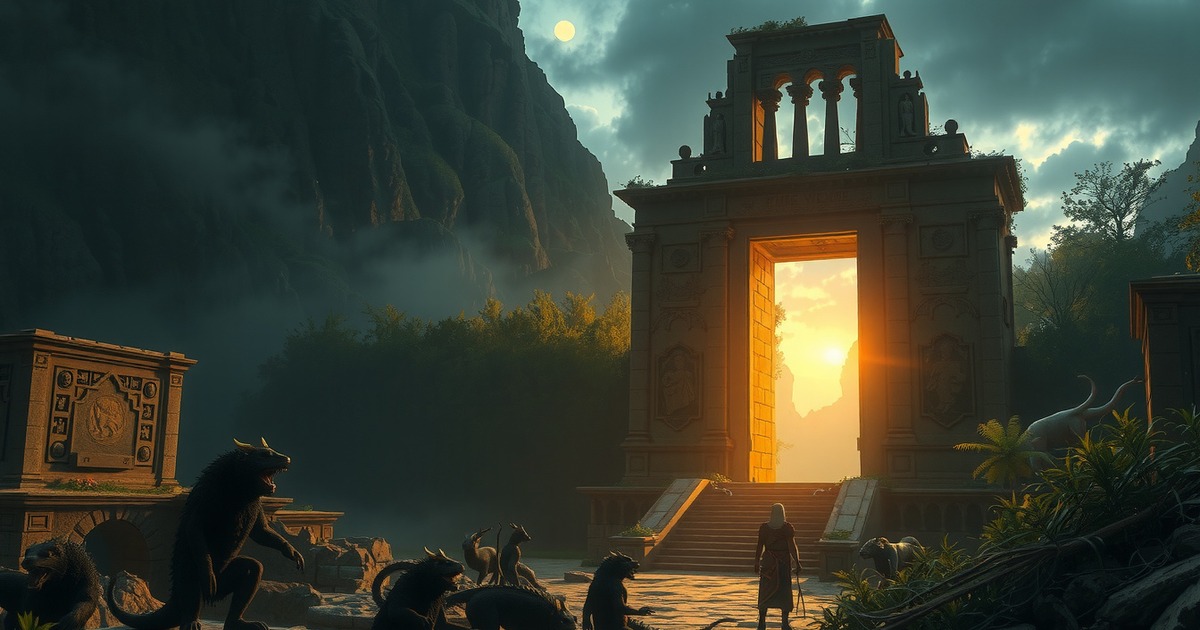
The Titanomachy, the ten-year war between the Olympian gods led by Zeus and the Titans led by Kronos, is one of the most epic conflicts in Greek mythology. Hesiod describes it as a cataclysm that shook the very foundations of the universe: “The boundless sea roared around, the earth crashed loudly, and the broad sky groaned as it was shaken.” Zeus, having freed his brothers and sisters, also released the Cyclopes and the Hecatoncheires from their imprisonment in Tartarus. In gratitude, the Cyclopes forged for Zeus his thunderbolt, for Poseidon his trident, and for Hades his helm of invisibility. The Hecatoncheires, with their hundred arms each, hurled massive boulders at the Titans, turning the tide of battle.
The Titans were not a unified force. While Kronos, Iapetus, and Atlas fought fiercely, other Titans like Oceanus and Themis remained neutral or even sided with Zeus. The war was not merely a physical conflict but a cosmic realignment. The Titans represented the old order—primordial, chaotic, and bound to the earth and sky. The Olympians represented a new order—one of hierarchy, law, and civilization. After ten years, Zeus and his allies prevailed. The defeated Titans were imprisoned in Tartarus, a dark abyss as far beneath the earth as the earth is beneath the sky, bound in chains and guarded by the Hecatoncheires. Only Atlas, Prometheus, and Epimetheus were spared immediate imprisonment, though each faced a unique fate. The Titanomachy is not just a war story; it is a foundational myth that explains the triumph of cosmic order over primordial chaos, a theme that resonates through Greek philosophy and later Western thought.
- Key Allies of Zeus: The Cyclopes (forged weapons), the Hecatoncheires (physical might), Styx and her children (first to swear allegiance).
- Key Titans Who Fought: Kronos, Iapetus, Atlas, Menoetius, Coeus, Crius.
- Neutral or Pro-Olympian Titans: Oceanus, Themis, Mnemosyne, Phoebe, Tethys.
- Primary Sources: Hesiod's Theogony (lines 617-735), Apollodorus's Library (1.1.1-1.2.1).
Prometheus and Epimetheus: The Titan Benefactors of Humanity
Among the Titans, Prometheus stands apart as a figure of profound complexity and sympathy. His name means “Forethought,” while his brother Epimetheus means “Afterthought.” In Hesiod's Works and Days and Aeschylus's Prometheus Bound, Prometheus is credited with creating humanity from clay and, more famously, stealing fire from the gods to give to mortals. This act was not merely a gift of warmth and light; fire represented technology, civilization, and the spark of divine knowledge. Prometheus also tricked Zeus at Mecone, where the first sacrificial feast was held, by hiding the best meat under animal entrails and covering the bones in fat, thus establishing the precedent that humans would burn the bones for the gods while keeping the meat for themselves.
Zeus's punishment for Prometheus was brutal and ingenious. He had the Titan chained to a rock in the Caucasus Mountains, where each day an eagle (or vulture) would consume his liver, which would regenerate each night, subjecting him to eternal torment. This punishment, described vividly by Aeschylus, is a central image of unjust suffering and defiance. Prometheus, however, possessed a secret: he knew which goddess would bear the son who would overthrow Zeus. After generations of torment, Heracles, with Zeus's permission, slew the eagle and freed Prometheus, who then revealed the secret, thus reconciling with Zeus. Prometheus's story is a powerful myth about the cost of knowledge, the nature of sacrifice, and the tension between divine authority and human progress. His legacy lives on in the modern concept of the “Promethean” figure—the rebel who brings enlightenment at great personal cost.
Atlas: The Titan Who Holds Up the Sky
Atlas, the son of Iapetus and the Oceanid Clymene (or Asia), is perhaps the most visually iconic of the Titans. His punishment for leading the Titan rebellion was unique: he was condemned to stand at the western edge of the earth (near the Garden of the Hesperides) and hold up the sky on his shoulders. This is not a punishment of imprisonment but of eternal, unending labor. In Hesiod's Theogony, Atlas holds the “broad heaven” apart from the earth, a task that requires immense strength and endurance. Later traditions, especially in Roman poetry, transformed him into a giant holding the celestial sphere, an image that became the standard in Renaissance and modern iconography.
Atlas's story is intertwined with several other myths. He was the father of the Pleiades (the seven star-nymphs), the Hyades, and the Hesperides, who guarded the golden apples in his garden. One of the most famous encounters involving Atlas is his meeting with Heracles during the hero's eleventh labor. Heracles needed the golden apples, and Atlas offered to retrieve them if Heracles would hold up the sky in his place. Atlas returned with the apples but, enjoying his freedom, initially refused to take back the sky. Heracles, using cunning, agreed to hold it temporarily but asked Atlas to take it back just for a moment so he could adjust a pad on his shoulders. When Atlas took the sky, Heracles picked up the apples and left. This tale highlights Atlas's strength but also his gullibility, a trait that humanizes this monumental figure. The phrase “to bear the weight of the world on one's shoulders” derives directly from Atlas, making him a lasting symbol of burden and endurance.
The Fates of the Fallen Titans: Tartarus and Beyond
While Prometheus and Atlas are the most famous Titans after Kronos, the other fallen Titans met varied fates. Most were imprisoned in Tartarus, a place described by Hesiod as a “great gulf” where “the roots of the earth and of the unvintaged sea” lie. Here, bound in darkness, they were guarded by the Hecatoncheires. Yet not all Titans were punished. Themis (divine law)
Related Posts


Your Weekly Dose of Inspiration
Journaling ideas, family tips, and gentle inspiration.
