In the waters beneath the earth, in the depths of sacred rivers, and in the cosmic oceans that encircle the world, dwell the Naga (नाग)—the divine serpent beings of Hindu and Buddhist mythology. These powerful creatures range from fearsome multi-headed serpent kings to benevolent rain-bringers and guardians of treasure. Neither purely gods nor demons, Nagas occupy a unique space in South and Southeast Asian religion, worshipped in temples, feared in jungles, and venerated as ancestors by royal houses across the continent.
Quick Facts About Nagas
| Origin | Hindu, Buddhist, Jain mythology |
| Name Meaning | Sanskrit “nāga” = serpent, snake |
| Type | Divine/semi-divine serpent beings |
| Realm | Patala (underworld), bodies of water |
| Key Figures | Shesha, Vasuki, Takshaka, Mucalinda |
| Enemies | Garuda (divine eagle) |
| Associated With | Water, rain, fertility, treasure, wisdom |
Origins and Nature
In Hindu cosmology, Nagas are born from the sage Kashyapa and his wife Kadru, making them half-siblings to the Garuda birds (born from Kashyapa and Vinata). This sibling rivalry became eternal enmity, with Garuda becoming the Nagas' mortal enemy—a conflict that echoes through countless myths.
Nagas exist in multiple forms:
Pure Serpent: Massive snakes, often with multiple heads (three, five, seven, or even a thousand), hooded like cobras.
Human Form: Nagas can assume fully human appearance, and many myths involve Naga princesses marrying human heroes or Naga kings attending celestial assemblies.
Half-Human: The most iconic form—human from the waist up, serpent from the waist down, often with a cobra hood behind the head.
They are neither inherently good nor evil. Some are protectors of dharma and sacred treasures; others are venomous threats. They control rainfall and rivers, guard precious gems, and hold ancient wisdom.
The Naga Realm: Patala
Nagas dwell primarily in Patala, the lowest of the seven underworlds in Hindu cosmology. But this is no dark hell—Patala is described as more beautiful than heaven itself:
The Naga capital, Bhogavati, is said to be filled with palaces of gold and gems, gardens of impossible beauty, and treasures beyond mortal imagination. The Nagarajas (Naga kings) rule over vast populations of serpent beings, holding courts as magnificent as any celestial realm.
Nagas also inhabit earthly waters—rivers, lakes, seas, and even wells. Villages throughout South and Southeast Asia have sacred bodies of water believed to be home to Nagas, and disturbing these places invites their wrath.
The Great Nagas

Several Nagas stand out as particularly important:
Shesha (Ananta): The greatest of all Nagas, with a thousand heads. Shesha serves as the cosmic bed upon which Lord Vishnu rests between cycles of creation. His name “Ananta” means “endless,” and he represents eternity itself. When the universe dissolves, only Shesha and Vishnu remain.
Vasuki: The Naga king who was wrapped around Mount Mandara and used as a rope during the Churning of the Ocean (Samudra Manthan). The gods and demons pulled him back and forth to churn the cosmic ocean, producing the nectar of immortality.
Takshaka: A fearsome Naga king, often portrayed as an enemy of humans. He killed King Parikshit and was the target of King Janamejaya's great snake sacrifice.
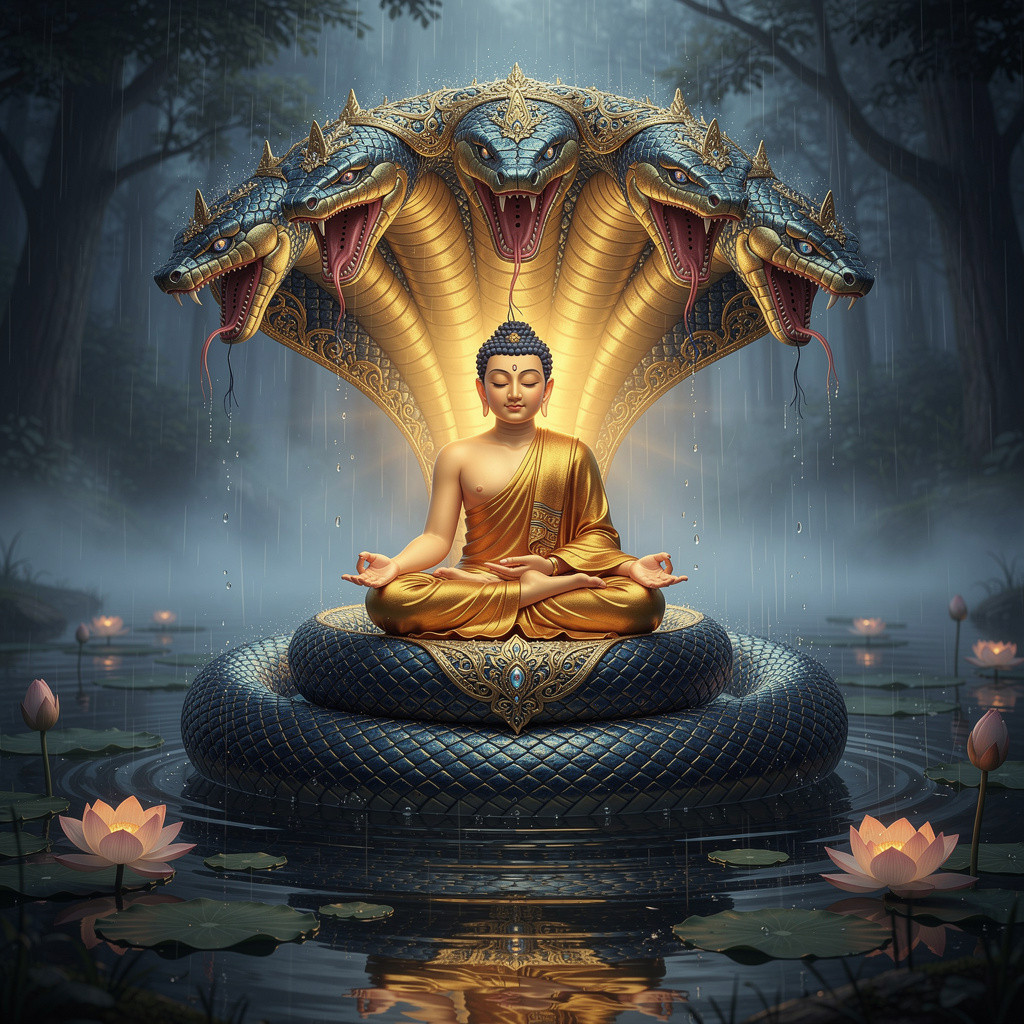
Mucalinda: A Naga king who sheltered the Buddha during a great storm. As the Buddha meditated, Mucalinda coiled beneath him and spread his many-headed hood above to protect the Enlightened One from rain.
Manasa: A Naga goddess worshipped in Bengal as protector against snakebite and bringer of fertility and prosperity.
Nagas and Garuda
The eternal enmity between Nagas and Garuda is one of Hindu mythology's most famous conflicts:
The conflict began when Kadru (mother of Nagas) and Vinata (mother of Garuda) made a bet about the color of the divine horse Uchchaihshravas. Kadru cheated by having her Naga children cling to the horse's tail, making it appear dark. When Vinata lost, she became Kadru's slave—and so did her son Garuda.
To free his mother, Garuda had to steal the Amrita (nectar of immortality) from the gods. He succeeded, but during the handover, the Nagas were tricked and never actually got to drink the nectar. In their attempt to lick it from the grass, they split their tongues—which is why snakes have forked tongues.
Since then, Garuda preys upon Nagas, and the two species remain eternal enemies. Yet they also represent cosmic balance—Garuda as sky and sun, Nagas as water and earth.
Nagas in Buddhism
Buddhism adopted and transformed Naga mythology:
Protectors of Dharma: Nagas became guardians of Buddhist teachings. The Prajnaparamita Sutras were said to have been hidden in the Naga realm until humanity was ready for them, then retrieved by the philosopher Nagarjuna (whose name means “Naga-hero”).
The Buddha and Mucalinda: The image of the Buddha seated on Mucalinda's coils, sheltered by the Naga's hood, became one of Buddhism's most iconic images, especially in Southeast Asia.
Rain and Agriculture: Buddhist Nagas retained their power over water and rain, making them important figures in agricultural societies.
Transformation: In some Buddhist traditions, Nagas can earn better rebirths through piety and can even become human or attain enlightenment.
Naga Worship
Nagas are actively worshipped across South and Southeast Asia:
Nag Panchami: A Hindu festival celebrating Nagas, held in July/August. Devotees offer milk to live snakes and pray for protection from snakebite.
Temple Nagas: Naga images guard the entrances of Hindu and Buddhist temples throughout Asia. Their serpentine bodies often form balustrades along staircases.
Sacred Groves: Many villages maintain sacred groves or pools where Nagas are believed to dwell. Cutting trees or polluting water in these places is strictly taboo.
Royal Lineages: Several Southeast Asian royal families claim descent from Nagas, including traditional Cambodian and Thai royal houses.
Nagas in Southeast Asia
The Naga tradition flourished dramatically in Southeast Asia:
Cambodia: The founding myth of the Khmer people involves the marriage of an Indian Brahmin to a Naga princess. Angkor Wat and other temples feature elaborate Naga imagery.
Thailand: Nagas (called “Nak” or “Nag”) are ubiquitous in Thai Buddhism, guarding temples and appearing in festivals. The Mekong River is believed to be home to powerful Nagas.
Laos: The Naga tradition is central to Lao culture. Mysterious “Naga fireballs” reportedly rise from the Mekong River during the full moon of the Buddhist Lent.
Indonesia: Naga imagery appears in Javanese and Balinese temples and art.
Powers and Abilities
Nagas possess numerous supernatural powers:
- Shapeshifting: Ability to assume human, serpent, or hybrid forms at will
- Weather Control: Power over rain, storms, and water sources
- Immortality: Nagas live for vast ages, though they can be killed
- Venomous Breath: Some can kill with their breath or gaze
- Treasure Guardianship: They guard gems, gold, and magical objects
- Wisdom: Ancient knowledge, particularly esoteric and magical lore
- Fertility: Power to bless or curse human reproduction and agriculture
Nagas in Modern Media
- Video Games: Appear in “Dungeons & Dragons,” “Warcraft,” “Final Fantasy,” “Shin Megami Tensei
- Anime/Manga: Featured in numerous Japanese works with Buddhist/Hindu themes
- Literature: Appear in fantasy novels with South Asian settings
- Film: Featured in various Bollywood mythological films and Thai horror movies
- Television: Appear in shows exploring Hindu/Buddhist mythology
Nagas Compared to Other Serpent Beings
| Being | Culture | Key Difference |
|---|---|---|
| Naga | Hindu/Buddhist | Divine beings, both benevolent and dangerous |
| Dragon (Long) | Chinese | Primarily benevolent, celestial, weather control |
| Serpent of Eden | Judeo-Christian | Tempter, symbol of evil |
| Quetzalcoatl | Mesoamerican | Feathered, divine creator, not underwater |
| Jörmungandr | Norse | World serpent, enemy of gods, apocalyptic |
Frequently Asked Questions
Are Nagas good or evil?
Neither exclusively. Nagas include protective deities like Mucalinda and dangerous threats like Takshaka. They're portrayed as a race of powerful beings with their own culture, morality, and individual personalities—some virtuous, some wicked, most complex.
What's the difference between a Naga and a dragon?
Nagas are specifically serpentine beings associated with water and the underworld, often with human elements. Asian dragons (like Chinese Long) are typically celestial, benevolent, and represent cosmic order. While related in some traditions, they have distinct mythological roles.
Can Nagas become human?
Nagas can take human form at will, and many myths involve Naga-human marriages. In Buddhist tradition, a Naga who wished to become a monk was told he could not be ordained but could achieve a better rebirth through devotion—which is why new monks are sometimes called “Naga” in Southeast Asian Buddhism.
Why do snakes have forked tongues?
According to Hindu mythology, when the Nagas tried to lick the Amrita (nectar of immortality) from the sharp grass where it had spilled, they cut their tongues. This is why snakes have forked tongues and why the grass (kusha) is considered sacred.
The Serpents Beneath
Nagas represent something profound in South Asian spirituality—the recognition that power exists in liminal spaces, in the places between worlds. They dwell in water, which is both life-giving and deadly. They live underground, in the realm of the dead, yet they're fully alive. They can appear human yet remain fundamentally other.
Worship of Nagas persists because they embody real forces—the unpredictable power of rivers, the danger of venomous snakes, the mystery of what lies beneath the surface. Every monsoon that nourishes crops, every flood that destroys villages, every snakebite in the fields—all carry echoes of the Nagas.
In temple courtyards from India to Indonesia, Nagas still guard the sacred spaces. Their stone coils line staircases; their hoods shade Buddha images; their eyes watch from doorways. The serpent beings of ancient myth remain woven into the living fabric of Asian spirituality.
Sources and Further Reading
- Vogel, Jean Philippe. “Indian Serpent-Lore.” Arthur Probsthain, 1926.
- Beer, Robert. The Handbook of Tibetan Buddhist Symbols.” Shambhala, 2003.
- Zimmer, Heinrich. “Myths and Symbols in Indian Art and Civilization.” Princeton, 1972.
- The Mahabharata.” Various translations available.