- Quick Facts About the Banshee
- Origins of the Banshee
- Appearance
- The Banshee's Wail
- Family Banshees
- Banshee Behaviors
- The Banshee and Death
- Related Spirits
- Banshee Encounters
- Symbolism and Meaning
- The Banshee in Modern Media
- The Banshee Compared to Other Death Omens
- Frequently Asked Questions
- Is the banshee evil?
- Can you see a banshee?
- What happens if you hear a banshee?
- Do only Irish families have banshees?
- The Cry in the Night
- Sources and Further Reading
- Related Posts
- Related Reading
In the dark of an Irish night, a sound rises that chills the blood of all who hear it—a keening wail so mournful, so unearthly, that those who recognize it know someone in their family will die. This is the cry of the Banshee (bean sídhe), the wailing woman of Irish folklore. She is not a killer or a demon, but a harbinger—an otherworldly woman whose lament announces that death is coming. For centuries, certain Irish families have claimed a banshee of their own, a supernatural spirit bound to their bloodline, forever doomed to mourn their deaths before they happen.
Quick Facts About the Banshee
| Origin | Irish and Scottish Gaelic folklore |
| Name Meaning | “Woman of the fairy mound” (bean sídhe) |
| Type | Fairy / Spirit / Omen |
| Appearance | Varies: young beauty, matronly woman, or withered hag |
| Associated Families | O'Neill, O'Brien, O'Connor, O'Grady, Kavanagh (and others) |
| Primary Attribute | Wailing cry that foretells death |
Origins of the Banshee
The word “banshee” comes from the Irish “bean sídhe” (pronounced “ban shee”), meaning “woman of the fairy mound” or “woman of the sídhe.” The sídhe were the fairy folk of Irish mythology—the Tuatha Dé Danann who retreated into hollow hills and fairy mounds after being defeated by the Milesians.
The banshee's origins may lie in several traditions:
The Keening Women: In ancient Ireland, professional mourners called “keeners” (bean chaointe) would wail at funerals, their stylized cries honoring the dead. The banshee may be a supernatural version of these mourners, grieving before death rather than after.
Ancestral Spirits: Some banshees are said to be the spirits of women who died in childbirth or who were closely connected to a family. They remain bound to their descendants, mourning each death.
The Fairy Folk: As “women of the sídhe,” banshees are connected to the fairy realm. They may be fairy women assigned to watch over mortal families, their laments expressing genuine grief at human mortality.
Appearance
The banshee's appearance varies dramatically between accounts, taking three primary forms:
The Maiden: A beautiful young woman with long silver or pale hair, wearing a white or gray cloak. Her beauty is ethereal and sorrowful, her eyes red from weeping.
The Matron: A middle-aged woman, stately and sad, dressed in dark colors. She represents the family's grief given form.
The Crone: A withered hag with wild gray hair, sunken eyes, and a face ravaged by endless mourning. This is the most terrifying form, associated with the most dire omens.
Some traditions say a single banshee can appear in all three forms, representing the three ages of womanhood. Others suggest different families have different types of banshee.
Common Features: Red eyes from constant weeping. Long pale or silver hair, often being combed. A gray or white cloak (or sometimes a grave shroud). An aura of profound sorrow.
The Banshee's Wail
The banshee's cry is her defining characteristic:
The Sound: Described variously as a wail, a shriek, a keening, or a mournful singing. It rises and falls like stylized funeral lamentations. Some describe it as beautiful in its terrible sadness; others say it sounds like nothing human.
When It's Heard: The wail comes at night, usually within a few days before the death it foretells. It may sound once or continue for hours. Sometimes only certain family members can hear it.
What It Means: When a banshee wails, someone in her family will die. She doesn't cause the death—she mourns it in advance. She is a messenger, not a killer.
Multiple Banshees: Some accounts say that when a great or holy person dies, multiple banshees wail together. The more banshees heard, the more significant the person who will die.
Family Banshees
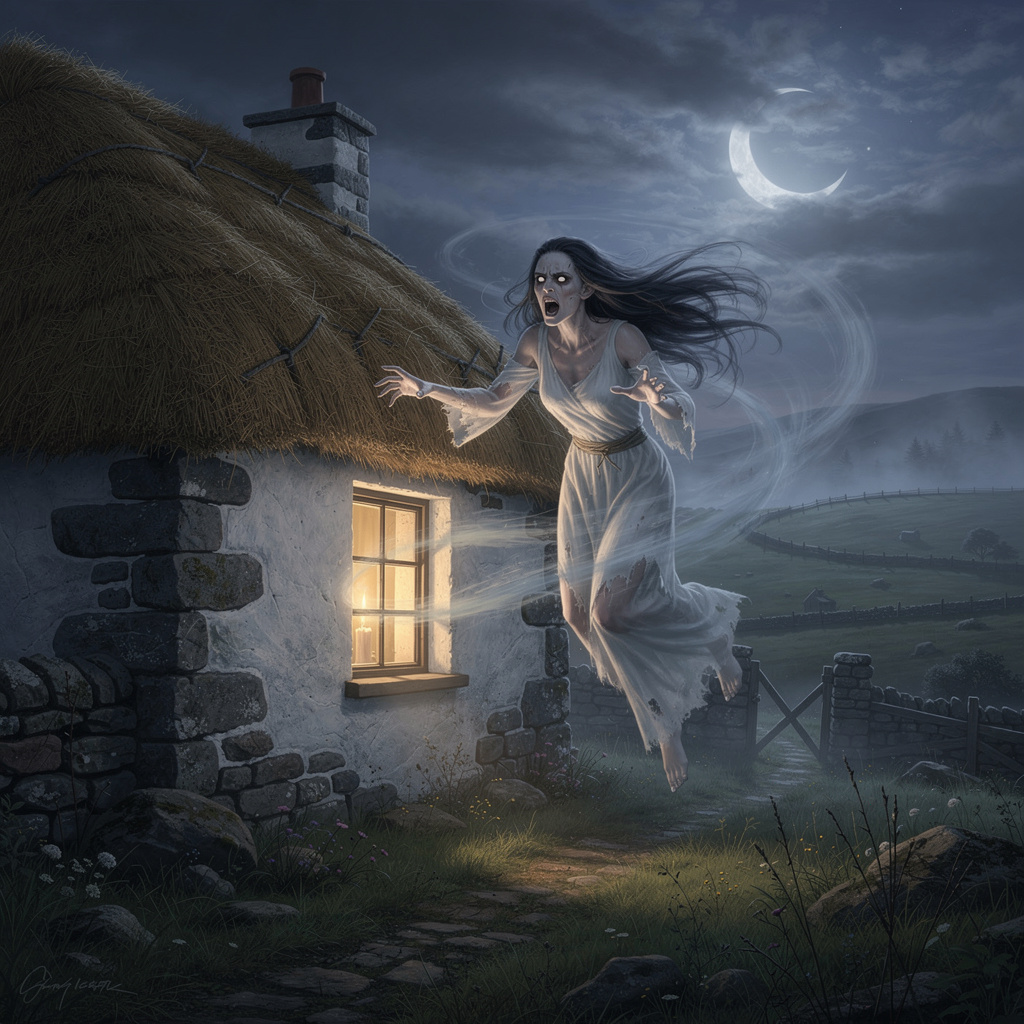
The banshee is unusual among supernatural beings: she is attached to specific families, not places or events.
The Great Families: Traditionally, only the oldest Irish families had banshees—those whose surnames began with “O'” or “Mac.” Families like O'Neill, O'Brien, O'Connor, O'Grady, and Kavanagh were said to have banshees attached to their lines.
Noble Blood: Some accounts say only families of pure Milesian (ancient Irish) descent have banshees. The presence of a banshee was sometimes considered a mark of nobility.
The Connection: The banshee's relationship to her family is complex. She may be an ancestor, a former keener for the family, a fairy woman who fell in love with a mortal man, or a spirit assigned to watch over the bloodline.
Following Emigrants: When Irish families emigrated to America, Scotland, or elsewhere, some claimed their banshees followed. Stories of banshee wails in Boston, New York, and the Scottish Highlands persist to this day.
Banshee Behaviors
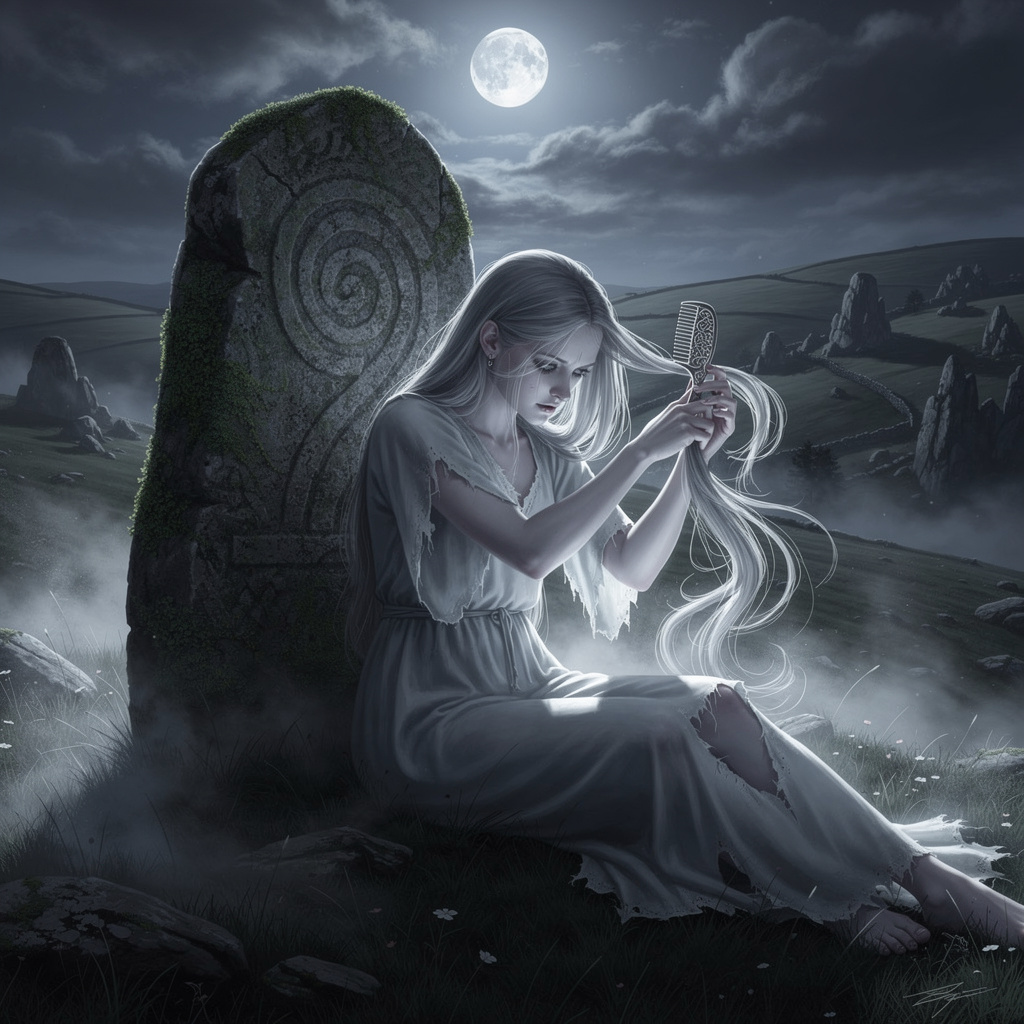
Beyond wailing, banshees exhibit several characteristic behaviors:
Combing Her Hair: Banshees are often seen combing their long hair with a silver comb. Legend warns against picking up a comb found on the ground—it might belong to a banshee, and she might come to reclaim it.
Washing Shrouds: Some accounts describe the banshee as a washer at the ford (bean nighe), washing bloody shrouds in a stream—the burial clothes of those about to die.
Hovering Near the Home: The banshee may be seen outside the home of the dying, or perched on a tree or rock nearby, wailing her lament.
Invisibility: Often the banshee is heard but not seen. Her wail rises from the darkness, from the moors, from the direction of fairy mounds.
The Banshee and Death
The banshee's relationship to death is misunderstood:
She Does Not Kill: The banshee is not a cause of death. She predicts it, mourns it, perhaps knows it is coming before anyone else—but she does not cause it. To hear her cry is to know death approaches, not to be cursed by her.
Grief, Not Malice: The banshee's wail is one of genuine sorrow. She grieves for the family she watches over. Her cry is mournful, not threatening. In some ways, she performs a service—giving families time to prepare.
The Warning: Hearing the banshee allows family members to say goodbye, to make peace, to attend to the dying. Some see her warning as a gift rather than a curse.
Averting Death: In most traditions, the death the banshee predicts cannot be prevented. She announces what will be, not what might be. The banshee knows; she cannot change.
Related Spirits
The banshee has relatives and counterparts in other Celtic traditions:
Bean Nighe (Scotland): The “washer woman” who washes the shrouds of the soon-to-die in streams. Sometimes considered the same as the banshee, sometimes a related but distinct spirit.
Cyhyraeth (Wales): A wailing spirit whose cry foretells death, particularly along the Welsh coast. Similar to the banshee but not attached to specific families.
Caoineag (Scottish Highlands): Another weeping spirit whose wail predicts death in a clan. The name means “weeper.”
The Dullahan: The headless horseman of Irish folklore, another death omen who rides forth when someone is about to die. Sometimes seen in company with the banshee.
Banshee Encounters
Traditional stories often describe banshee encounters:
The O'Brien Banshee: According to legend, the O'Brien family has been attended by a banshee for centuries. During the death of Brian Boru, High King of Ireland, multiple banshees were said to wail across the country.
The Emigrant's Tale: Stories tell of Irish emigrants in America who heard the banshee wail, only to receive news days later that a relative had died back in Ireland at that exact moment.
The Comb: Many tales involve someone picking up a banshee's comb. The banshee appears to demand it back—and sometimes takes the finder's life as payment.
Modern Sightings: As recently as the 20th century, Irish families have reported hearing the banshee's wail before the death of relatives. Whether folklore, coincidence, or something else, the tradition persists.
Symbolism and Meaning
The banshee embodies several profound themes:
Death's Inevitability: The banshee represents the certainty of death. She does not kill, but she knows. Her cry reminds us that death comes for everyone, and she honors that passage with her mourning.
Family and Lineage: As a spirit attached to bloodlines, the banshee represents the connection between generations. She mourns not just individuals but the ongoing loss that every family experiences across time.
The Feminine Divine: The banshee is always female, connected to ancient Celtic goddess traditions. Her three forms—maiden, matron, crone—echo the triple goddess archetype.
Irish Identity: Having a banshee marked a family as truly Irish, connected to the ancient bloodlines. The banshee became a symbol of Irish cultural identity and continuity.
The Banshee in Modern Media
- Literature: Appears in works by W.B. Yeats, in urban fantasy series, and countless horror novels
- Film: Featured in “Darby O'Gill and the Little People” (1959), “Banshee” (2006), and various horror films
- Television: Appears in “Supernatural,” “Teen Wolf,” “Charmed,” and many fantasy series
- Video Games: Featured in “Mass Effect,” “Dungeons & Dragons,” “World of Warcraft,” and numerous RPGs
- Comics: Various Marvel and DC characters bear the banshee name
The Banshee Compared to Other Death Omens
| Being | Culture | Key Difference |
|---|---|---|
| Banshee | Irish | Wails to announce death, attached to families |
| Dullahan | Irish | Headless horseman, announces death by speaking names |
| Grim Reaper | European | Personification of death itself, takes souls |
| Bean Nighe | Scottish | Washes shrouds, can be questioned |
| Valkyrie | Norse | Chooses the slain, carries them to Valhalla |
Frequently Asked Questions
Is the banshee evil?
No. The banshee is a messenger and mourner, not a malevolent spirit. She grieves for the families she watches over. Her wail is an expression of sorrow, not a curse. She announces death; she does not cause it.
Can you see a banshee?
Sometimes. Banshees are more often heard than seen, but encounters describe seeing a woman in white or gray, combing her hair or hovering near the home of the dying. Seeing her is rarer than hearing her cry.
What happens if you hear a banshee?
According to folklore, if you hear a banshee, someone in your family will die soon—usually within days. The banshee's cry is a warning, allowing time for preparation and goodbyes. The death cannot be prevented.
Do only Irish families have banshees?
Traditionally, yes—specifically old Gaelic families with surnames beginning with “O'” or “Mac.” However, as Irish families intermarried and emigrated, the banshee tradition spread. Related spirits like the Welsh Cyhyraeth and Scottish Bean Nighe exist in other Celtic cultures.
The Cry in the Night
The banshee endures because she gives voice to what we cannot escape. Death comes for everyone, and she mourns in advance—not to terrify, but to honor. Her wail across the Irish moors is a reminder that every death matters, that every passing deserves to be grieved.
For the Irish families who claim her, the banshee is both burden and blessing. Her cry brings terror, yes—but also time. Time to say goodbye. Time to make peace. Time to gather at the bedside and hold the hand of someone who will soon be gone.
Somewhere in the darkness of an Irish night, she still waits. She still watches. And when the time comes, she will still keen—a mournful, beautiful, terrible song for the dead and the dying, carried on the wind across generations, connecting us to ancestors who heard the same cry centuries ago.
Sources and Further Reading
- Lysaght, Patricia. “The Banshee: The Irish Death Messenger.” Roberts Rinehart, 1986.
- Yeats, W.B. “Fairy and Folk Tales of the Irish Peasantry.” Walter Scott, 1888.
- Briggs, Katharine. “An Encyclopedia of Fairies.” Pantheon, 1976.
- MacKillop, James. A Dictionary of Celtic Mythology.” Oxford University Press, 1998.