The Legendary Kitsune
The mystical fox spirits of Japanese mythology—beings of extraordinary cunning and magical power who grow additional tails as they age, eventually becoming divine messengers of the gods themselves.

Overview: The Fox Spirits of Japan
The Kitsune (狐, literally “fox”) stands among the most beloved, complex, and culturally significant creatures in all of Japanese mythology. Far more than mere animals with magical powers, kitsune occupy a unique space in Japanese spiritual thought—simultaneously wild creatures, divine messengers, dangerous tricksters, and sometimes devoted lovers.
What distinguishes kitsune from ordinary foxes is their supernatural intelligence and ability to accumulate magical power over time. A young kitsune may possess only minor abilities, but as centuries pass, these fox spirits grow increasingly powerful, eventually gaining the ability to manipulate reality itself. The most obvious sign of a kitsune's age and power is the number of its tails—ranging from one to the legendary nine tails of a celestial fox.
Kitsune mythology has roots dating back to at least the 8th century CE, with the oldest Japanese literary reference appearing in the Nihon Ryōiki (日本霊異記), a collection of Buddhist tales. However, the fox's sacred status likely predates written records, possibly imported from Chinese fox spirit traditions or developed independently from Japan's reverence for the animals they observed in daily life.
“A kitsune grows a new tail every hundred years, and by the time it has nine tails, it has become nearly a god itself.” — Japanese Folk Saying
The Classification of Kitsune
Japanese folklore divides kitsune into several distinct categories based on their nature, allegiance, and spiritual alignment. Understanding these classifications is essential for comprehending the full depth of kitsune mythology.
Zenko (善狐) — The Celestial Foxes
Zenko, meaning “good foxes” or “divine foxes,” serve the Shinto deity Inari Ōkami, the god of rice, fertility, prosperity, industry, and worldly success. These benevolent spirits act as Inari's messengers and guardians, protecting shrines, households, and individuals who show proper reverence.
Zenko are associated with:
- Protecting rice harvests and ensuring agricultural prosperity
- Guarding businesses and bringing commercial success
- Answering prayers made at Inari shrines
- Warding off evil spirits and malevolent supernatural beings
- Guiding lost souls and providing wisdom to the worthy
Yako (野狐) — The Wild Foxes
Also called nogitsune (野狐, “field foxes”), these kitsune operate independently of divine service. They follow their own whims and desires, which may be mischievous, malevolent, or simply indifferent to human welfare.
Yako are not inherently evil—they simply exist outside the moral framework of divine service. A yako might:
- Play elaborate pranks on travelers, sometimes with harmful consequences
- Possess humans (kitsunetsuki) for various purposes
- Seduce mortals for their own amusement or to feed on their life energy
- Punish those who have wronged foxes or nature
- Occasionally help humans who have earned their favor
Kyūbi no Kitsune (九尾の狐) — The Nine-Tailed Fox
The nine-tailed fox represents the pinnacle of kitsune evolution. Having lived for at least 1,000 years, these beings have transcended ordinary existence to become near-divine entities. Their fur typically transforms to silver, white, or golden, and their power becomes virtually limitless.
A nine-tailed kitsune possesses:
- Omniscience—the ability to see and hear anything occurring in the mortal world
- Reality manipulation on a grand scale
- Effective immortality and invulnerability to most harm
- The power to bless or curse nations
- Direct communication with the highest deities
Magical Powers & Abilities
Kitsunebi
Fox-fire: ghostly blue or green flames produced from their tails or exhaled as breath, used to light the way or as weapons
Shapeshifting
Transform into any human form, most commonly beautiful women, though age and skill determine the perfection of the disguise
Illusion Mastery
Create elaborate illusions indistinguishable from reality—entire towns, forests, or palaces that vanish at dawn
Kitsunetsuki
The ability to possess humans, entering through fingernails or breasts, often causing madness or granting temporary powers
Dream Walking
Enter and manipulate the dreams of sleeping mortals, delivering prophecies or tormenting enemies
Hoshi no Tama
The star ball—a mystical pearl containing a portion of the kitsune's soul and power, kept close and guarded jealously
Weather Control
Powerful kitsune can summon rain, conjure storms, or bring sunshine—particularly important for rice-growing communities
Curse & Blessing
The power to bring fortune or misfortune to individuals, families, or entire villages for generations
The Hoshi no Tama: Star Ball
One of the most fascinating aspects of kitsune mythology is the hoshi no tama (星の玉), translated as “star ball” or “star jewel.” This mystical object appears as a glowing pearl or orb, typically white or pale gold, which kitsune are often depicted carrying in their mouths or guarding jealously.
The hoshi no tama contains a portion of the kitsune's soul—its very essence and magical power made manifest. For this reason, kitsune guard these objects with their lives. According to folklore, if a human can obtain a kitsune's star ball, they gain tremendous leverage over the fox spirit:
- The kitsune may be forced to serve the human to recover its precious treasure
- Some legends claim the kitsune will grant wishes in exchange for the star ball's return
- A kitsune separated from its hoshi no tama grows progressively weaker
- Destroying the star ball might destroy the kitsune itself
Some scholars interpret the hoshi no tama as a symbol of the kitsune's honor and integrity—losing it represents a profound spiritual violation. Others see it as representing the secret knowledge that kitsune accumulate over their long lives, crystallized into physical form.
Famous Kitsune Tales
The Fox Wife (Kitsune Nyōbō)
Perhaps the most common type of kitsune tale involves a fox taking human form to marry a mortal man. In these stories, the kitsune wife is invariably loving, devoted, and makes an excellent partner. However, her true nature must remain hidden—and the discovery of her secret always ends the marriage.
The most famous version tells of a man who encounters a beautiful woman on a moonlit road. They marry and have children, living in happiness for years. One day, the family dog—who has always hated the wife—attacks her, and in her fear, she momentarily reveals her fox ears and tail. Unable to remain after being seen, she vanishes into the night, leaving only a poem behind.
Tamamo-no-Mae: The Golden Fox
One of the most legendary kitsune in Japanese history, Tamamo-no-Mae was said to be a nine-tailed fox who infiltrated the Imperial court during the late Heian period. Disguised as a beautiful and impossibly intelligent courtesan, she became the favored consort of Emperor Toba.
However, when the Emperor fell mysteriously ill, the court astrologer Abe no Yasunari exposed her true nature. Tamamo-no-Mae fled, but was eventually hunted down and killed. Her body transformed into the Sessho-seki (Killing Stone), a rock that emits poisonous gas and kills any who approach—her malevolence persisting even in death.
Ono and the Fox
A gentler tale tells of a man named Ono who saved a wounded fox. Years later, a beautiful woman appeared and became his wife. When Ono's old fox companion appeared—and the wife's shadow revealed fox ears—he realized the truth. But unlike other tales, Ono accepted his wife's nature, and they lived together until her natural death, their love transcending the divide between human and fox.
Kitsune & Inari Worship
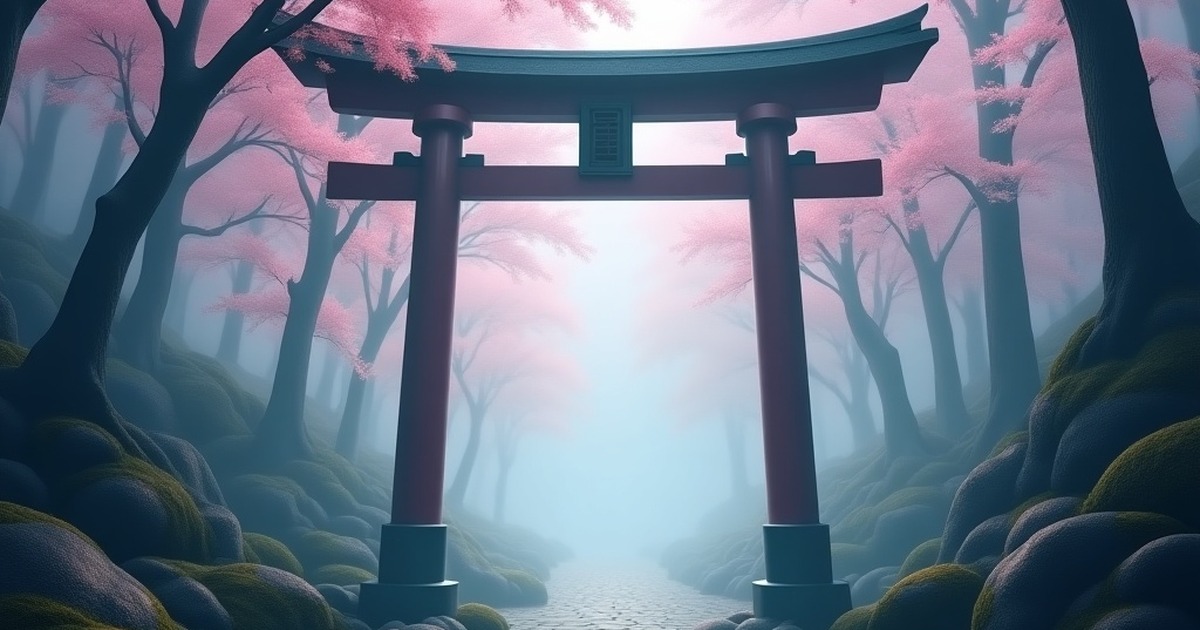
The connection between kitsune and Inari Ōkami (稲荷大神) forms one of the most important aspects of fox mythology in Japan. Inari shrines—numbering over 30,000 throughout the country—are instantly recognizable by their guardian fox statues (komainu or koma-kitsune) and their brilliant vermillion torii gates.
The most famous of these, Fushimi Inari Taisha in Kyoto, features thousands of torii gates winding up Mount Inari, creating one of Japan's most iconic religious sites. Fox statues throughout the complex hold various symbolic items:
- Keys — Representing access to rice granaries and prosperity
- Jewels — Symbolizing the hoshi no tama and spiritual power
- Scrolls — Representing wisdom and the sutras of enlightenment
- Sheaves of rice — Connecting to Inari's role as god of the harvest
Worshippers at Inari shrines often leave offerings specifically for the fox messengers, including aburaage (fried tofu), which is said to be the foxes' favorite food. This tradition gave rise to the dish Inari-zushi—sushi rice stuffed in fried tofu pouches, named for the deity and his fox servants.
Identifying a Kitsune in Human Form
Japanese folklore provides numerous ways to detect a kitsune disguised as a human, though older and more powerful foxes become increasingly difficult to identify:
Physical Signs
- Shadows or reflections may reveal fox ears, tail, or entire fox form
- Fear or drunkenness may cause the disguise to slip momentarily
- Very young kitsune may fail to completely hide their tail
- Their eyes may glow or reflect light like an animal's
- An unusual aversion to or fear of dogs
Behavioral Signs
- Excessive beauty or charm that seems almost supernatural
- Knowledge that seems impossible for their apparent age or station
- A fondness for fried tofu and other traditional fox foods
- Discomfort around Shinto shrines not dedicated to Inari
- Speaking in an unusually archaic or formal manner
Kitsune in Modern Culture
The kitsune remains one of the most popular mythological creatures in contemporary Japanese media and has gained significant international recognition. Their presence spans virtually every medium:
Anime & Manga
Kitsune appear in countless series, from the nine-tailed fox Kurama sealed within Naruto Uzumaki to the various fox spirits in works like Inuyasha, Kamisama Kiss, Gugure! Kokkuri-san, and The Helpful Fox Senko-san. These modern interpretations often blend traditional folklore with contemporary storytelling.
Video Games
Games like Okami, Nioh, Persona, League of Legends (Ahri), and countless others feature kitsune characters. The fox spirit has become a staple of Japanese RPGs and has crossed into Western game development as well.
Contemporary Art & Fashion
Kitsune masks remain popular in Japanese festivals and have become fashion statements worldwide. The kitsune aesthetic—mixing beauty, mystery, and danger—continues to inspire artists, designers, and storytellers around the globe.
Continue Your Journey Through Japanese Mythology
The kitsune is just one of hundreds of yokai in Japanese folklore. Discover oni, tengu, tanuki, jorogumo, and many more supernatural beings.