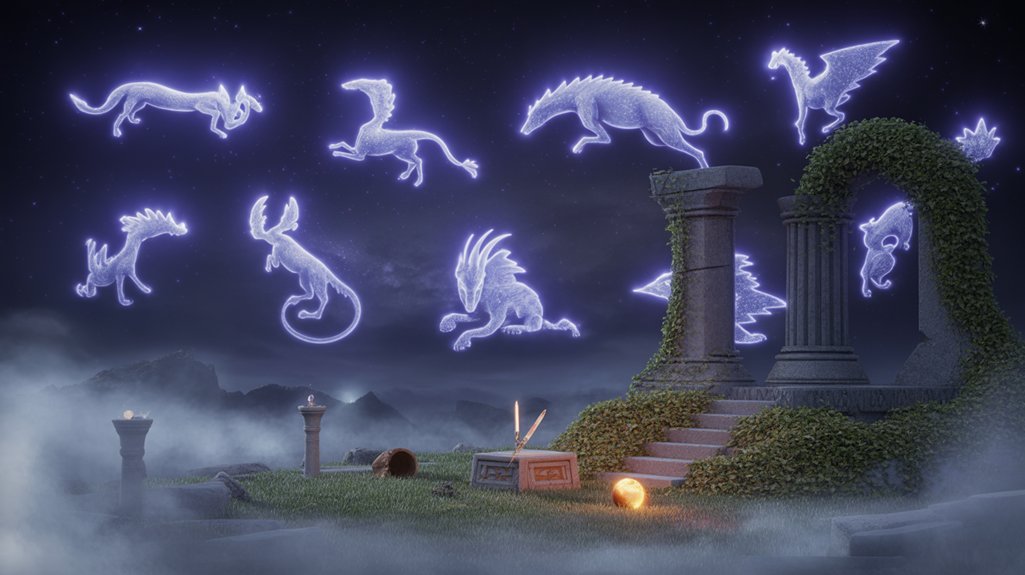
Ancient civilizations altered celestial patterns into bestial forms—Sumerian priest-astronomers cataloging the Bull of Heaven circa 3200 BCE, Greeks immortalizing Hydra's regenerative chaos, Egyptians mapping scorpions guiding souls through death's threshold. These chimeric constellations functioned as mnemonic vessels, encoding agricultural cycles and navigation routes while projecting archetypal struggles onto the cosmos. Carl Jung recognized these stellar beasts as manifestations of the collective unconscious, universal symbols bridging disparate cultures through shared psychological landscapes. Modern astronomical nomenclature preserves this ancient wisdom, maintaining mythological archives within scientific frameworks that reveal humanity's enduring need to map meaning across darkness.
Key Takeaways
- Ancient civilizations projected mythological narratives onto star patterns, transforming constellations into celestial repositories of cultural stories and symbolic meaning.
- Greek constellations feature heroic beasts like Draco, Hydra, and Leo, each representing specific myths about divine intervention and moral transformation.
- Mesopotamian astronomers cataloged celestial creatures including the Bull of Heaven and Scorpion Man, guiding agriculture and navigation through stellar configurations.
- Constellations embody psychological archetypes like rescue fantasies and regeneration cycles, reflecting universal human experiences across diverse cultures through shared symbolism.
- Modern astronomy preserves ancient mythological names in star catalogs, maintaining the cultural legacy of celestial beasts in contemporary navigation and nomenclature.
Ancient Sky Stories Unite Cultures

When ancient peoples gazed upward into the velvet darkness, they didn't merely observe scattered points of light—they witnessed a vast celestial tapestry woven with chimeric forms and heroic sagas that transcended the boundaries of their terrestrial kingdoms.
Greek constellations like Hercules and Hydra embodied eternal struggles, their patterns serving as mnemonic vessels for cultural symbolism that united disparate civilizations. The Andromeda-Cetus narrative, depicting rescue and redemption, carried moral wisdom across Mediterranean shores.
These weren't isolated Greek innovations. Sumerian and Akkadian stargazers had already inscribed their own mythologies onto heaven's vault, establishing precedents that Hellenic astronomers would inherit and reshape. Roman artisans later immortalized these stellar beasts in mosaic and stone, perpetuating shared heritage.
Beyond artistic expression, constellations enabled celestial navigation—sailors plotted courses by Ursa Major while farmers timed harvests by Orion's rise. The Olympian gods themselves were intrinsically linked to celestial phenomena, with Zeus commanding thunder from the heavens while Apollo guided the sun across the sky. The cosmos became humanity's common text, its eldritch characters readable to all who sought liberation through understanding the infinite above.
##
The firmament above ancient civilizations teemed with chimeric forms—serpentine dragons coiling through northern skies, leonine hunters prowling the ecliptic, hybrid creatures born from humanity's primal need to map both cosmos and psyche.
Greek astronomers altered their pantheon's most eldritch beings into stellar arrangements: Draco the dragon guarding golden apples, Hydra stretching her venomous coils across the celestial meridian, Cetus rising from abyssal depths to threaten chained Andromeda.
These zodiacal beasts, emerging from Mesopotamian star catalogs circa 1000 BCE and refined through Hellenistic scholarship, created a universal bestiary where cultures projected their deepest fears and sacred animals onto the wheeling vault above.
Norse peoples similarly encoded their cosmology in celestial observation, with figures like Odin and Thor serving as cultural expressions through which the Vikings interpreted both earthly phenomena and the movements of heavenly bodies.
Dragons in the Sky
Across the celestial vault of ancient Greece, dragons coiled through darkness as permanent symbols of heroic conquest and divine judgment. Draco immortalized Ladon, the eldritch guardian whose serpentine form protected golden apples until Heracles's fatal strike.
These celestial guardians weren't mere decorations—they embodied chaos itself, chimeric forces demanding confrontation. Hydra's multiple heads stretched across the heavens, commemorating another of Heracles's labors. Monster slain, legend preserved.
Cetus emerged from ocean depths at Poseidon's command, threatening Andromeda's kingdom until Perseus intervened with divine weaponry. This dragon symbolism transcended entertainment; it mapped humanity's eternal struggle against overwhelming odds, inscribing victories into permanent astral record.
Each constellation represented liberation through courage, reminding ancient observers that even cosmic monsters yielded to mortal determination backed by divine favor.
Celestial Creatures of Greece
Beyond dragons and serpents, ancient Greek astronomers populated the heavens with an entire menagerie of chimeric forms, each constellation serving as eternal tribute to heroes' triumphs and gods' interventions.
Leo blazed forth as the Nemean Lion, its constellation symbolism embodying supremacy through Heracles' legendary victory. Cetus emerged as the sea monster threatening Andromeda, while Hydra's serpentine coils enacted mythical interpretations of perpetual cosmic pursuit.
Canis Major materialized as Orion's magical hound, frozen mid-chase among stellar paths. Most striking: Capricorn's goat-fish hybrid Aegipan, altered while fleeing Cronos' wrath.
Centaurus immortalized wise Chiron, blending human intellect with bestial form. These stellar creatures weren't mere decorative patterns—they represented living mythology, eldritch guardians preserving ancient wisdom through celestial geography, ensuring heroic deeds transcended mortal memory.
Beasts Across Ancient Cultures
While Greek astronomers gazed upward and inscribed their heroes among stars, civilizations across Mesopotamia, Egypt, China, and the Americas simultaneously wove their own bestial tapestries across the celestial sphere—each culture modifying the same stellar configurations into creatures reflecting their unique cosmological anxieties and triumphs.
The Sumerians and Akkadians reshaped constellations into bulls and eagles, establishing beast symbolism that would ripple through subsequent millennia of astronomical tradition. These chimeric forms served dual purposes: encoding cultural narratives while marking agricultural cycles and navigational waypoints.
The eldritch creatures inhabiting night skies weren't mere decoration. They represented cosmic order, seasonal changes, divine communication.
Egyptian scorpions, Chinese dragons, Mesoamerican jaguars—all emerged from identical star clusters, yet each civilization interpreted these luminous patterns through distinct mythological lenses, creating parallel universes of meaning overhead.
Zodiac's Animal Origins
The zodiac—*zodiakos kyklos* in ancient Greek, meaning “circle of animals”—crystallized these cross-cultural celestial menageries into twelve distinct stations through which the sun, moon, and planets journeyed across the ecliptic plane.
Each sign carried profound zodiac symbolism inherited from Sumerian and Akkadian star-lore, altered through Hellenic interpretation. Aries embodied the ram of divine sacrifice, while Leo commanded the celestial sphere with leonine supremacy. Capricorn manifested as chimeric Aegipan, the goat-fish melding terrestrial and aquatic domains.
These weren't mere astronomical markers but vessels of mythological significance—semi-divine spirits bound to heroic narratives, their eldritch forms mapping humanity's relationship with cosmos and fate.
The zodiac's animal origins reveal how ancient minds decoded celestial movements through bestial intermediaries, creatures bridging mortal understanding and stellar infinitude.
Sumerian Star Catalogs Document Beasts
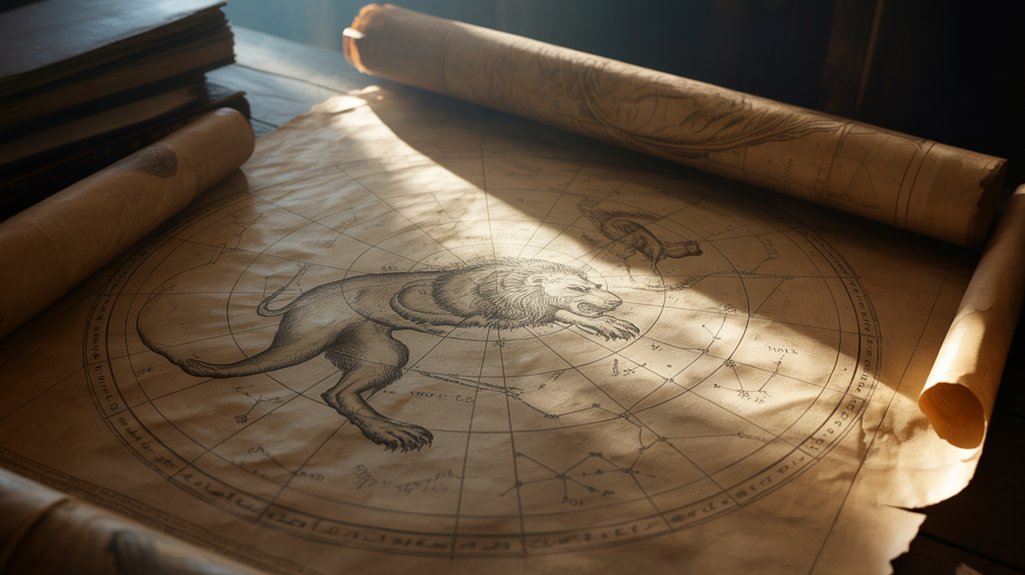
The Sumerian astronomical texts, predating their Babylonian successors of 1700 BCE by some three centuries, emerged from the fertile crescents of the Mesopotamian river valleys where priest-astronomers first mapped the eldritch configurations overhead.
These primordial catalogs served dual purposes—regulating agricultural cycles through celestial omens and guiding merchants across trackless deserts beneath the chimeric forms of star-beasts.
Within ziggurats' shadow, scribes etched cuneiform tablets that converted the Bull of Heaven and serpentine dragons into navigational instruments, their mythic power channeled toward earthly necessity.
Babylonian Star Catalogs 1700 BCE
Cuneiform tablets etched with celestial wisdom preserved humanity's earliest systematic attempts to map the beasts dwelling among the stars.
The Mul.Apin, dating to 1700 BCE, stands as Babylonian astronomy's definitive stellar compendium, documenting positions and movements of chimeric figures traced across the vault of night. These catalogs weren't mere navigation tools—they embodied sacred knowledge, converting celestial navigation into communion with the divine.
The Bull of Heaven, the Scorpion—eldritch guardians encoded in clay—represented power incarnate, mythological forces governing both sky and earthly fate.
Babylonian astronomers inherited Sumerian traditions, refining them into systematic frameworks that would eventually infiltrate Greek consciousness, carrying these bestial constellations westward.
Each recorded position marked humanity's defiant claim: understanding the cosmos meant grasping the eternal beasts prowling through infinite darkness.
Mesopotamian River Valley Beginnings
Between the Tigris and Euphrates, where fertile silt accumulated into humanity's first cradle of civilization, Sumerian priest-astronomers turned their gaze skyward and witnessed monsters. Their clay tablets, inscribed circa 3200 BCE, cataloged eldritch forms traversing the celestial vault—chimeric beings that bridged earthly understanding and cosmic mystery.
| Mythical Beast | Constellation Function |
|---|---|
| Bull of Heaven | Agricultural timing markers |
| Scorpion Man | Boundary guardian, celestial navigation |
| Lion-Dragon | Seasonal flood prediction |
| Celestial Serpent | Pathway through underworld domains |
Sumerian cosmology encoded practical wisdom within mythic frameworks. These star catalogs weren't mere fantasy—they freed agricultural communities from uncertainty, enabling autonomous planning through celestial navigation. The beasts became interpretive keys, revealing temporal patterns that subsequent civilizations would inherit, modify, preserve. Ancient knowledge, democratized through starlight.
Agricultural Calendar and Navigation Aid
When stellar configurations first emerged above Mesopotamian horizons each year, farmers recognized these celestial heralds as infallible guides—more dependable than any earthly counsel.
The Pleiades' heliacal rising signaled planting season, while Orion's appearance marked harvest time, anchoring agricultural cycles to chimeric forms mapped across darkness. These weren't mere decorations. Sumerian astronomers altered eldritch beasts—winged bulls, serpentine dragons—into mnemonic anchors, binding cosmic patterns to earthbound survival.
Sailors likewise claimed freedom through celestial navigation, tracking Ursa Major's arc toward the North Star, charting courses across unmapped waters. Each constellation embodied both deity and directional tool, practical astronomy woven through mythological framework.
The ziggurat priests understood: liberation comes through knowledge, and knowledge resided in those stellar beasts prowling heaven's vault, eternal guardians of seasonal truth.
Greek Vs Egyptian Interpretations

The ancient Greeks and Egyptians gazed upon the same celestial vault, yet they etched entirely different narratives across its star-strewn expanse—narratives that reveal the fundamental divergence between their cosmic philosophies. Greek constellations immortalized heroic narratives and transformative myths, weaving tales of semi-divine champions like Andromeda and Hercules into the celestial sphere. Egyptian deities, conversely, dominated their star lore, with afterlife symbolism permeating every astronomical observation.
| Aspect | Greek Interpretation | Egyptian Interpretation |
|---|---|---|
| Primary Focus | Heroic adventures, moral transformation | Cosmic order, soul's journey through death |
| Seasonal Changes | Agricultural markers like the Pleiades | Nile flooding cycles, religious ceremonies |
| Animal Representations | Strength attributes (Leo, Capricorn) | Divine embodiments (Sekhmet, Khnum) |
| Celestial Purpose | Commemorating mythological events | Guiding souls, maintaining ma'at |
These chimeric beasts served distinct functions—Greek constellations celebrated earthly achievements raised to eldritch permanence, while Egyptian star patterns mapped the sacred geography of resurrection itself.
Psychological Archetypes in Star Patterns
Beyond these cultural divergences lies a deeper psychological substrate—one where stellar configurations function as mirrors for humanity's interior landscapes. The ancients embedded within celestial symbolism a profound cartography of the psyche, altering eldritch night-fires into archetypal vessels.
These heroic journeys, traced across the cosmic vault, reveal humanity's perpetual confrontation with shadow and light.
Three Primary Archetypal Manifestations:
- The Vulnerable-Redeemer Dyad — Andromeda's chains embody powerlessness altered through intervention, illustrating rescue fantasies that transcend millennia.
- Eternal Regeneration — Hydra's chimeric form mirrors cyclical struggle, where severed heads spawn anew, reflecting humanity's ceaseless battle against entropy.
- Divine Election — Aquarius, housing Ganymedes' essence, captures alteration through supernatural favor and youthful ascension.
Hercules burning overhead. Leo's prideful stance. Each constellation operates as psychological shorthand, compressing complex emotional territories into navigable star-patterns.
Ancient observers didn't merely project stories skyward—they constructed frameworks for understanding bravery, sacrifice, vulnerability. These stellar archetypes persist, offering liberation through self-recognition within timeless mythic structures.
Heracles' Twelve Labor Constellations
The celestial vault preserves Heracles' redemptive odyssey through three particularly potent constellations, each marking a beast subdued through preternatural strength and cunning.
Leo's leonine sprawl across the summer sky immortalizes the Nemean Lion's impenetrable hide, while the serpentine coils of Hydra—stretching across the southern horizon in eldritch magnificence—commemorate the many-headed horror whose venomous blood would later prove both curse and weapon.
Taurus, the celestial bull whose horns pierce the winter darkness, conflates multiple mythic traditions yet remains inextricably linked to the Cretan Bull's capture, that savage creature whose divine madness Heracles channeled through brute force into submission.
Nemean Lion and Leo
Heracles' first labor, the vanquishing of the Nemean Lion, established a celestial legacy that burns across the ecliptic in the constellation Leo—a luminous tribute to mortal triumph over eldritch terror.
This chimeric beast possessed impenetrable skin, forcing Heracles to strangle it barehanded, converting brute necessity into divine legend.
The constellation symbolism persists through millennia, positioning Leo as spring's herald, its celestial strength radiating across ancient star charts and modern interpretations alike.
Heracles mythology weaves through the lion's form, each stellar point marking where flesh met godly determination.
The astrological significance extends beyond mere pattern recognition; these stars embody authority, courage, and liberation from tyranny.
Mythological narratives transcend time here, where humanity's struggle against the impossible becomes eternal architecture.
Leo stands defiant. Watchful. Unconquerable.
Lernaean Hydra in Stars
Slithering across southern celestial fields, constellation Hydra sprawls through 102 degrees of right ascension—an astronomical serpent whose immensity dwarfs all other star patterns humanity's ever mapped.
This eldritch cartography preserves Heracles' challenge, the second labor demanding both martial prowess and strategic cunning against regeneration itself. When bronze blade severed one head, two emerged—chimeric multiplication that couldn't be conquered through strength alone.
The hero's nephew Iolaus cauterized each wound with flame, preventing supernatural regrowth. Hydra symbolism permeates this 3,000-square-degree expanse, embodying perpetual struggle against adversaries who adapt, multiply, persist.
Ancient astronomers traced these stars as memorial to impossible triumph, celestial legacy that monstrous obstacles demand innovation beyond mere force. The constellation remains, eternal reminder that humanity's greatest battles require both courage and intellect.
Cretan Bull as Taurus
Mediterranean winds once carried tales of divine madness and earthshaking hooves. Taurus now claims dominion over winter skies—celestial monument to Heracles' seventh labor and the white bull that Poseidon crafted from seafoam and divine wrath.
The Cretan symbolism embedded within this constellation transcends mere stellar arrangement; it preserves autonomy's struggle against divine tyranny, immortalizing the beast that terrorized Minos's kingdom until Heracles claimed its freedom through capture.
Taurus mythology weaves through the Hyades' V-shaped formation—the bull's lowered head, eternally charging—while neighboring Pleiades witness this eldritch drama. Ancient navigators recognized these stellar markers as liberation from terrestrial constraints, the chimeric bull converted into celestial compass.
Each winter apparition reminds observers that even creatures born from divine caprice might rise above their origins, achieving immortality through human courage.
Star Wars Zodiac References
Though rooted in the futuristic expanse of a galaxy far, far away, the Star Wars saga draws upon ancient astrological archetypes with striking deliberation, weaving zodiacal symbolism into character construction and narrative destiny. The cosmic influence permeates both Jedi archetypes and Sith personalities, creating a chimeric blend of science fiction and celestial wisdom.
Consider these astrological alignments:
- Anakin Skywalker embodies Aries – his ambition, warrior spirit, and leadership manifest the ram's cardinal fire, driving narrative connections toward inevitable alteration.
- Padmé Amidala channels Libra's essence – diplomatic balance, justice-seeking nature, and harmonious intentions reflect the scales' fundamental character traits.
- Yoda personifies Piscean wisdom – his eldritch connection to the Force, intuitive empathy, and transcendent understanding mirror the fish's mutable waters.
This astrological symbolism frees Star Wars from mere space opera, elevating it into mythic territory. The zodiac signs become interpretive keys, revealing deeper patterns within character arcs.
Ancient celestial knowledge therefore infiltrates modern storytelling, bridging temporal divides.
Carl Jung's Collective Unconscious Theory
When Carl Jung first articulated his theory of the collective unconscious in 1916, he revealed a psychological framework that would fundamentally alter humanity's understanding of mythical beasts and their celestial counterparts.
These archetypal symbols—dragons coiling through Eastern skies, griffins guarding Western treasures, chimeric creatures inhabiting every culture's star maps—emerged not from isolated imagination but from shared psychic depths, ancient wellsprings where humanity's primordial experiences crystallized into repeating forms.
Jung recognized constellations as projection screens for these eldritch patterns, celestial canvases where universal themes materialized: the hero's struggle against cosmic chaos, the mother's nurturing embrace within the Great Bear's outline, death and rebirth cycling through Scorpio's venomous arc.
Through this lens, mythical beasts weren't mere superstition but profound psychological necessities, archetypal vessels carrying fundamental human truths across millennia.
Each culture dressed them differently—feathered serpents, scaled leviathans, winged lions—yet beneath varied forms pulsed identical core meanings, linking disparate civilizations through shared symbolic language written in starlight.
Modern Astronomy Navigation Systems
The archetypal symbols Jung identified in celestial patterns have found unexpected resurrection in satellite constellations now orbiting Earth—though these modern formations serve navigational precision rather than psychological projection.
GPS, operational since 1995, triangulates signals from celestial mechanics reimagined—artificial stars transmitting coordinates with meter-grade accuracy. GLONASS, Galileo, BeiDou: these chimeric systems weave invisible lattices across the heavens, liberating travelers from earthbound authorities who once controlled maritime charts and territorial boundaries.
Satellite constellations weave invisible lattices across the heavens, liberating travelers from earthbound authorities who once controlled maritime charts and territorial boundaries.
Yet the eldritch practice of celestial navigation persists. When satellite technology fails in remote wilderness or electromagnetic storms render electronic systems dormant, ancient star-wisdom resurfaces.
Navigators still decode Polaris, still trace the Hunter's Belt, still read celestial bodies as their ancestors did across millennia. This dual knowledge—algorithmic and ancestral—represents humanity's refusal to surrender completely to technological dependence, preserving pathways through darkness that require neither permission nor infrastructure, only eyes lifted skyward.
Celestial Mythology's Enduring Legacy
Across millennia and meridians, humanity's compulsion to map meaning onto stellar arrangements has woven itself into civilization's foundational architecture—a cognitive inheritance neither science nor secularism has managed to extinguish.
Modern astronomical nomenclature preserves Hydra's eldritch coils, Leo's regal bearing, Cetus rising from primordial depths—each designation carrying forward ancient celestial symbolism through institutional legitimacy.
Contemporary star catalogs function simultaneously as scientific databases and mythological archives, their coordinate systems encoding both precise spatial measurements and chimeric narratives spanning Mesopotamian, Hellenic, and Egyptian cosmologies.
Navigation technologies may have rendered Orion's belt obsolete for seafaring, yet its presence anchors cultural memory. The Pleiades still mark agricultural seasons in indigenous practices worldwide.
These stellar configurations transcend mere asterisms; they constitute living heritage, repositories of humanity's perpetual dialogue with the infinite.
Mythical narratives persist not through stubborn tradition but because they articulate something essential—our species' refusal to accept void without story, darkness without meaning, cosmos without consciousness peering back.
Frequently Asked Questions
How Do Different Cultures Identify the Same Constellation With Different Mythical Beasts?
Cultural interpretations shape how civilizations perceive stellar patterns, altering identical astronomical formations into vastly different chimeric entities.
Ancient Greeks saw Ursa Major as a bear, while Chinese astronomers identified it as a celestial bureaucrat's chariot. This divergence stems from each culture's unique environmental experiences, spiritual cosmologies, and narrative traditions.
The celestial symbolism reflects what societies value—Nordic peoples recognized wolves where Egyptians discerned crocodiles.
Same stars, different souls. Each constellation becomes a mirror of earthbound consciousness, projecting cultural identity onto the eternal void.
What Scientific Evidence Links Ancient Beast Myths to Actual Celestial Observations?
Scientific observations reveal celestial interpretations through archaeoastronomical evidence: Lascaux's Paleolithic cave paintings (17,000 BCE) depict auroch arrangements matching Taurus's stars.
Babylonian cuneiform tablets document heliacal risings. The Nebra Sky Disk preserves Bronze Age cosmology.
Star catalogs from Han Dynasty China correlate chimeric creatures with precise coordinates.
These artifacts don't prove causation—they whisper something deeper. Ancient observers tracked celestial patterns, altering raw data into eldritch narratives.
The beasts emerged where measurement met meaning, scientific precision birthing mystical interpretation across liberated minds seeking cosmic connection.
Are There Undiscovered Constellations Named After Mythical Creatures in Other Cultures?
Indigenous astronomies harbor countless undiscovered constellations—chimeric forms traced by cultures whose celestial maps remain unrecorded by Western science.
Aboriginal Australian star-lore preserves eldritch emu and serpent patterns spanning millennia. Polynesian navigators charted mythical creatures across Pacific skies.
The cultural significance proves staggering: these aren't lost knowledge but living traditions, deliberately preserved outside academic channels.
Modern researchers who approach respectfully find entire zodiacal systems, complete with origin myths, ritual calendars, and navigational wisdom that predates Greek constellations by thousands of years.
How Did Sailors Historically Use Beast Constellations for Ocean Navigation Purposes?
Ancient mariners didn't have GPS—yet they navigated vast oceans through chimeric star patterns etched across night skies.
Sailor navigation relied upon beast constellations as celestial compasses; Ursa Major guided northern voyages, while Draco marked seasonal shifts.
Maritime myths weren't mere superstition but encoded wayfinding wisdom, passed through generations who understood these eldritch creatures as living maps.
Polynesian navigators traced shark-gods overhead, Viking seafarers followed celestial wolves—each culture altering survival knowledge into sacred stellar beasts that promised freedom beyond horizons.
Can Mythical Beast Constellations Predict Personality Traits Like Modern Astrology Claims?
Modern astrology's personality claims lack empirical foundation, yet the mythical meanings embedded within beast constellations—Draco's serpentine wisdom, Pegasus's untamed flight—offer something deeper.
These aren't predictive tools but mirrors. The ancients saw personality parallels between celestial chimeric forms and human nature, not as deterministic fate but as archetypal guides.
One chooses whether to embody Leo's courage or reject its shadow-pride. The stars illuminate possibilities; they don't bind destinies.
That's the essential difference.
Conclusion
These celestial cartographies persist, encoded in our smartphones' GPS systems and ancient psyches alike. The chimeric forms haunting humanity's collective unconscious transcend mere astronomical data—they constitute eldritch repositories of cultural memory. From Mesopotamian cuneiform tablets to Jungian psychology, the star-beasts endure. Their luminous geometries map both outer cosmos and inner terrain, guiding seekers through liminal darkness. Constellation mythology remains humanity's oldest continuous narrative, inscribed above yet dwelling within.