- Key Takeaways
- The Architecture of the Sacred: From Bamboo Groves to Marble Palaces
- Kami: The Formless Life in Everything
- The Greek Pantheon: A Family Drama for the Ages
- Humanity's Role: Coexistence vs. Negotiation
- Actionable Takeaways: What These Myths Teach Us Today
- Listen Now: The Old Fires Podcast
- You Might Also Enjoy
- Related Posts
- Frequently Asked Questions
- What is the main difference between Japanese kami and Greek gods?
- Can kami be compared to Zeus or other Olympian gods?
- Are kami considered more accessible than Greek gods?
- Related Posts
- Related Posts
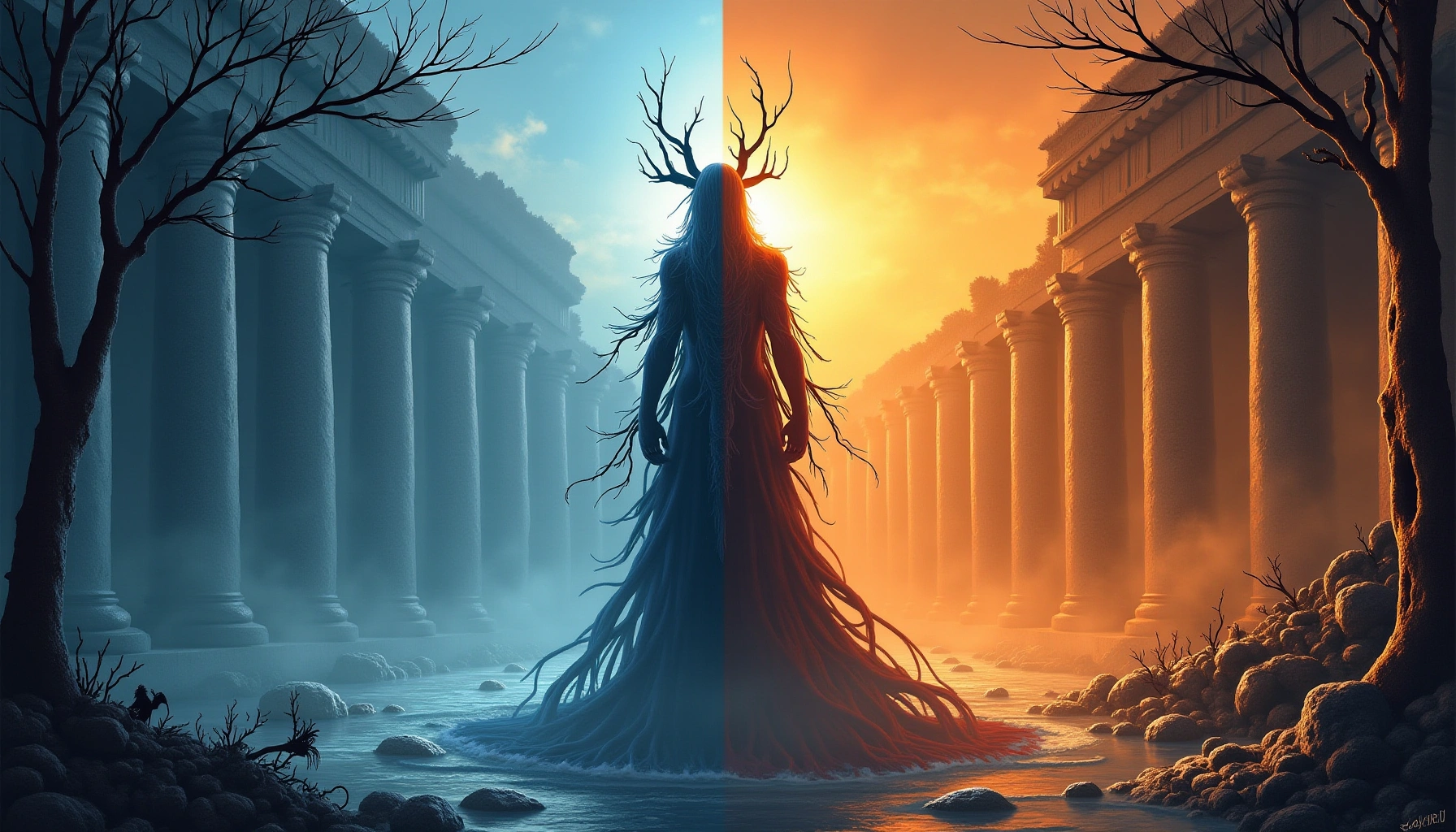
Standing in a serene bamboo grove outside Kyoto, feeling the presence of something sacred in the wind and the moss-covered stones, and then months later, gazing up at the colossal, sun-bleached columns of the Parthenon, one is struck by a profound question. How can two cultures, looking at the same world, arrive at such stunningly different conceptions of the divine? This is the heart of our Japanese kami vs Greek gods comparison, a journey that explores not just the stories we tell, but how those stories shape our very perception of reality, the sacred, and our place within it. It’s a tale of two worlds: one of immanent, formless spirits and another of dramatic, anthropomorphic beings ruling from a celestial court.
The Architecture of the Sacred: From Bamboo Groves to Marble Palaces
The most immediate difference between these two mythological systems is written in the landscapes they sanctified. As our podcast episode describes, the experience of a Shinto shrine is often one of subtle, marked absence. A simple rope (shimenawa) and hanging paper strips (shide) denote a sacred space—a powerful tree, a unique stone, a waterfall—inhabited by a kami. There is no demand for a grand idol; the divine is the tree itself, the rock itself. The central object in a shrine’s innermost sanctum (honden) is often a mirror, reflecting the viewer back upon themselves, symbolizing that purity and the divine potential within are what grant one access to the kami’s presence.
This stands in stark contrast to the Greek impulse, which was to build, to sculpt, and to proclaim. The gods were not the mountain; they lived on the mountain, in a magnificent palace. They were not the sea; they were a powerful, temperamental king who ruled the sea from a sunken golden court. The Greek temple was not a marker of presence but a house (oikos) for a divine resident, centered around a colossal, breathtaking cult statue like Phidias’s chryselephantine statue of Zeus at Olympia. The architecture screams of human ambition to reach the divine, to create something so perfect it might please or even capture the essence of a god. This fundamental difference in sacred space—marking immanence versus housing a deity—is the first and most powerful clue to understanding everything that follows.
Kami: The Formless Life in Everything
Perhaps the greatest challenge for a Western mind is understanding the nature of kami. Translating the term as “god” is misleading, creating an image of a Zeus-like figure sitting on a cloud. Kami are better understood as sacred spirits, essences, or forces. They are the unique, awe-inspiring power (musubi) within a natural phenomenon or a concept. This includes:
- Nature Kami (山の神, Yama-no-Kami): The spirit of a specific mountain, a great ancient tree, a powerful waterfall, or a storm.
- Ancestral Kami (祖霊, Sorei): The revered spirits of ancestors who watch over and protect their living family members.
- Concept Kami (現象の神, Genshō-no-Kami): Kami associated with abstract concepts like growth, fertility, or industry.
Kami are not omnipotent nor omnipresent in the Western monotheistic sense. They are countless, and their influence is often localized. Most importantly, they are not purely “good” or “evil” but possess a positive and negative potential, much like nature itself—a life-giving rain can become a destructive flood. The goal of Shinto practice is not to petition for salvation but to maintain ritual purity and live in harmonious, respectful coexistence (kannagara) with these myriad forces that make up the world. This stands in contrast to many other global pantheons, like the clearly defined gods and goddesses of other traditions who govern specific domains from a distance.
The Greek Pantheon: A Family Drama for the Ages
If kami are defined by their formless immanence, the Greek gods are defined by their intensely human-like anthropomorphism. The Greek mythology pantheon is a structured, hierarchical family, a divine reflection of the ancient Greek aristocratic courts. Zeus, the patriarch, rules from his throne on Olympus, but his power is constantly challenged by his wife, his siblings, and his children.
Each deity has a distinct, often flawed, personality, a defined sphere of influence, and a clear genealogy. Aphrodite is love and beauty, but also vanity and jealousy. Ares is the brutal and bloodthirsty spirit of war, while Athena is the strategic and intellectual aspect of warfare. Their stories are less about explaining natural phenomena and more about exploring human nature—our passions, our follies, our ambitions, and our tragedies. The Greek gods love, feud, plot, and punish with a scale and drama that is profoundly human.
Humanity's Role: Coexistence vs. Negotiation
This difference in the nature of the divine dictates humanity’s relationship with it. In the Shinto view, people are part of a natural world already saturated with the sacred. The purpose of ritual, from the great festivals (matsuri) to the simple act of clapping one’s hands at a shrine, is to celebrate this connection, express gratitude, and purify oneself to better align with the harmonious flow of the kami.
For the ancient Greeks, the relationship was transactional and often precarious. The gods were powerful, immortal beings who could be allies or terrifying enemies. Religion was a form of negotiation: “I give you this offering (xenia) so that you may grant me favor (kharis).” Forget an offering to Poseidon, and your ship might be wrecked. Fail to honor Artemis, and your hunt will be fruitless. This was not about inner purity but external appeasement, a constant effort to manage the whims of these vastly powerful, emotional beings. This concept of a transactional relationship with a sometimes-capricious pantheon finds echoes in other traditions, such as the complex dynamics within Norse myths.
Actionable Takeaways: What These Myths Teach Us Today
This comparison is more than an academic exercise; it offers profound insights for how we view our world today.
- Finding Awe in the Everyday: The Shinto perspective invites us to see the sacred not in a distant heaven but in our immediate environment. It encourages a mindset of reverence for nature, gratitude for our food and resources, and an appreciation for the “kami” within our own communities and homes.
- Understanding Our Stories: The Greek myths hold a mirror to our own psyches. They teach us about the complexities of power (Zeus), wisdom (Athena), love (Aphrodite), and rage (Hera). By understanding their stories, we better understand the driving forces of our own motivations and relationships.
- Two Models of the Sacred: We don't have to choose one. These traditions offer two complementary lenses. One is a lens of integration—seeing ourselves as part of a sacred, natural world. The other is a lens of projection—using stories to externalize and examine the human condition. Both are incredibly valuable tools for a meaningful life.
Listen Now: The Old Fires Podcast
If this exploration has sparked your curiosity, we invite you to experience the full journey. In the podcast episode, we use immersive soundscapes and storytelling to transport you to those bamboo groves and marble temples, making the philosophical differences between kami and the Greek gods feel immediate and visceral. Listen to the episode “Japanese Kami Vs Greek Gods Comparison” on The Old Fires, available on Transistor and all major podcast platforms.
Dive deeper with our recommended mythology reading list to continue your exploration of these fascinating belief systems. Whether you are drawn to the serene integration of Shinto or the dramatic humanity of Greek myths, these stories remain a timeless wellspring of wisdom, reminding us of the countless ways to answer life’s biggest questions.
Every week, a new myth. Subscribe to Mythical Archives for deep-dive episode recaps and exclusive scholarly notes.
This post is a companion to the “Japanese Kami Vs Greek Gods Comparison” podcast episode. The episode is the authoritative version; this article expands on its themes for readers and search engines.
Related Posts

Frequently Asked Questions
What is the main difference between Japanese kami and Greek gods?
Greek gods are anthropomorphic, immortal beings with distinct personalities and hierarchies, often ruling from Mount Olympus. In contrast, Japanese kami are more diffuse spirits found in nature, ancestors, and even objects, and they are not necessarily immortal or all-powerful.
Can kami be compared to Zeus or other Olympian gods?
While both kami and Olympian gods govern natural forces and human affairs, kami lack the centralized pantheon and clear genealogies of Greek mythology. The supreme kami, Amaterasu, is a sun goddess similar to Apollo, but she is more closely tied to Japan’s imperial lineage than to a dramatic, soap-opera-like family drama.
Are kami considered more accessible than Greek gods?
Yes, because kami are believed to inhabit everyday places like trees, rocks, and rivers, making them more immediate and approachable in daily life. Greek gods, on the other hand, are typically distant and require specific rituals or heroic deeds to gain their attention or favor.
Related Posts
Related Posts
Your Weekly Dose of Inspiration
Journaling ideas, family tips, and gentle inspiration.